


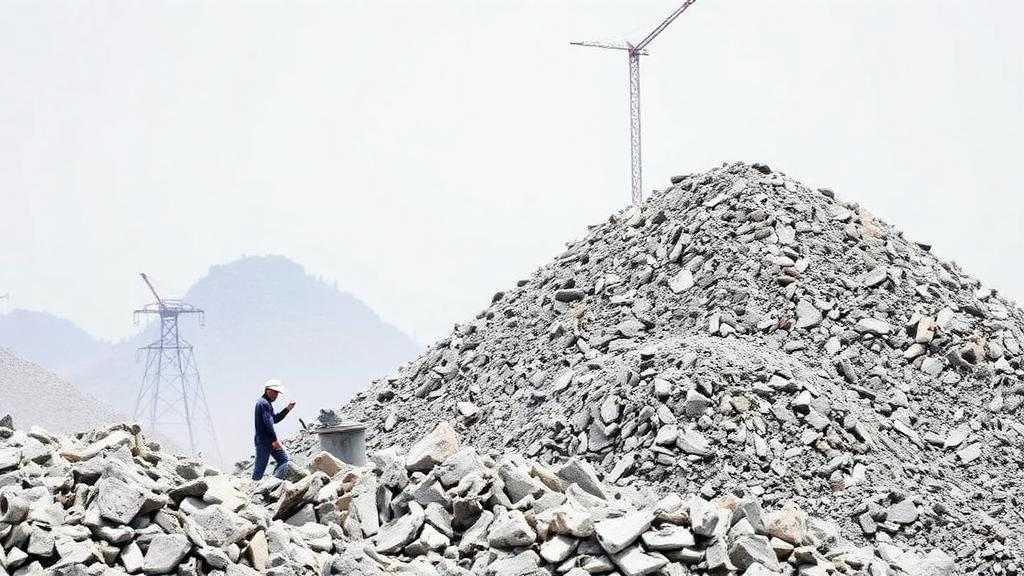
Boron rarely makes headlines, yet the quiet element with atomic number 5 sits behind windshields, smartphone components, electric vehicle batteries, nuclear reactor control rods, and the NdFeB magnets that spin inside wind turbines and EV motors. A new dynamic material flow analysis published in Environmental Challenges has, for the first time, mapped the complete life cycle of boron in China from 2004 to 2023, and the picture it paints is striking: a nation that consumes boron at industrial scale, imports more than 70 percent of it, and recycles almost none of it back into the supply chain.
The research team, led by Jingwei Hou and Yong Geng, applied dynamic material flow analysis (dMFA), a mass-conservation accounting framework that tracks every tonne of a substance through extraction, refining, manufacturing, use, and disposal. Their system boundary covered mainland China and divided the boron industry chain into seven stages: mining and beneficiation, refining and separation, smelting, fabrication, manufacture, use, and waste management and recycling. Thirty-eight boron-containing commodities were tracked, with trade data drawn from China Customs Yearbooks and the UN Comtrade database, production statistics from the U.S. Geological Survey and the CBC Metal database, and process parameters validated through field visits to major producers and ten face-to-face interviews with industry executives and technical personnel.
The methodological machinery is considerable. Process flows were calculated by multiplying production quantities by boron concentrations, losses were applied at each stage using documented loss rates, and the accumulation and retirement of boron in products was modeled with a Weibull probability distribution, the standard statistical tool for describing how products fail and exit service over time. To test robustness, the team ran a Monte Carlo simulation with 10,000 iterations, assigning coefficients of variation of 5 percent to reliable official statistics and 10 percent to literature-derived parameters. The results showed uncertainty below 5 percent for imports, exports, and consumption, and 13 to 19 percent for end-of-life flows, narrow enough that the study’s central conclusions hold firm.
The headline numbers are sobering. Over the twenty-year period, net imported boron at the mining and refining stages reached 2,784 kilotonnes, while domestic extraction contributed only 1,026.7 kilotonnes. China’s reserves, ranked fifth globally at 9.1 million tonnes of boron trioxide equivalent, are concentrated in Qinghai and Liaoning provinces but suffer from low ore grades that make domestic mining economically punishing. Turkey, which holds 950 million tonnes of reserves, dominates the global market and supplied roughly half of China’s total boron imports, with borax, boron ores, boric acid, and boron oxides making up 99.5 percent of that bilateral trade. Such concentration in a single supplier exposes China to geopolitical, trade-policy, and natural-disaster risks.
Consumption tells its own story of transformation. Annual boron use climbed from 41.3 kilotonnes in 2004 to a peak of 161.8 kilotonnes in 2021, before easing to 94.6 kilotonnes in 2023 as upstream mining constraints bit. Glass, ceramics, and enamel products consistently absorbed more than 40 percent of total consumption, with the chemical industry, spanning disinfectants, flame retardants, and catalysts, taking another 24 percent. But the fastest growth came from emerging technologies: by 2020, new energy vehicles and batteries accounted for over 4 percent and 8 percent of consumption respectively, a share that seemed set to expand before supply bottlenecks curtailed it.
The losses along the chain are enormous. Refining borax generates roughly four tonnes of boron mud for every tonne of product, and China discharges about two million tonnes of this waste annually, with boron content of only 0.76 percent. Across the full period, total boron losses reached 1,757.1 kilotonnes, while just 24 kilotonnes were recycled, an overall recycling rate of approximately 1.37 percent. Chemical extraction from boron mud requires acid leaching with high reagent and energy costs and risks secondary pollution, so most recovery involves low-value physical processes such as sintering the mud into construction materials. By contrast, Turkey recovers more than 90 percent of boron from industrial wastes, a benchmark the authors argue China should urgently study.
Meanwhile, an invisible reservoir is quietly building. In-use boron stocks, the element embedded in products currently serving society, nearly doubled during the second decade of the study, rising from 502.5 kilotonnes in 2014 to 966.8 kilotonnes in 2023. Glass, ceramics, and enamel dominate this urban mine at 664.2 kilotonnes, followed by batteries, which grew from 25.7 to 68.7 kilotonnes over the decade, earthmoving machinery, glazed tiles, and aircraft. End-of-life flows, delayed by the roughly 16.5-year average lifespan of boron-containing products, entered rapid growth in the 2010s and reached 31 kilotonnes in 2023, signaling a secondary resource stream that current infrastructure is not equipped to capture.
The trade structure reveals a low-value trap. China imported 2,955.2 kilotonnes of boron over the period, dominated by raw and intermediate materials, then exported 1,257.4 kilotonnes of finished products, chiefly glass and ceramics, glazes, and boron steel, to 225 countries and regions, with Indonesia the largest buyer. Fabrication losses ran at roughly 20 percent, and the authors conclude that the whole boron industry chain remains low-value oriented, generating thin profits while imposing heavy environmental pressure. High-end products such as boron carbide, boron nitride, and rare earth borides are still largely manufactured in developed countries, and Chinese enterprises struggle to achieve large-scale production of these materials essential for energy, defense, and nuclear applications.
The policy prescriptions are concrete. The authors call for increased research and development investment and university-industry cooperation to crack the technological bottlenecks in high-end boron products and boron mud valorization, including promising but unconfirmed routes such as converting the waste into nuclear radiation shielding materials or fertilizers. They recommend a national boron information platform, national standards requiring retired boron-containing products to reach designated disassembly stations, and financial support for recycling enterprises. On supply security, they point to diversification through Chile, Russia, Peru, Argentina, Bolivia, and Kazakhstan, countries aligned with China’s Belt and Road frameworks and recent green minerals cooperation agreements. Economic instruments, including differentiated resource taxes tied to ore recovery rates, carbon taxes on energy-intensive operations, emission fees, and green labeling, round out the governance agenda.
What makes this study resonate beyond China is the method itself. dMFA has previously illuminated the metabolism of steel, aluminum, copper, rare earths, and dozens of critical metals, but boron, a nonmetallic critical material with extreme import dependence, had never received this treatment at national scale. As the world’s clean energy transition accelerates demand for every element that hardens steel, toughens glass, and steadies neutrons, the study warns that a country can dominate manufacturing yet remain dangerously exposed at the raw material frontier, and that the urban mines accumulating in its cities, currently leaking 790.7 kilotonnes of boron into the environment as waste, represent both an untapped opportunity and an unaddressed environmental burden.
Subject of Research: Dynamic material flow analysis of boron flows, stocks, trade, and recycling in China from 2004 to 2023
Article Title: Uncovering the features of boron flows and stocks in China
Article References: Hou, J., Geng, Y., Zhong, C., Gao, Z., & Liu, S. (2026). Uncovering the features of boron flows and stocks in China. Environmental Challenges, 25, Article 101675. https://doi.org/10.1016/j.envc.2026.101675
Image Credits: AI Generated
DOI: 10.1016/j.envc.2026.101675
Keywords: boron, material flow analysis, China, critical materials, recycling, supply chain, boron mud, in-use stocks, Turkey, import dependence, urban mining, resource policy
Cite Scienmag News
Sloane Callahan. (October 2, 2026). China’s Boron Habit Revealed: Huge Imports, Tiny Recycling, Rising Stocks. Scienmag. https://scienmag.com/chinas-boron-habit-revealed-huge-imports-tiny-recycling-rising-stocks/
Sloane Callahan. "China’s Boron Habit Revealed: Huge Imports, Tiny Recycling, Rising Stocks." Scienmag, 2 October 2026, https://scienmag.com/chinas-boron-habit-revealed-huge-imports-tiny-recycling-rising-stocks/. Accessed 4 October 2026.
Sloane Callahan. "China’s Boron Habit Revealed: Huge Imports, Tiny Recycling, Rising Stocks." Scienmag. October 2, 2026. https://scienmag.com/chinas-boron-habit-revealed-huge-imports-tiny-recycling-rising-stocks/


