


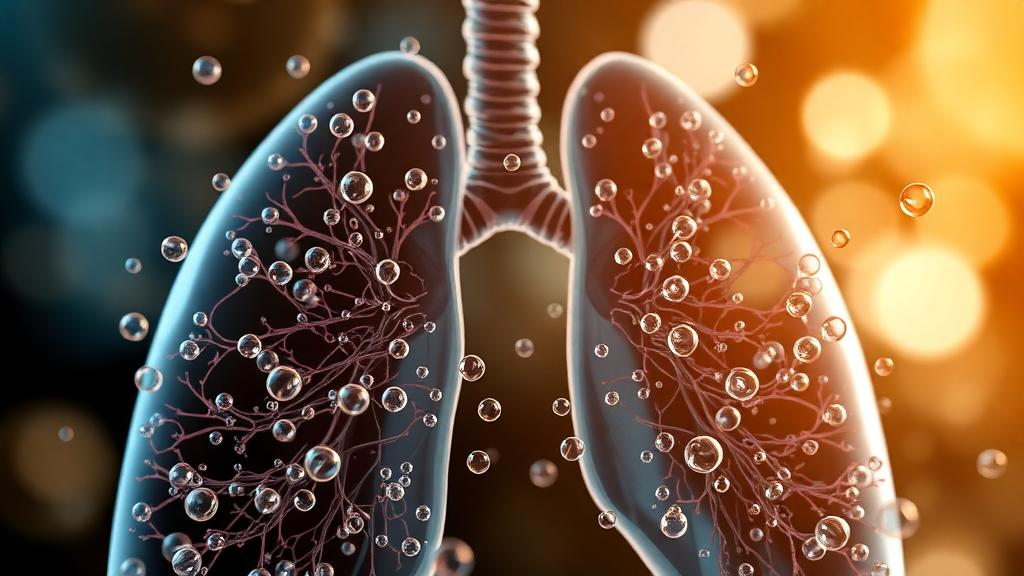
Pulmonary fibrosis is one of the most relentless diseases in medicine, a progressive scarring of lung tissue in which activated fibroblasts deposit extracellular matrix until the delicate architecture of the alveoli stiffens and gas exchange fails. Approved drugs such as pirfenidone and nintedanib can slow the decline, but they cannot stop it, and median survival after diagnosis remains measured in just a few years. Now a comprehensive review published in Molecular Biology Reports by Xinyi Liu, Lan Jiang and colleagues argues that the key to understanding and eventually treating this disease may be floating in the fluid between our cells: extracellular vesicles, lipid-enclosed nanoparticles that cells use as couriers, shipping microRNAs, proteins and lipids from one cell to another.
Extracellular vesicles, or EVs, were once dismissed as cellular debris, but researchers now recognize them as a fundamental communication system. Every cell type in the lung releases them, and their cargo is not random. A vesicle shed by an injured alveolar epithelial cell carries a molecular snapshot of that cell’s stress state, and when it fuses with a fibroblast deep in the interstitium, it can reprogram the recipient’s behavior. The review synthesizes evidence that this vesicle-mediated crosstalk sits at the heart of the fibrotic cascade, driving the transformation of quiescent fibroblasts into collagen-producing myofibroblasts and fueling the relentless accumulation of scar tissue.
The most detailed mechanistic story involves microRNAs, short non-coding RNA molecules that silence target genes after delivery into recipient cells. Epithelial- and immune-cell-derived vesicles can carry pro-fibrotic microRNAs such as miR-494-3p, which converge on the transforming growth factor beta (TGF-β)/Smad pathway and the Wnt/β-catenin pathway, the two canonical signaling axes that orchestrate fibroblast-to-myofibroblast transition. Other studies cited in the review show that senescent epithelial cells release vesicles containing miR-217-5p, which suppresses the Sirt1 axis in fibroblasts, while endothelial cells depleted of let-7d emit vesicles that push pericytes toward a fibrotic fate through the TGFβRI/FoxM1/Smad/β-catenin route. In each case, the vesicle is not merely a bystander but an active vector of disease transmission.
The review also describes a self-amplifying quality to this system that helps explain why pulmonary fibrosis, once established, tends to accelerate. Fibroblast-derived vesicles carrying the secreted protein SFRP1 can induce senescence in epithelial cells, and myofibroblast-derived vesicles operating through a Nestin-Rab7 axis appear to propagate profibrotic signals in a cascade. Macrophages add another layer: pyroptotic macrophages release vesicles whose microRNA cargo drives fibroblast-to-myofibroblast transition in silica-induced models, and macrophage-derived exosomal HMGB3 promotes M1 polarization and recruitment of inflammatory cells. In effect, the disease creates its own messengers, and each round of vesicle exchange deepens the fibrotic loop.
What makes the field genuinely exciting, however, is that the same delivery system can be turned against the disease. Mesenchymal stem cell-derived extracellular vesicles, or MSC-EVs, have shown consistent anti-fibrotic effects in preclinical models. Umbilical cord MSC-EVs attenuate fibrosis by inhibiting TGF-β signaling, and specific microRNA cargoes have been pinned to discrete mechanisms: miR-186 interacting with SOX4 and DKK1, miR-29c and miR-129 transferred between cells to facilitate resolution of fibrosis, miR-31-5p repressing fibrosis via IGFBP7, miR-4516 suppressing integrin αV-mediated fibrosis, and miR-148a-3p inhibiting β-catenin signaling in silica-induced disease. MSC-EVs also modulate immune responses, shifting macrophages toward the pro-resolving M2 phenotype, curbing monocyte-macrophage migration through ERK1/2-mediated suppression of CCL2, and restoring mitochondrial function and autophagy in damaged epithelium.
The translational pipeline has already produced a milestone. A phase I clinical investigation of nebulized human umbilical cord MSC-derived extracellular vesicles for pulmonary fibrosis has provided initial evidence that inhaled, clinical-grade vesicle preparations can be administered safely. The review is careful to note that therapeutic efficacy in pulmonary fibrosis has not yet been established, but the safety signal, together with earlier preclinical work on nebulized allogenic adipose MSC-derived vesicles, establishes a plausible route of administration that delivers vesicles directly to the lung while avoiding much of the systemic exposure that complicates cell-based therapies.
Beyond MSC-EVs, the review surveys an emerging menagerie of alternative vesicle platforms. Plant-derived exosome-like nanoparticles from fruits, vegetables and herbs, including broccoli and grapefruit preparations, have demonstrated anti-inflammatory and drug-carrier properties, and plant-derived exosomal microRNAs have been shown to inhibit lung inflammation triggered by SARS-CoV-2 protein-containing vesicles. Milk-derived vesicles are particularly attractive for inhalation therapy because they are abundant, scalable and generally regarded as safe; nebulized milk exosomes loaded with siRNA against TGF-β1 have ameliorated pulmonary fibrosis in animal models, and milk-derived vesicles loaded with glycyrrhetinic acid have been developed for inhalation treatment of idiopathic pulmonary fibrosis. Engineered macrophage-derived exosomes have even been used to deliver pirfenidone directly to fibrotic lung tissue in silicosis models, combining an existing drug with targeted vesicle delivery.
Parallel to the therapeutic story runs a diagnostic one. Because vesicles cross into nearly every body fluid and carry disease-specific cargo, they are attractive candidates for liquid biopsy. The review compiles evidence that EVs isolated from plasma, bronchoalveolar lavage fluid, sputum and urine carry molecular signatures associated with pulmonary fibrosis. Serum vesicle biomarkers have been reported to reflect disease activity in idiopathic pulmonary fibrosis, and SFTPB protein in serum extracellular vesicles has been proposed as a marker of progressive pulmonary fibrosis. Distinct exosomal microRNA profiles distinguish BAL fluid from patients with idiopathic pulmonary fibrosis and COPD, sputum exosomes have been flagged as promising biomarkers for IPF, and urine-derived exosomes from IPF patients carry pro-fibrotic cargo. Downregulation of exosomal let-7d and miR-16 has been documented in IPF patients, and exosomal miR-143-5p and miR-342-5p regulate fatty acid synthase in the disease. If validated, such signatures could allow earlier diagnosis and non-invasive monitoring of a disease that is currently confirmed only through a combination of high-resolution computed tomography and, in uncertain cases, surgical lung biopsy.
The authors are candid about the obstacles standing between this science and the clinic. Vesicle cargo varies with the source cell, culture conditions and isolation method, and the field’s reporting standards, codified in frameworks such as MISEV2023, are still being adopted unevenly. Cargo standardization, targeted delivery to fibrotic regions of the lung, and scalable manufacturing remain unsolved problems; a single therapeutic dose may require vesicle quantities that current production pipelines struggle to supply. Recent work on scalable platforms for induced pluripotent stem cell-derived MSC vesicles and on three-dimensional culture systems that enhance vesicle potency suggests these bottlenecks are not insurmountable, but clinical adoption will demand rigorous batch-to-batch consistency and regulatory frameworks that barely exist today.
Still, the conceptual shift the review describes is hard to overstate. Pulmonary fibrosis has long been treated as a disease of runaway cells, attacked with broad drugs that dampen proliferation and inflammation without addressing why the fibrotic program persists. The extracellular vesicle perspective reframes the disease as a communication failure, in which injured cells broadcast profibrotic instructions and healthy counter-signals are drowned out. Restoring the balance, whether by blocking harmful vesicle cargo, delivering anti-fibrotic microRNAs in engineered vesicles, or reading vesicle signatures to catch the disease before it becomes irreversible, offers a strategy that is mechanistically precise in a way current therapies are not. For patients whose lungs are steadily stiffening despite the best available drugs, that reframing may prove to be the most important development in the field in two decades.
Subject of Research: The role of extracellular vesicles and microRNAs in pulmonary fibrosis pathogenesis, diagnosis, and therapy
Article Title: How extracellular vesicles contribute to pulmonary fibrosis: miRNA-mediated mechanisms, diagnostic potential, and emerging therapeutic strategies
Article References: Liu, X., Zhao, Z., Zhu, L., Zhang, W., Zhou, J., Wu, X., & Jiang, L. (2026). How extracellular vesicles contribute to pulmonary fibrosis: miRNA-mediated mechanisms, diagnostic potential, and emerging therapeutic strategies. Molecular Biology Reports, 53(1), Article 1672. https://doi.org/10.1007/s11033-026-12858-9
Image Credits: AI Generated
DOI: 10.1007/s11033-026-12858-9
Keywords: pulmonary fibrosis, extracellular vesicles, exosomes, microRNAs, TGF-beta signaling, mesenchymal stem cells, biomarkers, drug delivery, idiopathic pulmonary fibrosis, myofibroblast, MSC-EVs, nebulized therapy
Cite Scienmag News
Drew Townsend. (October 1, 2026). Tiny Cellular Bubbles May Drive and Heal Pulmonary Fibrosis. Scienmag. https://scienmag.com/tiny-cellular-bubbles-may-drive-and-heal-pulmonary-fibrosis/
Drew Townsend. "Tiny Cellular Bubbles May Drive and Heal Pulmonary Fibrosis." Scienmag, 1 October 2026, https://scienmag.com/tiny-cellular-bubbles-may-drive-and-heal-pulmonary-fibrosis/. Accessed 1 October 2026.
Drew Townsend. "Tiny Cellular Bubbles May Drive and Heal Pulmonary Fibrosis." Scienmag. October 1, 2026. https://scienmag.com/tiny-cellular-bubbles-may-drive-and-heal-pulmonary-fibrosis/


