


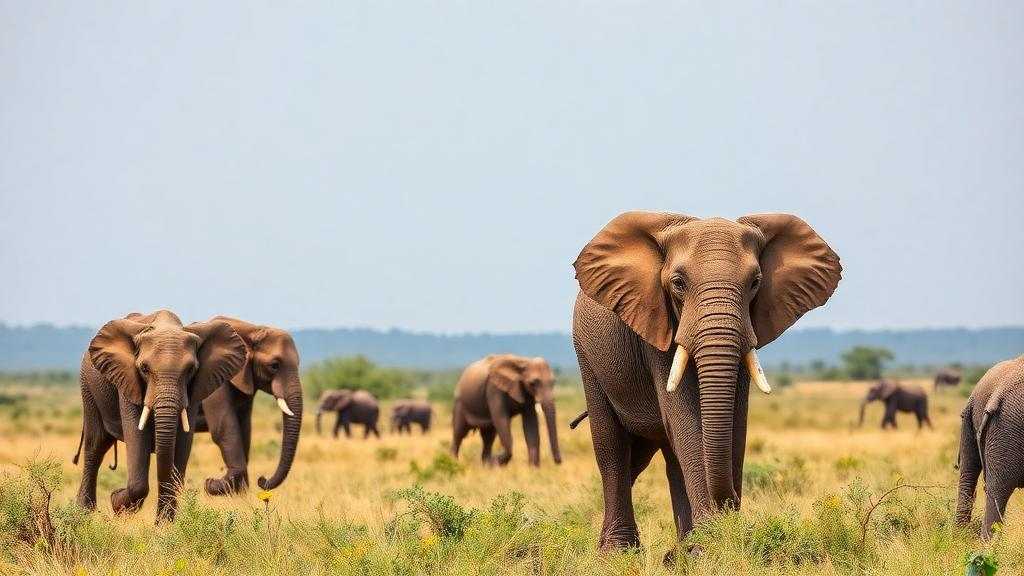
The African savanna elephant, the largest land animal on Earth and an ecological architect of the continent’s grasslands, is facing a future that is shrinking faster than many conservationists feared. A new modeling study published in Ecology and Evolution has mapped the species’ climatically suitable habitat across East Africa and projected how it will fare under two widely used greenhouse gas scenarios. The results are stark: by 2050, the endangered species is predicted to lose roughly half of its suitable habitat, and by 2070 the losses deepen further, leaving only a small fraction of viable range safely inside protected areas.
The research team, led by scientists affiliated with Hawassa University and Addis Ababa University in Ethiopia, compiled more than 6,800 occurrence records for Loxodonta africana from field surveys in Ethiopian national parks, published literature, and the Global Biodiversity Information Facility. After removing duplicate and spatially redundant records, 4,298 verified presence points remained, spanning eight East African countries: Eritrea, Ethiopia, South Sudan, Somalia, Kenya, Uganda, Tanzania, and Rwanda. The authors restricted the dataset to records documented since the 1990s to avoid contaminating the models with historical distributions that no longer reflect where elephants actually live.
To translate those sightings into a predictive map, the researchers built an ensemble species distribution model that combined seven algorithms: three regression-based methods, namely generalized linear models, generalized additive models, and multivariate adaptive regression splines, and four machine-learning approaches, including boosted regression trees, maximum entropy, random forests, and support vector machines. Each algorithm was trained on 70 percent of the occurrence data and validated on the remaining 30 percent using a ten-fold subsampling scheme, with 10,000 background points generated across the study area to represent pseudo-absences. The final ensemble prediction was produced by averaging the individual model outputs, weighting each by its true skill statistic, a standard technique for reducing the uncertainty inherent in any single algorithm.
The environmental backbone of the models came from twenty predictor variables: nineteen bioclimatic layers drawn from the WorldClim 2.1 database at roughly one-kilometer resolution, plus a human footprint index that quantifies cumulative pressure from roads, settlements, agriculture, and infrastructure. Because many climate variables are strongly correlated with one another, the team screened them for multicollinearity, retaining only predictors with pairwise correlations below 0.7 and variance inflation factors under 5. Ten variables survived the filtering. Future projections relied on the HadGEM3-GC global circulation model from the Coupled Model Intercomparison Project Phase 6, run under two shared socioeconomic pathways: SSP2-4.5, an intermediate emissions scenario, and SSP5-8.5, a very high emissions pathway in which atmospheric carbon dioxide roughly triples by 2100.
The models performed exceptionally well. The average area under the receiver operating characteristic curve reached 0.94, with random forests and support vector machines delivering the strongest individual results, and the machine-learning algorithms significantly outperformed the regression-based approaches. Sensitivity and specificity values of 0.91 and 0.86 respectively indicated that the models were both reliable at identifying where elephants can live and where they cannot. Importantly, the predicted current suitable habitat of approximately 887,000 square kilometers under the weighted-mean threshold closely matched the species’ extant range of about 889,000 square kilometers delineated by the IUCN, lending the projections considerable credibility.
Which environmental factors mattered most? Not the human footprint, surprisingly. At the broad regional scale of the analysis, the dominant drivers of elephant habitat suitability were climatic: precipitation of the warmest quarter, isothermality, the mean temperature of the driest quarter, and precipitation of the driest month. These variables govern water availability, forage productivity, and thermal stress tolerance, all of which directly shape elephant distribution, migration corridors, and survival. The authors note that while climate determines the overall pattern of suitable habitat across East Africa, human pressures such as agricultural expansion, roads, and poaching remain critical local threats that fragment landscapes and squeeze the corridors elephants need to move between resource patches.
The future projections are where the study turns alarming. Under the intermediate SSP2-4.5 scenario, mean suitable habitat is projected to decline by 51.9 percent by 2050 and 52.6 percent by 2070 compared with the current average of roughly 821,000 square kilometers. Under the worst-case combinations, losses reach as high as 71.3 percent by 2050 and 73 percent by 2070, depending on the threshold applied. New habitat gains are minimal, amounting to only about 4 to 5 percent of the current range, meaning the species faces a net contraction of nearly half its climatic niche. The Horn of Africa fares worst of all: suitable areas in South Sudan and Somalia are projected to become unsuitable entirely, and the already fragmented habitats of Eritrea and eastern Ethiopia shrink to isolated patches.
Perhaps the most sobering finding concerns protected areas. East Africa’s protected area network covers about 573,000 square kilometers, yet only 17.2 to 17.9 percent of the currently suitable elephant habitat falls inside it. More than 82 percent of predicted suitable habitat lies outside formal protection, exposed to agricultural conversion, charcoal production, and infrastructure development. The concept of Anthropocene refugia, areas that remain climatically suitable and protected over time, offers a framework for identifying the landscapes most likely to sustain elephants through the coming decades. The study found that only about 21 percent of the remaining stable habitat projected for 2050 and 2070 sits within protected areas, and these refugia themselves decline under the harsher emissions scenario, shrinking by more than 21,000 square kilometers between the moderate and severe 2050 projections.
The authors caution that legal designation alone does not guarantee viable habitat. Substantial portions of the existing protected area network are already climatically unsuitable for elephants, and many reserves face severe encroachment and anthropogenic pressure. Elephants surviving in marginal or degraded habitats may function as refugee species, confined to forests and fragments to avoid people rather than occupying the landscapes their climatic tolerances would predict. This behavioral compression can mask the true extent of range loss and complicates conservation planning, particularly in the Horn of Africa where continuous population monitoring is limited and corridor establishment remains insufficient.
The study’s conclusions point toward an urgent agenda: reassess and realign protected area boundaries so that future climatic refugia are actually captured within conservation networks, establish transboundary corridors to maintain connectivity across national borders, strengthen community engagement and stewardship, and protect current habitats even where models forecast future unsuitability, especially for the vulnerable populations of Eritrea, Somalia, and South Sudan. Neither the suitable habitats inside protected areas nor those outside them, the authors conclude, can by themselves guarantee the long-term survival of the species. With Africa’s savanna elephants already down 30 percent over recent decades according to continent-wide surveys, and roughly 415,000 individuals of both African elephant species remaining, the window for proactive, climate-informed conservation in East Africa is narrowing rapidly. Mapping where elephants can persist, and securing those places before the climate closes them off, may be the difference between a managed decline and a functional extinction across much of the species’ eastern range.
Subject of Research: Climate-driven habitat suitability and Anthropocene refugia for the African savanna elephant in East Africa
Article Title: Persistence Vulnerability of the African Savanna Elephant Loxodonta africana to Anthropocene Threats in East Africa
Article References: Ahmed, A. S., Melese, D., Aligaz, M. A., Atickm, A., & Kufa, C. A. (2026). Persistence Vulnerability of the African Savanna Elephant Loxodonta africana to Anthropocene Threats in East Africa. Ecology and Evolution, 16(9), Article e74389. https://doi.org/10.1002/ece3.74389
Image Credits: AI Generated
DOI: 10.1002/ece3.74389
Keywords: African savanna elephant, Loxodonta africana, species distribution modeling, climate change, Anthropocene refugia, East Africa, protected areas, habitat loss, ensemble models, human-elephant conflict, conservation planning, Horn of Africa
Cite Scienmag News
Margaret Porter. (October 1, 2026). Climate Models Warn East Africa’s Savanna Elephants Could Lose Half Their Habitat by 2050. Scienmag. https://scienmag.com/climate-models-warn-east-africas-savanna-elephants-could-lose-half-their-habitat-by-2050/
Margaret Porter. "Climate Models Warn East Africa’s Savanna Elephants Could Lose Half Their Habitat by 2050." Scienmag, 1 October 2026, https://scienmag.com/climate-models-warn-east-africas-savanna-elephants-could-lose-half-their-habitat-by-2050/. Accessed 4 October 2026.
Margaret Porter. "Climate Models Warn East Africa’s Savanna Elephants Could Lose Half Their Habitat by 2050." Scienmag. October 1, 2026. https://scienmag.com/climate-models-warn-east-africas-savanna-elephants-could-lose-half-their-habitat-by-2050/


