


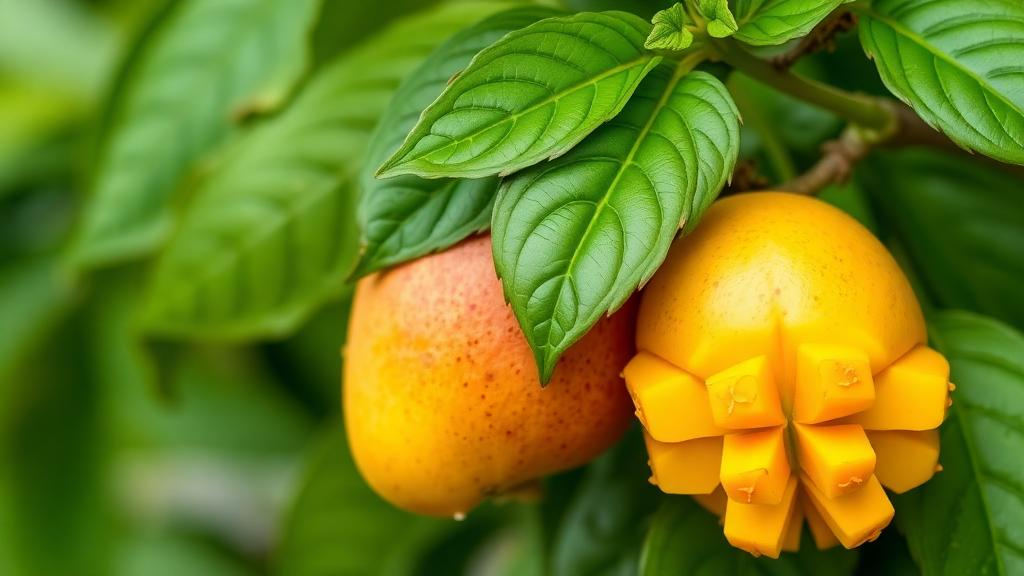
Thai basil is best known for lending its anise-like aroma to street food across Southeast Asia, but a new study suggests the herb’s essential oil could also play a supporting role in the fruit bowl. Researchers in Thailand have tested whether vapour from Thai basil essential oil, released inside sealed storage containers without ever touching the fruit, can slow the ripening of one of the country’s most valuable mango exports and hold back the devastating fungal disease anthracnose. The results, published in BMC Agriculture, reveal a nuanced picture: the fragrant vapour modestly delays visible ripening, yet it cannot stand alone as a disease-fighting treatment.
The fruit in question, ‘Nam Dok Mai Si Thong’, is a flagship Thai mango cultivar that generated an export value of 95 million US dollars in 2021. Like all mangoes, it is a climacteric fruit, meaning it continues to ripen after harvest, driven by the plant hormone ethylene. Under ambient conditions of roughly 27 to 30 degrees Celsius, freshly harvested mangoes last only four to eight days before softening, yellowing, and succumbing to microbial infection. The most serious threat is anthracnose, caused by fungi of the genus Colletotrichum, which can destroy up to 45 percent of the harvest. Conventional control relies on synthetic fungicides, but consumer demand for residue-free produce and tightening regulations have pushed scientists to seek natural alternatives.
Essential oils from aromatic plants have attracted considerable attention for exactly this purpose. Thai basil, Ocimum basilicum var. thyrsiflora, produces an oil rich in bioactive compounds, and the team led by Tibet Tangpao and Piyachat Sunanta of Chiang Mai University set out to test it under realistic postharvest conditions. Gas chromatography-mass spectrometry revealed that the oil was dominated by estragole, a phenylpropanoid accounting for roughly 90 percent of the total volatile content, alongside smaller amounts of fenchyl alcohol, eucalyptol, and T-cadinol. Crucially, the researchers also ran a headspace-trap analysis at 40 degrees Celsius to see which compounds actually escape into the air. Here the picture shifted: estragole showed the highest relative release at 37 percent, followed by beta-cis-ocimene at just over 10 percent, with trans-alpha-bergamotene, linalool, and eucalyptol trailing behind. This distinction matters because in a vapour-phase, non-contact treatment, the composition of the air surrounding the fruit, not the bulk composition of the oil, determines what the fruit actually experiences.
The experiment itself was meticulous. The team purchased 135 uniform, undamaged mangoes, each weighing approximately 420 grams, from an orchard in Mae Taeng District, Chiang Mai, during the commercial harvest. Each fruit was placed in its own one-litre perforated polypropylene container, and the oil was pipetted onto cotton wool inside at concentrations ranging from 13 to 500 microlitres per container. The containers were sealed and stored at 17 to 19 degrees Celsius with 75 to 85 percent relative humidity for 16 days, with destructive sampling at days 5, 8, 12, and 16. A separate antifungal assay used mangoes artificially wounded and inoculated with a confirmed Colletotrichum isolate, originally recovered from diseased ‘Nam Dok Mai Si Thong’ fruit and verified by RNA sequencing.
Over the 16 days, storage time emerged as the overwhelming driver of change. Peel colour shifted as chlorophyll degraded and yellow carotenoid pigments accumulated, firmness collapsed by up to 99 percent as cell wall-degrading enzymes such as polygalacturonase and pectin methylesterase dismantled pectin and hemicellulose networks, and weight loss climbed steadily through transpiration and respiration. Pulp pH rose from 3.22 to about 5.44 while titratable acidity plummeted from 1.19 percent to a mere 0.06 percent, reflecting the consumption of organic acids in the tricarboxylic acid cycle. Total sugars rose from 0.15 grams per gram to a peak of 0.39 grams per gram at day 12 before crashing to 0.05 grams per gram as senescence set in, and electrolyte leakage, a marker of membrane breakdown, reached 58.45 percent by the end of storage.
Against this backdrop, the basil oil vapour exerted a secondary, modulatory influence concentrated on the fruit’s exterior. BEO concentration significantly affected the yellowness parameter and overall colour difference, and at 500 microlitres per litre it reduced peel redness by 13.99 percent relative to untreated controls, indicating a delay in colour development. Lower concentrations were associated with better firmness retention, while the highest concentration failed to protect against softening and even pushed weight loss to 7 to 8 percent, comparable to the control. The researchers interpret this as a concentration-dependent trade-off: mild vapour exposure may slow transpiration and preserve cuticular integrity, whereas heavier doses may trigger stress or phytotoxic responses that disrupt membranes and accelerate water loss. Notably, flesh firmness was untouched, suggesting the vapour acts mainly on outer tissues.
Perhaps the most striking finding is what the oil did not do. Neither BEO concentration nor its interaction with storage time significantly altered pH, acidity, total sugars, reducing sugars, or soluble solids, meaning the treatment left core respiratory and carbohydrate metabolism essentially intact. Biochemical analyses told a similar story: total phenolic content declined and total flavonoid content rose with ripening, exactly as expected, with no meaningful BEO effect. Antioxidant activity measured by the DPPH assay fell gradually while ABTS activity held steady through mid-storage before declining, a divergence the authors attribute to the different chemical classes each assay detects, with lipophilic antioxidants such as carotenoids depleting earlier than hydrophilic phenolics. Principal component analysis confirmed that samples clustered by storage time rather than by treatment, reinforcing that ripening progression, not basil vapour, dictated the fruit’s internal chemistry.
On the disease front, the results were sobering. Inoculated control mangoes developed anthracnose lesions averaging 3.99 square centimetres after seven days, and fruit treated with 500 microlitres per litre of BEO vapour showed only a 10.78 percent reduction in lesion area, an effect that was not statistically significant. The authors attribute this limited efficacy to the biology of Colletotrichum, which establishes infections inside host tissues before symptoms appear, placing the pathogen beyond the reach of surface-acting volatiles. The volatile constituents, including beta-cis-ocimene, linalool, and eucalyptol, are generally fungistatic rather than fungicidal, slowing lesion expansion without preventing infection, and their high volatility means they dissipate quickly from perforated storage containers, undermining sustained antifungal activity.
The study’s authors are candid about the implications. BEO vapour shows genuine potential as a natural treatment for modulating the visible and textural aspects of mango ripening, but it is insufficient as a standalone disease control measure. They argue that future progress lies not in simply cranking up the concentration, which risks phytotoxic damage and greater weight loss, but in smarter delivery: controlled-release packaging materials, encapsulation systems, and modified ventilation designs that keep volatile compounds at effective levels throughout storage. Combining basil vapour with complementary preservation strategies could also enhance both shelf life and disease management.
For a fruit industry worth tens of millions of dollars and for consumers increasingly wary of chemical residues, the message is one of cautious optimism. A kitchen herb’s fragrance can nudge a mango’s ripening clock and preserve its appearance a little longer, but the invisible fungus lurking within the peel demands more than vapour alone. The study adds a valuable piece to the growing science of vapour-phase natural preservatives, demonstrating that what matters in non-contact treatments is not just what is in the oil, but what actually reaches the air around the fruit, and for how long.
Subject of Research: Effects of vapour-phase Thai basil essential oil on postharvest ripening quality and anthracnose development in mango fruit
Article Title: Vapour-phase Thai basil essential oil and its effects on postharvest quality of ‘Nam Dok Mai Si Thong’ mango
Article References: Tangpao, T., Chung, H.-H., George, D. R., Suksathan, R., Sommano, S. R., Khemacheewakul, J., Wongkaew, M., & Sunanta, P. (2026). Vapour-phase Thai basil essential oil and its effects on postharvest quality of ‘Nam Dok Mai Si Thong’ mango. BMC Agriculture, 2(1), Article 32. https://doi.org/10.1186/s44399-026-00057-7
Image Credits: AI Generated
DOI: 10.1186/s44399-026-00057-7
Keywords: mango, Thai basil, essential oil, postharvest, anthracnose, Colletotrichum, ripening, volatile compounds, estragole, food preservation, shelf life, natural preservatives
Cite Scienmag News
Alan Morgan. (October 1, 2026). Basil Oil Vapour Gently Slows Mango Ripening but Falls Short on Disease Control. Scienmag. https://scienmag.com/basil-oil-vapour-gently-slows-mango-ripening-but-falls-short-on-disease-control/
Alan Morgan. "Basil Oil Vapour Gently Slows Mango Ripening but Falls Short on Disease Control." Scienmag, 1 October 2026, https://scienmag.com/basil-oil-vapour-gently-slows-mango-ripening-but-falls-short-on-disease-control/. Accessed 1 October 2026.
Alan Morgan. "Basil Oil Vapour Gently Slows Mango Ripening but Falls Short on Disease Control." Scienmag. October 1, 2026. https://scienmag.com/basil-oil-vapour-gently-slows-mango-ripening-but-falls-short-on-disease-control/


