


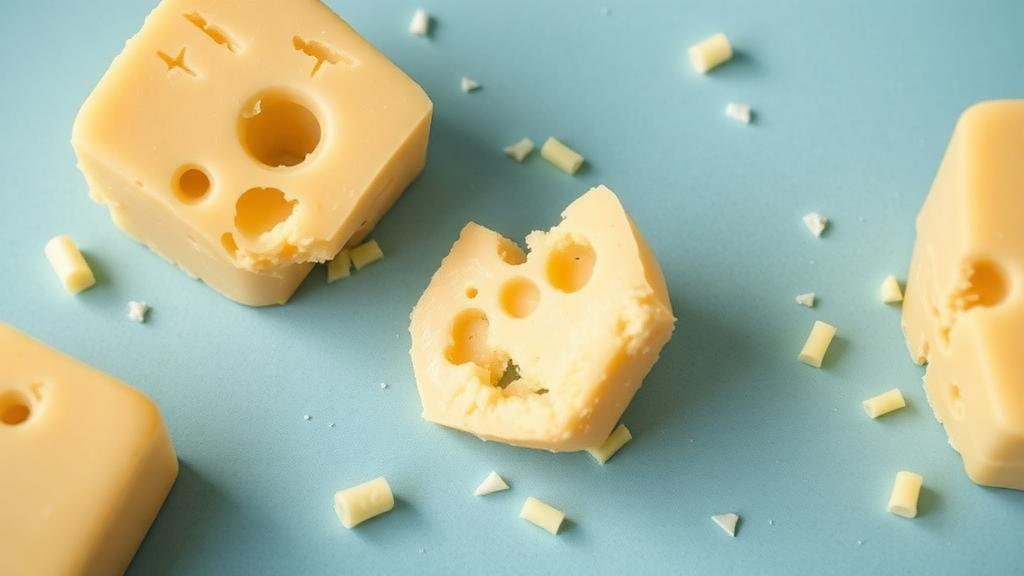
Gouda cheese is supposed to age into a smooth, dense wheel with a mild, nutty character. When something goes wrong deep inside the ripening block, the failure is dramatic: wheels crack open, slits and irregular eyes riddle the paste, and a sharp butyric stench replaces the clean dairy aroma. This phenomenon, known as late blowing defect, has haunted cheesemakers for more than a century and remains one of the most economically damaging quality failures in semi-hard cheese production. A new study from researchers at Kyung Hee University, Eulji University and Samyang Foods in South Korea, published in Food Science and Biotechnology, reports that a specially selected starter culture can suppress the culprit microbe so thoroughly that it becomes undetectable in the finished cheese.
The villain in this story is Clostridium tyrobutyricum, a spore-forming anaerobic bacterium that survives pasteurization as dormant spores and then germinates once conditions inside the maturing cheese turn favorable. As the cheese sits in the warm ripening room, the spores wake up and ferment lactic acid into butyric acid, acetic acid, carbon dioxide and hydrogen gas. Because the cheese matrix is relatively impermeable at that stage, the accumulating gas has nowhere to go. Pressure builds inside the wheel until the texture fractures, producing the characteristic cracks and off-flavors that render entire batches unsellable. The spores enter the milk supply primarily through silage-contaminated fecal residues on the farm, which makes complete exclusion from raw milk practically impossible.
Conventional countermeasures have struggled to keep pace. Dairy plants have experimented with added nitrate, lysozyme from egg white, polyphosphate additives, high-pressure processing and aromatic plant extracts, each with drawbacks ranging from allergen labeling concerns to regulatory restrictions and sensory side effects. Bacteriocin-producing lactococcal starters have shown promise in earlier work, but the field still lacks a robust, industrially practical culture that combines strong acidification with reliable anticlostridial activity. The Korean team set out to close that gap by developing and validating a Lactococcus lactis subsp. lactis strain, designated KFOM 0478, as a Gouda starter with both properties built in.
The experimental design was straightforward but rigorous. The researchers manufactured Gouda cheese in parallel batches, one set inoculated with the KFOM 0478 starter and a control set without it, and then tracked the microbial communities and physicochemical properties across the manufacturing and ripening process. The decisive test came at the end of maturation: cheese made with the KFOM 0478 culture showed no signs of late blowing defect, while the non-inoculated control cheeses developed the defect in full. That single contrast, reproduced through community profiling, provided the clearest possible demonstration that the starter was doing more than acidifying the curd.
What makes the study particularly timely is the resolution of the microbial analysis. Rather than relying on traditional culturing alone, the team applied Oxford Nanopore sequencing, a long-read technology that can resolve bacterial identities down to the species level. Short-read amplicon sequencing often stalls at genus-level assignments, which is a serious limitation when the difference between a harmless relative and a spoilage organism matters. Long, full-length 16S rRNA reads allow precise taxonomic calls, and this capability is increasingly recognized as transformative for food microbiome work, where complex communities of lactic acid bacteria, enterobacteria and environmental contaminants coexist in a rapidly changing matrix.
The sequencing results told a clean story. In the control cheeses without the protective starter, the researchers detected both Clostridium tyrobutyricum, the agent of late blowing, and Enterobacter cloacae, a gas-producing member of the Enterobacteriaceae associated with early blowing defect, a related but faster-acting quality failure that occurs during the initial stages of production. In the cheeses inoculated with KFOM 0478, neither organism was detected; the growth of both species was inhibited to the point of being undetectable. The starter culture therefore acted as a broad shield against the two principal gas-forming threats to Gouda quality, rather than a narrow weapon aimed at a single target.
The mechanism appears to rest on two pillars. The first is acidification: KFOM 0478 was selected for its high acid-producing capacity, and a rapid drop in pH during the early stages of cheesemaking suppresses the germination and outgrowth of clostridial spores, which are sensitive to acidic conditions. The second is direct anticlostridial activity, which may involve bacteriocins or other inhibitory metabolites produced by the strain, consistent with a growing body of literature on Lactococcus strains that inhibit dairy-related Clostridium species. By combining both traits in a single starter, the culture attacks the problem on two fronts simultaneously, lowering the environmental pH while actively poisoning would-be competitors.
The physicochemical data reinforced the microbiological findings. Cheeses made with the protective starter maintained the quality parameters expected of sound Gouda, while the defect-ridden controls showed the chemical fingerprints of butyric fermentation. This matters because a protective culture that ruins the sensory profile of the cheese would be no solution at all. The study’s authors conclude that KFOM 0478, through its acidification ability and inhibition of C. tyrobutyricum growth, effectively maintains cheese quality and contributes to the advancement of the cheese industry, a claim supported by the complete absence of late blowing in the inoculated batches.
The economic stakes are considerable. Late blowing defect is a persistent problem for producers of Gouda and related semi-hard varieties worldwide, and risk assessment models developed in recent years highlight how difficult it is to predict which milk deliveries will carry enough spores to trigger the defect. Because a single contaminated batch can force the destruction of entire wheels after months of investment in ripening, prevention at the starter level is far more attractive than detection downstream. A culture that renders the defect organism undetectable offers producers a form of biological insurance that works inside the cheese rather than in the processing plant.
There are broader implications as well. The food industry is under pressure to reduce chemical preservatives and move toward biopreservation strategies built on lactic acid bacteria and their antimicrobial compounds. Bacteriocin-based approaches have gained momentum as consumers and regulators push back against nitrate and other traditional additives. This study adds a well-documented example of a starter culture that delivers both the fermentation performance demanded by industrial cheesemaking and the protective function normally sought from separate additives. If the KFOM 0478 approach translates from the pilot scale to full production lines, it could reshape how Gouda and similar cheeses are protected against one of their oldest and most stubborn enemies, turning the microbial community itself into the first line of defense.
Subject of Research: Use of an anticlostridial Lactococcus lactis starter culture to prevent late blowing defect in Gouda cheese
Article Title: Microbial community dynamics during Gouda cheese manufacturing using the Lactococcus lactis subsp. lactis KFOM 0478 starter culture with anticlostridial activity
Article References: Gwak, Y.-S., Yoon, H.-R., Yoo, Y., Bae, C.-I., Kim, G. E., Shin, J.-S., & Kim, M.-J. (2026). Microbial community dynamics during Gouda cheese manufacturing using the Lactococcus lactis subsp. lactis KFOM 0478 starter culture with anticlostridial activity. Food Science and Biotechnology. https://doi.org/10.1007/s10068-026-02317-3
Image Credits: AI Generated
DOI: 10.1007/s10068-026-02317-3
Keywords: Gouda cheese, late blowing defect, Clostridium tyrobutyricum, Lactococcus lactis, starter culture, food microbiology, Oxford Nanopore sequencing, biopreservation, dairy fermentation, Enterobacter cloacae, cheese ripening, food quality
Cite Scienmag News
Drew Townsend. (September 30, 2026). Engineered Cheese Starter Culture Wipes Out the Microbe Behind Costly Blowing Defects. Scienmag. https://scienmag.com/engineered-cheese-starter-culture-wipes-out-the-microbe-behind-costly-blowing-defects/
Drew Townsend. "Engineered Cheese Starter Culture Wipes Out the Microbe Behind Costly Blowing Defects." Scienmag, 30 September 2026, https://scienmag.com/engineered-cheese-starter-culture-wipes-out-the-microbe-behind-costly-blowing-defects/. Accessed 30 September 2026.
Drew Townsend. "Engineered Cheese Starter Culture Wipes Out the Microbe Behind Costly Blowing Defects." Scienmag. September 30, 2026. https://scienmag.com/engineered-cheese-starter-culture-wipes-out-the-microbe-behind-costly-blowing-defects/


