


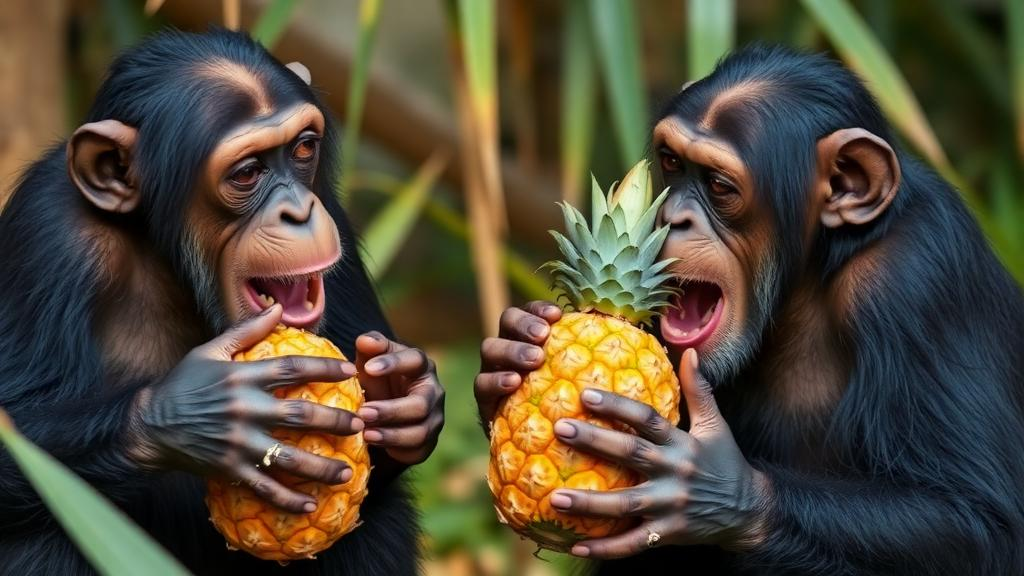
Friendship, it turns out, may run deeper in chimpanzees than a simple preference for grooming partners. A new study from the University of California, Berkeley has found that chimpanzees steal less often from individuals they are closely bonded with, and that the emotional reactions of both thieves and victims shift dramatically depending on the state of their relationship. The findings, published in the journal Evolution and Human Behavior, offer some of the strongest experimental evidence yet that the social expectations at the heart of human friendship may have deep evolutionary roots shared with our closest living relatives.
The research, led by Oded Ritov, a psychology Ph.D. student in Berkeley’s Social Origins Lab, used an ingeniously simple setup involving pineapple, ropes, and two connected rooms. Over the course of more than 800 hours of observation, the team studied 26 chimpanzees at the Ngamba Island Chimpanzee Sanctuary in Uganda, documenting grooming patterns, daily interactions, and how regularly individuals stayed within arm’s reach of one another. From these observations, the researchers identified which chimps appeared to be closely bonded, effectively mapping the friendship networks of the sanctuary’s residents.
Once those relationships were established, the experiment began. One chimpanzee, designated the victim, was placed in a room containing three trays baited with pineapple. A rope attached to the trays ran into an adjacent room, where a second chimpanzee, the potential thief, could either leave the rope untouched or yank it to pull the fruit toward itself and steal the pineapple. The design allowed researchers to compare how the same individual behaved when paired with a close friend versus a non-friend, a within-subject approach that strengthens confidence that observed differences reflect the relationship itself rather than individual personality.
The results were striking. Chimpanzees stole in 70 percent of trials involving non-friends, but only 61 percent of trials involving friends. While a nine percentage point difference might appear modest at first glance, the methodological design gives it considerable weight. Because each chimp experienced both the friend and non-friend conditions, the researchers could be more confident that the reduction in stealing was a meaningful response to relationship status rather than random variation. According to Ritov, this is the first study to demonstrate that chimpanzees are able to hold back antisocial behavior specifically toward their friends.
Just as revealing were the emotional dynamics that unfolded after a theft. The researchers evaluated victims’ responses by measuring stomping, fist-pounding, and screeching, behaviors that serve as visible indicators of agitation in chimpanzees. Victims were initially angrier when a friend stole from them, an outcome that may reflect the violation of expectations that come with closeness. Yet they calmed down noticeably faster when the thief was a friend compared with when the thief was a non-friend, suggesting that the underlying bond helped de-escalate the emotional fallout of the transgression.
The thieves’ behavior changed as well. When the thief and victim were not friends, the thief expressed negative emotions for a much longer period, indicating that the interaction was perceived as more hostile. When stealing from a bonded partner, thieves showed less hostility, hinting that the act itself carried a different emotional texture depending on who was on the receiving end. Taken together, these patterns suggest that both parties in a chimpanzee friendship carry expectations about how they should be treated, and that violations of those expectations register emotionally on both sides.
“This suggests that there may be mutual expectations in chimps from both sides of the friendship, which makes it seem more like the complex friendships we see in humans,” Ritov said. The idea of mutual expectation is critical. Previous research has documented relationship-specific intentions in nonhuman primates, such as preferential grooming and selective food sharing, but intentions are only one component of what makes human friendships distinctive. Jan Engelmann, an associate professor of psychology and senior author of the paper, argues that the stronger ingredient is expectation.
“We expect more of our friends,” Engelmann said. “These findings really deepen our understanding of the evolutionary roots of friendships. This is, to my knowledge, the first evidence showing that also chimpanzees expect and maybe demand special treatment from their friends. These kinds of social expectations might form the basis of human moral principles.” In other words, the study hints that the normative glue binding human societies, the sense that certain people owe us certain treatment and that we owe it in return, may not have emerged from nothing but may instead trace back to social dynamics already present in the common ancestor we share with chimpanzees.
Scientists have long been cautious about labeling close chimpanzee relationships as friendships in the human sense, arguing that we cannot fully grasp the cognitive and emotional complexity behind their behavior. The new study addresses that skepticism by combining long-term observational data with a controlled experimental task, allowing researchers to move beyond correlation. The observation that closely bonded chimps groom together and share food more often had already suggested prosocial preferences; the theft experiment adds an antisocial dimension, showing that the same bonds restrain harmful behavior and shape emotional responses when harm occurs anyway.
The work fits into a broader research program by Ritov examining the evolution of human behavior and the possibility that morals and norms are part of our core being, traceable to other animals. He has recently investigated whether nonhuman animals possess a sense of fairness, and he is broadly interested in how emotions unfold across cultures and species. “We think that these expectations might be the basic building blocks of the larger-scale cooperation we see in humans,” Ritov said. “The expectations that chimpanzees have from their friends or close collaborative partners might have scaled up to more generalized expectations for how we should treat each other.”
That scaling hypothesis carries significant implications. If the expectations embedded in chimpanzee friendships represent the raw material from which human moral systems evolved, then the emotional underpinnings of our social lives, our sense of obligation, our outrage at betrayal, our capacity to forgive those we love, may be far older than our species. Collaborative relationships are important for our well-being, health, and survival, Ritov notes, and increasingly researchers are recognizing that this is not unique to humans. Other animals have friends as well, and with those friendships come expectations that, when broken, are felt on both sides of the relationship. The pineapple heists at Ngamba Island may be a small drama, but they illuminate something profound about where human morality may have begun.
Subject of Research: Experimental study of how chimpanzee friendships influence stealing behavior and emotional responses
Article Title: Chimps plunder less pineapple from friends — and expect them to do the same
Article References: Chimps plunder less pineapple from friends — and expect them to do the same. (n.d.). Original publication
Image Credits: AI Generated
DOI: Not provided
Keywords: chimpanzees, friendship, social expectations, evolutionary psychology, antisocial behavior, emotions, cooperation, Ngamba Island, UC Berkeley, Evolution and Human Behavior, primates, moral evolution
Cite Scienmag News
Glenn Wilkins. (September 30, 2026). Chimpanzees steal less pineapple from friends and expect loyalty in return. Scienmag. https://scienmag.com/chimpanzees-steal-less-pineapple-from-friends-and-expect-loyalty-in-return/
Glenn Wilkins. "Chimpanzees steal less pineapple from friends and expect loyalty in return." Scienmag, 30 September 2026, https://scienmag.com/chimpanzees-steal-less-pineapple-from-friends-and-expect-loyalty-in-return/. Accessed 4 October 2026.
Glenn Wilkins. "Chimpanzees steal less pineapple from friends and expect loyalty in return." Scienmag. September 30, 2026. https://scienmag.com/chimpanzees-steal-less-pineapple-from-friends-and-expect-loyalty-in-return/


