


Insect pests are quietly one of the most expensive problems in global agriculture. According to estimates from the Food and Agriculture Organization cited in a new review published in Discover Agriculture, insect infestations destroy up to 40 percent of global crop production each year, inflicting economic damage exceeding 220 billion US dollars. For decades, farmers have fought back with manual scouting, pheromone traps, sticky cards, and satellite imagery, tools that are slow, labour-intensive, and prone to human error. A comprehensive synthesis by B. Kariyanna and Karnam Poojitha of CSIR-Indian Institute of Chemical Technology argues that a convergence of artificial intelligence, the Internet of Things, and deep learning is now poised to replace that reactive model with continuous, automated, and predictive pest surveillance.
The review, which followed PRISMA 2020 guidelines and screened literature across Google Scholar, IEEE Xplore, ScienceDirect, SpringerLink, MDPI, Frontiers, ACM, Wiley, and arXiv, ultimately included 165 studies in its final synthesis. The bibliometric picture is striking: roughly a quarter of the analysed literature dates from 2015 to 2020, with 2021–2022 and 2024 each contributing 21 percent, and 2025 accounting for a further 16 percent. Only 2 percent of the reviewed work predates 2000. In other words, AI-driven pest detection is not a mature field with a long history; it is a young discipline expanding at breakneck speed, driven by better sensors, cheaper computing, and rapidly growing agricultural image datasets.
Technically, the field splits into two broad families. Conventional machine learning methods, including support vector machines, random forests, k-nearest neighbours, decision trees, and gradient boosting algorithms such as XGBoost, depend on handcrafted features like colour histograms, texture descriptors, and edge maps extracted from images. These remain valuable when data or computing resources are scarce. The review documents impressive results: Bag-of-Words SIFT features paired with SVM achieved 97.5 percent accuracy in pest classification, while XGBoost-based approaches reached up to 97 percent accuracy in pest forecasting and crop disease prediction. Random forest pipelines combined with YOLOv4 detection and UNet-style segmentation exceeded 92 percent accuracy in identifying larval instars of the fall armyworm, Spodoptera frugiperda, one of the world’s most destructive invasive pests.
Deep learning, however, has become the dominant paradigm because it learns hierarchical feature representations directly from raw pixels rather than relying on engineered descriptors. Convolutional neural networks dominate the literature. The review reports ResNet-50 achieving 99.40 percent accuracy across benchmark pest datasets, and a self-attention-enhanced variant, ResNet50-SA, pushing that figure to 99.80 percent. Enhanced VGG-16 and VGG-19 architectures reached up to 99.99 percent accuracy for vegetable pest classification, outperforming InceptionV3 and ResNet50 baselines. A modified AlexNet paired with 5G-enabled high-definition imaging improved recognition accuracy by 18.76 percent over 4G systems, hinting at how network infrastructure itself shapes what field AI can do.
Classification alone is not enough for real farms, where insects must be found, counted, and tracked within cluttered scenes. Object detection frameworks fill that role. YOLO-family models are the workhorses: a YOLOv4 system for grain-storage facilities achieved a mean average precision of 97.55 percent in detecting red flour beetles and rice weevils, while an attention-enhanced Insect-YOLO reached 93.8 percent mAP on low-resolution field images, beating YOLOv5 and Faster R-CNN. For soybean pests, YOLOv5 topped comparisons with 99.5 percent mAP, and specialised variants such as YOLO-SG and SP-YOLO improved tiny-insect detection and processing speed, with SP-YOLO running at 256.4 frames per second. Sequential models add a temporal dimension: bidirectional LSTM networks achieved an AUC of 0.9545 for cotton pest prediction using climate and atmospheric circulation data, and hybrid ARIMA–LSTM models improved multi-step forecasting for sugarcane pests.
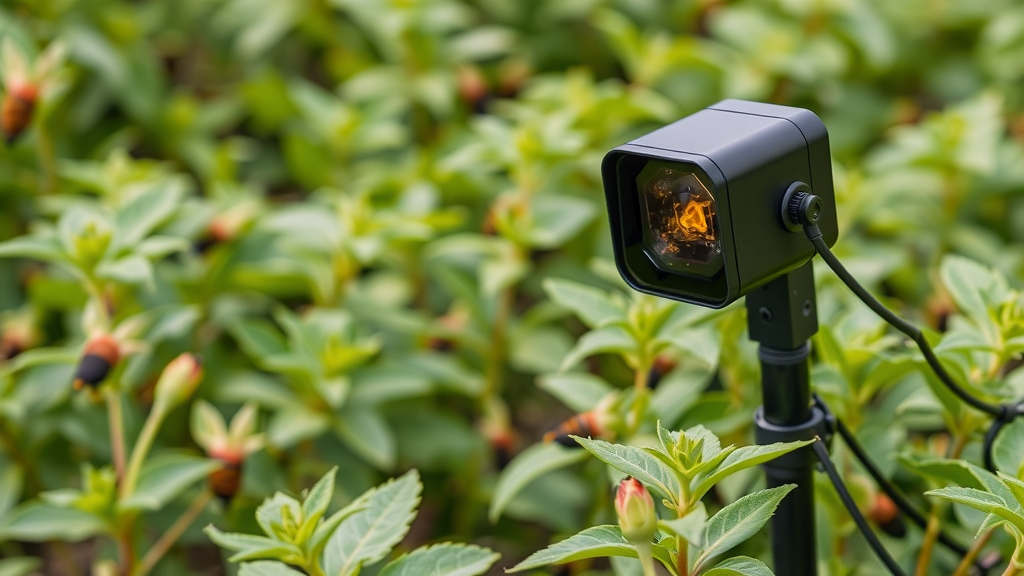
What turns these algorithms into a functioning surveillance system is the Internet of Things. The review describes a layered architecture in which cameras, trap-mounted imaging devices, environmental probes, and multispectral modules form the perception layer, feeding data to microcontrollers such as Raspberry Pi and ESP32 for preprocessing. Wireless protocols including LoRaWAN, NB-IoT, ZigBee, Wi-Fi, and cellular links, often carrying lightweight MQTT messages, move data to the edge, where NVIDIA Jetson modules and Raspberry Pi boards run compressed deep learning models for near-real-time detection without constant cloud connectivity. Cloud servers handle long-term storage, model training, population forecasting, anomaly detection, and spatiotemporal risk mapping, while dashboards and mobile apps translate the results into actionable alerts for farmers.
Lightweight architectures are the key to putting this intelligence literally in farmers’ hands. MobileNetV2 variants enhanced with attention mechanisms have reached 96.89 percent accuracy across nine pest classes, and Android-deployed density-classification models achieved 92.59 percent accuracy, giving growers real-time pest-density assessments on ordinary smartphones. EfficientNet models have proven equally field-ready: a real-time implementation on a Raspberry Pi reached 93.5 percent accuracy using transfer learning, and EfficientNet-based systems in peach orchards achieved 96.6 percent accuracy with 98 percent specificity. Unmanned aerial vehicles equipped with multispectral, hyperspectral, and thermal sensors extend this capability to the canopy scale, allowing convolutional networks to map infestation hotspots across entire fields with high temporal frequency.
Yet the review is unusually candid about the gap between laboratory numbers and field reality. Models trained on curated, well-lit datasets routinely lose accuracy when confronted with shifting sunlight, shadows, humidity, leaf occlusion, wind-induced blur, and background clutter. Class imbalance compounds the problem: benchmark datasets such as IP102 and PlantVillage overrepresent a few dominant pest classes while rare but economically significant species remain scarce, biasing models toward majority categories. Many datasets are also geographically narrow, drawn from single regions or crops, so models struggle to generalise across climates and cultivars. The authors note that reported detection accuracies climbed to roughly 99 percent by 2023, but a slight dip in 2024 underscores persistent generalisation challenges, and they call for domain adaptation techniques, season-long data collection, and standardised benchmarking protocols.
The trajectory, however, points firmly toward predictive precision agriculture. The review highlights explainable AI tools such as SHAP, LIME, and Grad-CAM, which visualise which image regions drive a model’s decisions, helping agronomists verify that systems focus on genuine pest symptoms rather than background artifacts, and building the trust needed for adoption. Multimodal sensing that fuses RGB, thermal, hyperspectral, acoustic, and pheromone-trap data promises pre-symptomatic detection of stress invisible to the human eye, while self-supervised and few-shot learning could ease data scarcity for rare species. Most strikingly, the authors estimate that closed-loop systems combining detection with reinforcement-learning-driven intervention could cut pesticide use by 50 to 70 percent while improving accuracy. Edge computing, federated learning for data privacy, and autonomous drones and smart sprayers round out a vision in which pest management shifts from blanket chemical response to targeted, data-driven prevention, a transformation with profound implications for food security, farmer economics, and environmental health worldwide.
Subject of Research: AI, IoT, and deep learning approaches for automated agricultural pest detection
Article Title: Revolutionizing pest detection in agriculture using artificial intelligence, Internet of Things, machine and deep learning approaches
Article References: Kariyanna, B., & Poojitha, K. (2026). Revolutionizing pest detection in agriculture using artificial intelligence, Internet of Things, machine and deep learning approaches. Discover Agriculture, 4(1), Article 297. https://doi.org/10.1007/s44279-026-00745-7
Image Credits: AI Generated
DOI: 10.1007/s44279-026-00745-7
Keywords: artificial intelligence, pest detection, deep learning, Internet of Things, convolutional neural networks, precision agriculture, YOLO, edge computing, UAV imaging, machine learning, crop protection, explainable AI
Cite Scienmag News
Alan Morgan. (September 26, 2026). AI and Smart Sensors Are Rewriting the Rules of Crop Pest Detection. Scienmag. https://scienmag.com/ai-and-smart-sensors-are-rewriting-the-rules-of-crop-pest-detection/
Alan Morgan. "AI and Smart Sensors Are Rewriting the Rules of Crop Pest Detection." Scienmag, 26 September 2026, https://scienmag.com/ai-and-smart-sensors-are-rewriting-the-rules-of-crop-pest-detection/. Accessed 26 September 2026.
Alan Morgan. "AI and Smart Sensors Are Rewriting the Rules of Crop Pest Detection." Scienmag. September 26, 2026. https://scienmag.com/ai-and-smart-sensors-are-rewriting-the-rules-of-crop-pest-detection/


