


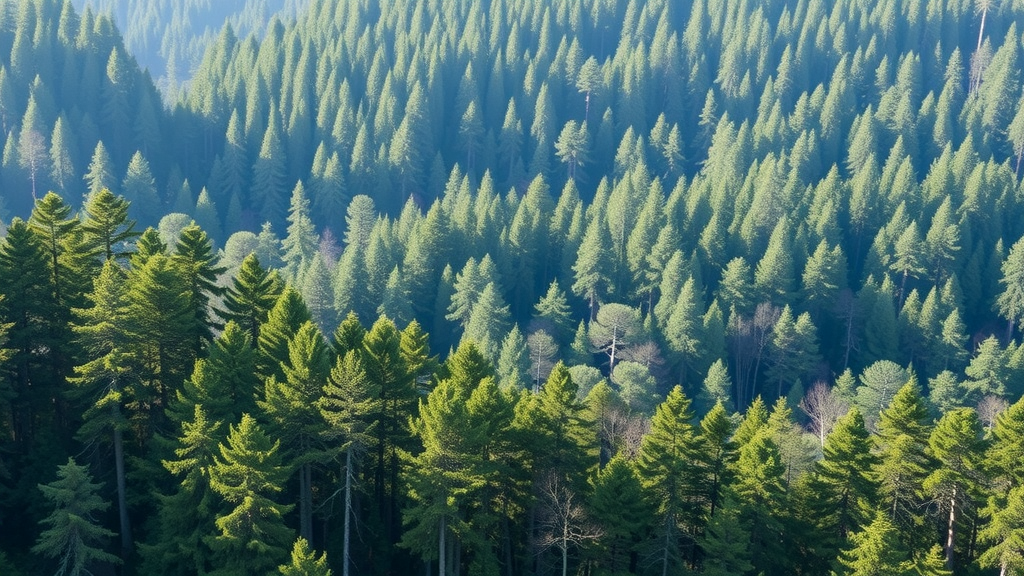
In the misty hills of Zhejiang Province, China, an experiment is quietly rewriting one of ecology’s most contested rules. For decades, scientists have debated whether forests packed with many species inevitably grow faster and store more carbon than their simpler counterparts. A new study in BMC Plant Biology suggests the answer depends on something surprisingly mundane: how aggressively humans cut trees down. When researchers thinned a subtropical secondary evergreen broad-leaved forest heavily, removing about a fifth to a quarter of the basal area, the relationship between biodiversity and productivity did not merely weaken or strengthen. It reversed direction entirely, flipping from negative to strongly positive within just three years.
The research team, led by Jiao Jiejie and Yao Liangjin of the Zhejiang Academy of Forestry, together with colleagues at Ningxia University and the Chinese Academy of Forestry, established thirty experimental plots in 2020 across a secondary forest that had regrown after past disturbance. Ten plots were left untouched as controls, ten received light thinning that removed 10 to 15 percent of basal area, and ten underwent heavy thinning at 20 to 25 percent. Three years later, the team returned to measure everything from tree heights and stem diameters to the functional traits of every species present, building one of the most complete pictures yet of how management intensity reshapes the architecture of a recovering forest.
The headline finding concerns biomass productivity, the rate at which the forest converts sunlight, water, and carbon dioxide into wood. Heavily thinned stands increased their total biomass at a relative growth rate 66.7 percent higher than the untouched controls. That is a striking acceleration for a treatment that, on its face, removes material from the ecosystem. The explanation lies in what foresters call a release effect. By cutting away crowded, suppressed individuals, thinning reduces competition for light, soil moisture, and nutrients, allowing the remaining trees to expand their canopies and accelerate growth. In dense secondary forests that have regrown without management, this competitive pressure can be severe, and the study demonstrates just how much latent productivity is locked away inside an overcrowded stand.
But the growth surge was only part of the story. The researchers measured diversity across three distinct dimensions: structural, species, and functional. Structural diversity captures how uneven the forest is in size, quantified here through the Gini coefficient of basal area and the standard deviation of tree height. Both metrics rose in thinned stands, meaning the forests became more architecturally heterogeneous, with a richer mix of tall dominants and smaller understory trees. Species diversity also climbed under heavy thinning, as newly available light and space allowed additional species to establish and persist. These changes matter because structural complexity is closely tied to habitat quality, light capture efficiency, and the overall resilience of a forest ecosystem.
Functional diversity, the variety of traits that determine how species use resources, told a more complicated tale. The team assessed it using eight plant traits, calculating three complementary indices: functional richness, functional evenness, and functional divergence. Heavy thinning significantly increased evenness and divergence, indicating that the surviving species occupied resource-use strategies more uniformly and more distinctly from one another. Yet functional richness, the total volume of trait space filled by the community, collapsed by 61.9 percent relative to the control. This apparent paradox makes ecological sense: thinning preferentially removes certain individuals and species, pruning away extremes of the trait distribution even as the remaining species pack the reduced trait space more evenly. A forest can simultaneously become more functionally balanced and less functionally expansive.
The most consequential result, however, is the shift in the diversity-productivity correlation itself. In unthinned and lightly thinned stands, functional diversity was negatively correlated with productivity, echoing the long-running debate in ecology over whether diversity genuinely drives ecosystem function or merely correlates with other factors. In heavily thinned stands, that correlation turned significantly positive. In other words, the same forest type, on the same landscape, over the same three years, exhibited opposite diversity-productivity relationships depending solely on management intensity. The finding suggests that many published inconsistencies in the biodiversity-ecosystem functioning literature may reflect unmeasured differences in disturbance and management history rather than genuine ecological disagreement.
Why would heavy thinning unlock a positive diversity effect? The authors’ interpretation rests on resource utilization. In an overcrowded stand, competition is so intense that species with complementary traits cannot fully express their complementary advantages; the forest is saturated, and niche differentiation provides little benefit. Once thinning opens the canopy, species with contrasting light requirements, rooting depths, and leaf economics can partition resources effectively, and the classic complementarity mechanism that underpins positive diversity-productivity relationships finally has room to operate. Functional divergence, which measures how spread out species are in trait space, increased under heavy thinning and aligns with this mechanism, offering a trait-based window into why the correlation flipped.
The authors are careful to frame these results as transient dynamics rather than equilibrium states. Three years is a snapshot in the life of a forest, and early post-treatment responses are often dominated by the release effect, which may fade as canopies close again. Species that colonize newly opened gaps may later be shaded out, and the reduced functional richness could recover, persist, or deepen as succession proceeds. The team explicitly calls for long-term monitoring to determine whether the positive diversity-productivity relationship under heavy thinning persists, strengthens, or reverses over decades. This caution is scientifically important: it distinguishes a genuine management insight from an overgeneralized rule, and it flags the study as a baseline for future re-measurements rather than a final verdict.
The practical implications are nonetheless immediate. Secondary forests now dominate large swaths of subtropical China and much of the world’s forested land, and they are increasingly relied upon for carbon sequestration targets, timber supply, and biodiversity conservation. If heavy thinning can raise productivity by two-thirds while simultaneously boosting species diversity and structural complexity, it offers a rare win-win-win for managers, though the 61.9 percent loss of functional richness tempers any triumphalism. The study also provides a template for evidence-based silviculture: rather than applying uniform thinning prescriptions, managers could tune intensity to specific objectives, using heavier thinning where rapid carbon accumulation and structural diversification are priorities and lighter treatments where preserving the full breadth of functional traits matters more.
Scientifically, the work adds a crucial temporal and managerial dimension to biodiversity-ecosystem functioning research, a field built largely on experiments in planted grasslands and young tree monocultures. By manipulating a real, unmanaged secondary forest and measuring all three dimensions of diversity simultaneously, the Zhejiang team shows that the diversity-productivity relationship is not a fixed property of an ecosystem but a moving target shaped by how humans intervene. As forests worldwide face mounting pressure from climate change, restoration initiatives, and demand for wood, understanding that thinning intensity can flip the sign of a fundamental ecological relationship may prove one of the most actionable discoveries in modern forest ecology, and the hills of Zhejiang are now the place to watch as the next chapter of this experiment unfolds.
Subject of Research: Effects of thinning intensity on tree diversity and forest productivity in subtropical secondary evergreen broad-leaved forests
Article Title: Tree diversity and productivity in subtropical secondary evergreen broad-leaved forests under different thinning intensities in Zhejiang Province, China
Article References: Jiejie, J., Chuping, W., Guangyao, S., Bo, J., Chenggong, L., & Liangjin, Y. (2026). Tree diversity and productivity in subtropical secondary evergreen broad-leaved forests under different thinning intensities in Zhejiang Province, China. BMC Plant Biology. https://doi.org/10.1186/s12870-026-09825-8
Image Credits: AI Generated
DOI: 10.1186/s12870-026-09825-8
Keywords: forest ecology, thinning, biodiversity, functional diversity, productivity, subtropical forests, secondary forest, biomass, Zhejiang, forest management, species diversity, structural diversity
Cite Scienmag News
Margaret Porter. (September 26, 2026). Heavy Thinning Supercharges Forest Growth and Flips the Diversity-Productivity Rule. Scienmag. https://scienmag.com/heavy-thinning-supercharges-forest-growth-and-flips-the-diversity-productivity-rule/
Margaret Porter. "Heavy Thinning Supercharges Forest Growth and Flips the Diversity-Productivity Rule." Scienmag, 26 September 2026, https://scienmag.com/heavy-thinning-supercharges-forest-growth-and-flips-the-diversity-productivity-rule/. Accessed 5 October 2026.
Margaret Porter. "Heavy Thinning Supercharges Forest Growth and Flips the Diversity-Productivity Rule." Scienmag. September 26, 2026. https://scienmag.com/heavy-thinning-supercharges-forest-growth-and-flips-the-diversity-productivity-rule/


