


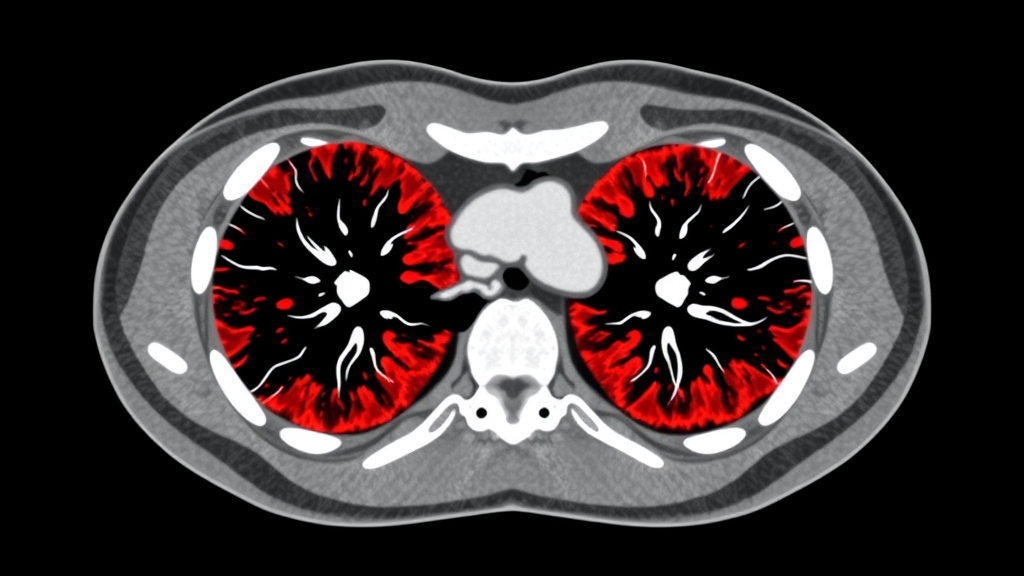
An artificial intelligence model developed at The University of Texas MD Anderson Cancer Center can scan ordinary chest CT images and flag lung cancer patients who are likely to develop a dangerous inflammation of the lungs before they receive a single dose of immunotherapy. The condition, known as pneumonitis, strikes roughly ten percent of lung cancer patients treated with immune checkpoint inhibitors and can escalate into a life-threatening emergency. The new tool, described in a study published in the Journal for ImmunoTherapy of Cancer, suggests that routine medical imaging already contains hidden signals of vulnerability that clinicians have been unable to read with the naked eye, and that a deep learning system can extract those signals reliably enough to outperform existing risk assessment methods.
The research was led by Jia Wu, Ph.D., associate professor of Imaging Physics and of Thoracic/Head and Neck Medical Oncology at MD Anderson and an affiliate member of the institution’s Institute for Data Science in Oncology. Co-senior authors include Ajay Sheshadri, M.D., associate professor of Pulmonary Medicine, and Mehmet Altan, M.D., associate professor of Thoracic/Head and Neck Medical Oncology. Their team set out to solve a problem that has long frustrated oncologists: immune checkpoint inhibitors have transformed outcomes in lung cancer, but the same drugs that unleash T cells against tumors can also trigger the immune system to attack healthy lung tissue, producing pneumonitis that is difficult to anticipate before symptoms appear.
“Pneumonitis remains one of the most challenging complications of immunotherapy because it can be difficult to predict before symptoms appear,” Wu said. “Our model was able to identify signals associated with future risk using information that already exists in routine CT scans.” That distinction matters clinically, because once symptomatic pneumonitis develops, patients often require high-dose corticosteroids or other immunosuppressive therapy, and in severe cases the drugs that were controlling their cancer must be stopped entirely. A method for identifying high-risk patients before treatment could allow oncologists to schedule closer monitoring, order earlier imaging follow-up, or enroll vulnerable patients in prevention trials.
The model, named the Checkpoint-Inhibitor Pneumonitis Hazard EstimatoR, or CIPHER, belongs to a class of systems known as AI foundation models. Rather than being trained narrowly on labeled examples of pneumonitis, the model was first trained on an enormous volume of chest CT data, more than 590,000 individual image slices drawn from 2,500 patients with lung cancer. During this phase it learned to recognize the underlying structural patterns of lung tissue: the fine meshwork of airways and vessels, the texture of healthy parenchyma, and the visual signatures of scarring, emphysema, and inflammation. This strategy, sometimes called self-supervised or transfer learning, lets the model build a rich internal representation of normal and abnormal lung anatomy before it is ever asked to make a clinical prediction.
Only after learning lung anatomy did the researchers ask whether the patterns CIPHER had absorbed could distinguish patients who later developed pneumonitis from those who did not. The team tested the model on pretreatment CT scans from 347 patients with non-small cell lung cancer treated at UT MD Anderson, and then validated it against an independent external dataset. In both cohorts, CIPHER achieved an area under the curve, or AUC, of approximately 0.83, a statistical measure in which 0.5 represents chance-level guessing and 1.0 represents perfect discrimination. An AUC of 0.83 indicates strong predictive performance, and critically, the model outperformed both conventional models built on clinical risk factors and radiomics approaches, which extract hand-designed quantitative features from images.
Robustness across different conditions is often the stumbling block for medical AI, and it is where CIPHER delivered some of its most persuasive results. The external validation cohort differed from the original in patient population, in the types of CT scanners used, and in imaging protocols, variables that frequently degrade the performance of image-based models when they are deployed outside their training environment. CIPHER nonetheless maintained its level of accuracy, suggesting the model captured genuine biology rather than scanner-specific artifacts or population quirks. Patients the model classified as high-risk also tended to develop pneumonitis sooner after starting immunotherapy, an indication that the model may be measuring a continuous degree of lung vulnerability rather than simply sorting patients into binary categories.
The team further tested whether CIPHER’s predictions stood up when adjusted for known clinical variables. Even after accounting for age, smoking history, tumor histology, and prior radiation therapy to the chest, factors that independently influence pneumonitis risk, the model’s predictions remained statistically significant. Prior thoracic radiation in particular is recognized as a major contributor to treatment-induced lung injury, so a model that adds predictive value on top of these established risk factors is capturing something that clinicians currently cannot see. “What makes this approach particularly interesting is that it was not designed to look for pneumonitis itself,” Wu said. “Instead, the model learned patterns within lung tissue and identified subtle abnormalities associated with future risk. That suggests routine imaging may contain much more information about treatment toxicity than we previously recognized.”
The findings arrive at a moment when immune checkpoint inhibitors have become a cornerstone of lung cancer therapy. These drugs work by releasing molecular brakes, such as the PD-1 and CTLA-4 pathways, that normally restrain T cell activity, allowing immune cells to recognize and attack tumor cells. The same mechanism, however, can produce immune-related adverse events in nearly any organ, with pneumonitis among the most feared because of its potential severity and because it can be difficult to distinguish from infection, tumor progression, or radiation injury. Current risk assessment relies on subjective radiologic review and broad clinical factors that fail to identify most of the patients who will ultimately be affected, leaving clinicians to detect pneumonitis only after cough, shortness of breath, or infiltrates on follow-up imaging appear.
The MD Anderson researchers caution that several steps remain before CIPHER can enter routine clinical use. Additional prospective studies involving larger and more diverse patient populations will be needed to determine whether the approach can be integrated into clinical workflows, where it would ideally run automatically on scans already being obtained for staging and treatment planning. The team also plans to evaluate whether the model performs similarly in other cancer types treated with immunotherapy, since checkpoint inhibitors are now used across melanoma, kidney, bladder, and many other malignancies, each with different baseline lung characteristics and treatment contexts.
Future work may also explore whether combining CIPHER’s imaging-based risk scores with other biomarkers, such as blood-based inflammatory markers or genetic signatures, can sharpen predictions further, and whether similar foundation models can forecast additional immunotherapy-related toxicities affecting other organs. If validated, such tools could identify candidates for prevention studies, guide the intensity of monitoring during treatment, and deepen scientific understanding of how immune-related side effects develop in the first place. The research was supported by the National Institutes of Health, the Cancer Prevention and Research Institute of Texas, and institutional funding from UT MD Anderson, and the study was published in the Journal for ImmunoTherapy of Cancer.
Subject of Research: An AI foundation model that predicts immune checkpoint inhibitor-induced pneumonitis risk in lung cancer patients from routine pretreatment CT scans.
Article Title: AI model uses routine imaging to identify patients at risk for serious treatment-induced lung inflammation
Article References: AI model uses routine imaging to identify patients at risk for serious treatment-induced lung inflammation. (n.d.). Original publication
Image Credits: AI Generated
DOI: Not provided
Keywords: artificial intelligence, immunotherapy, pneumonitis, lung cancer, CT imaging, deep learning, checkpoint inhibitors, MD Anderson, risk prediction, radiomics, non-small cell lung cancer, medical imaging
Cite Scienmag News
Nathaniel Bowman. (September 25, 2026). AI Reads Routine CT Scans to Predict Dangerous Immunotherapy Lung Inflammation Before It Starts. Scienmag. https://scienmag.com/ai-reads-routine-ct-scans-to-predict-dangerous-immunotherapy-lung-inflammation-before-it-starts/
Nathaniel Bowman. "AI Reads Routine CT Scans to Predict Dangerous Immunotherapy Lung Inflammation Before It Starts." Scienmag, 25 September 2026, https://scienmag.com/ai-reads-routine-ct-scans-to-predict-dangerous-immunotherapy-lung-inflammation-before-it-starts/. Accessed 25 September 2026.
Nathaniel Bowman. "AI Reads Routine CT Scans to Predict Dangerous Immunotherapy Lung Inflammation Before It Starts." Scienmag. September 25, 2026. https://scienmag.com/ai-reads-routine-ct-scans-to-predict-dangerous-immunotherapy-lung-inflammation-before-it-starts/


