


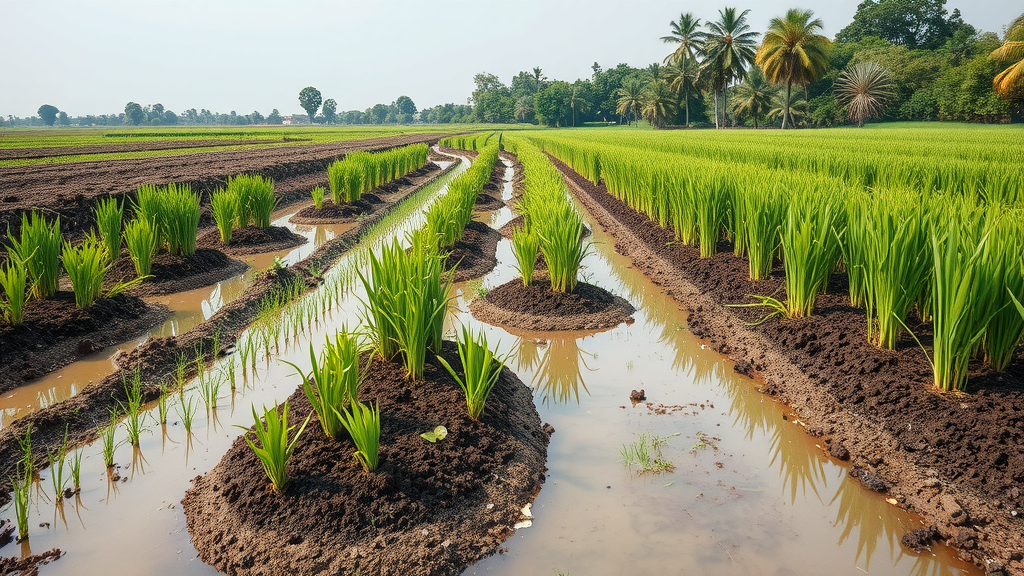
Beneath every flooded rice paddy lies an architecture most people never think about: a three-dimensional labyrinth of soil crumbs, ranging from grit-like microaggregates to chunky clumps visible to the naked eye. How those crumbs are sized, how tightly they hold together, and how much organic carbon they trap inside their pores may sound like arcane soil physics, but it sits at the heart of two of agriculture’s biggest challenges: keeping water in the fields where rice is grown and keeping carbon out of the atmosphere. A new study published in Plant and Soil by Kechun Wang of Northwest A&F University and Hohai University, together with colleagues at Ghent University and collaborators in China, shows that two management choices — switching from continuous flooding to controlled irrigation, and amending soil with a charcoal-like material called hydrochar — can measurably reorganize this hidden architecture and shift where organic carbon accumulates within it.
The team’s starting point was a gap in the literature. The link between soil aggregates and soil organic carbon cycling has been documented extensively, yet the combined effects of irrigation regime and exogenous organic carbon additions on aggregate distribution, aggregate-bound carbon and microbial communities in paddy soils remained poorly understood. Paddy soils are an unusual case: they spend much of the growing season saturated, which changes everything from oxygen availability to how particles stick together. As water-saving irrigation schemes spread across rice-growing regions to conserve scarce freshwater, researchers have worried about what drier, more fluctuating moisture conditions do to the physical structures that protect carbon in these soils. The new experiment was designed to answer that question directly.
Methodologically, the study was deliberately gentle with its samples. Rather than subjecting soil to aggressive dry sieving, which can shatter natural aggregates and distort the size distribution, the researchers used an optimal-moisture sieving method, working the soil at a moisture content chosen to preserve aggregate integrity. Soil was separated into size classes, from large aggregates larger than 2 millimeters down to fine fractions smaller than 0.25 millimeters. The treatments compared flooding irrigation with controlled irrigation, and each water regime was crossed with additions of rice straw or with hydrochar produced from that same straw by hydrothermal carbonization — a process that converts wet biomass into a carbon-rich, chemically altered solid using heat and pressure in water.
The first striking result is how lopsided paddy soil architecture turned out to be. Across the treatments, aggregates larger than 2 millimeters dominated the soil mass, accounting for between 67 and 80 percent of the total, while the finest fraction below 0.25 millimeters was the least abundant class at just 7 to 16 percent. That imbalance matters more than it might seem. When scientists calculate how much organic carbon sits in the soil as a whole, the bulk of the number comes from whatever size class holds most of the mass — in this case, the big aggregates — even if smaller fractions are individually richer in carbon per gram. The study confirmed exactly this pattern: the fine fractions were enriched in organic carbon and microbial attributes, yet the larger-than-2-millimeter class made the largest numerical contribution to calculated bulk soil organic carbon simply because of its overwhelming mass proportion.
Water management left a clear fingerprint on this architecture. Compared with continuous flooding, controlled irrigation increased the proportion of large aggregates greater than 2 millimeters and improved aggregate-related structural indices, as reflected in higher values of mean weight diameter and geometric mean diameter — two standard measures that essentially summarize whether a soil is dominated by sturdy, well-formed crumbs or by loose, easily eroded fragments. For a water-saving technique, that is a reassuring outcome. It suggests that the drying and re-wetting cycles inherent to controlled irrigation do not necessarily degrade paddy soil structure; instead, under the conditions of this experiment, they appear to have nudged the soil toward a coarser, better-aggregated state.
Adding exogenous organic carbon raised the amount of organic carbon associated with aggregates in both water regimes, but the two amendments behaved in intriguingly different ways. Rice straw proved the stronger stimulator of microbial biomass, consistent with its role as a fresh, easily decomposable food source for soil organisms. Hydrochar, by contrast, produced a greater increase in the proportion of large aggregates and in the organic carbon concentration within that greater-than-2-millimeter class. In other words, straw fed the microbes, while hydrochar built the structure — and locked more carbon into the biggest, mass-dominant crumbs. The authors conclude that hydrochar amendment under controlled irrigation improved aggregate-related structural characteristics and increased aggregate-associated organic carbon mainly by boosting both the mass share and the carbon concentration of the large-aggregate fraction.
The interaction between the two levers was not simply additive. The study found that controlled irrigation and hydrochar amendment influenced aggregate distribution and aggregate-associated organic carbon independently and, for some aggregate-size responses, interactively. This nuance carries practical weight: it means farmers and researchers cannot assume that the effect of a soil amendment is the same under a flooded field as under a water-saving schedule. The moisture regime sets a context that shapes how organic additions translate into physical structure and carbon stabilization, which is precisely the kind of information needed to design management packages rather than isolated interventions.
Why should carbon cling to large aggregates so effectively when hydrochar enters the picture? The mechanistic story, as the authors and the surrounding literature frame it, involves the way particulate organic materials act as binding agents. Fresh plant residues serve as nuclei around which mineral particles and microbial products accumulate, forming larger and more stable aggregates. Hydrochar, being more chemically recalcitrant than raw straw, persists longer and may act as a durable skeletal component within these crumbs, while its own carbon rides along inside the aggregate structure. Meanwhile, the enrichment of organic carbon and microbial attributes in the fine fractions reflects the reality that microaggregates offer protected microhabitats where decomposers and their substrates are held in close, moisture-buffered contact. Both ends of the size spectrum do important work — they just do it in different currencies.
For rice systems, which cover vast areas of Asia and store substantial carbon in their periodically waterlogged soils, the findings arrive at a moment when water scarcity is pushing irrigation reform and carbon accounting is tightening around agriculture. Controlled irrigation is already valued for cutting water use and, according to related work by overlapping research groups, for mitigating methane emissions from paddies. This study adds a structural dimension to its credentials: the practice did not sacrifice, and in fact improved, the aggregation metrics that underpin soil physical health. Pairing it with hydrochar made from the very straw that rice harvests generate offers a circular route — crop residue is converted off-field and returned as a stable carbon amendment that reinforces soil structure rather than decomposing rapidly and releasing its carbon back to the air.
Cautions remain, as they always do with short-term experiments. The aggregates and microbial responses reported here were measured under experimental conditions, and longer-term field studies will be needed to confirm that hydrochar-driven gains in large-aggregate carbon persist across seasons and soil types, and that microbial stimulation by straw does not simply accelerate carbon loss elsewhere in the system. The researchers also note that datasets from the study are available from the corresponding author on reasonable request, inviting replication. Still, the central message is crisp and actionable: the amount of carbon a paddy soil can bank depends not just on what you add to it, but on how wet you keep it — and the best results come when the two are tuned together.
Subject of Research: Effects of controlled irrigation and hydrochar amendment on soil aggregate-size distribution and aggregate-associated organic carbon in paddy soils
Article Title: Controlled irrigation and hydrocchar amendment alter aggregate-size distribution and aggregate-associated organic carbon in paddy soils
Article References: Controlled irrigation and hydrocchar amendment alter aggregate-size distribution and aggregate-associated organic carbon in paddy soils. (n.d.). https://doi.org/10.1007/s11104-026-09144-9
Image Credits: AI Generated
DOI: 10.1007/s11104-026-09144-9
Keywords: paddy soil, soil aggregates, hydrochar, controlled irrigation, soil organic carbon, rice straw, microbial biomass, aggregate stability, carbon sequestration, water-saving irrigation, soil structure, hydrothermal carbonization
Cite Scienmag News
Alan Morgan. (September 23, 2026). Water-Saving Irrigation and Hydrochar Reshape Carbon Storage in Paddy Soil Clumps. Scienmag. https://scienmag.com/water-saving-irrigation-and-hydrochar-reshape-carbon-storage-in-paddy-soil-clumps/
Alan Morgan. "Water-Saving Irrigation and Hydrochar Reshape Carbon Storage in Paddy Soil Clumps." Scienmag, 23 September 2026, https://scienmag.com/water-saving-irrigation-and-hydrochar-reshape-carbon-storage-in-paddy-soil-clumps/. Accessed 23 September 2026.
Alan Morgan. "Water-Saving Irrigation and Hydrochar Reshape Carbon Storage in Paddy Soil Clumps." Scienmag. September 23, 2026. https://scienmag.com/water-saving-irrigation-and-hydrochar-reshape-carbon-storage-in-paddy-soil-clumps/


