


Soils are not silent. Beneath every forest floor and every paddy field, trillions of microorganisms are dismantling organic matter, releasing carbon dioxide and cycling the nutrients on which entire ecosystems depend. A new study from the humid tropical state of Tripura in Northeast India shows just how dramatically the way we use land reshapes this hidden machinery, from the surface litter layer all the way down to a metre deep. The research, published in Discover Soil, compared four dominant land-use systems in the Khowai District and found that the type of land management, rather than soil depth alone, is the dominant force controlling soil physical structure, nutrient availability and microbial activity.
The team, led by Dipankar Deb of Tripura University together with colleagues at Iswar Chandra Vidyasagar College, sampled twelve sites across four land-use types: managed monoculture Sal plantations dominated by Shorea robusta, relatively undisturbed natural mixed forests, pineapple-based agroforestry systems that combine crops with scattered trees, and rain-fed agricultural fields that rely entirely on monsoonal rainfall. Each system was replicated at three spatially independent locations separated by five to ten kilometres, reducing the risk that a single unusually fertile site would skew the conclusions.
What makes the study distinctive is its vertical ambition. At each site, the researchers collected soil from four standardized depth intervals of 0 to 15, 15 to 30, 30 to 45 and 45 to 100 centimetres, homogenizing five randomly placed one-square-metre quadrats per depth into composite samples. Sampling ran from October 2022 to April 2023, spanning the post-monsoon and dry seasons. The analysts then measured a full battery of indicators, including soil temperature and moisture, bulk density, porosity, pH, organic carbon by the Walkley and Black method, available nitrogen and phosphorus, microbial biomass carbon by chloroform fumigation-extraction, and basal respiration by incubating field-moist soil and trapping the evolved carbon dioxide in alkali.
Statistically, the researchers departed from the conventional analysis of variance approach that has dominated land-use studies. Instead they applied linear mixed-effects models, treating land use and soil depth as fixed effects while including site as a random effect, and modelling depth as a repeated measure with a first-order autoregressive covariance structure, since adjacent soil layers are expected to be more strongly correlated than distant ones. This framework matters because depth-averaged analyses can smear out genuine differences and inflate apparent variability. When the researchers compared approaches, the contrast was striking: the model-adjusted relationship between microbial biomass carbon and respiration explained 81.8 percent of the variation, whereas a conventional one-way ANOVA on raw data explained only 38.1 percent, illustrating how much unaccounted site-level heterogeneity can obscure real patterns.
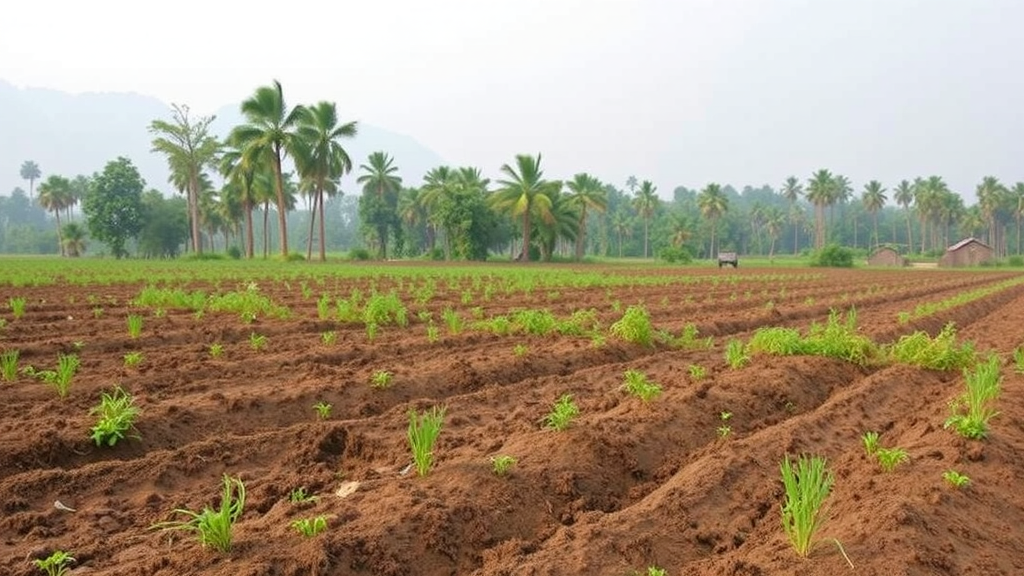
The headline finding is counterintuitive at first glance: the intensively managed rain-fed agricultural fields, far from being biologically impoverished, showed 25 to 40 percent higher soil respiration and microbial biomass than the forest systems. These agricultural soils were also warmer, wetter, denser and richer in organic carbon and nutrients. The maximum soil temperature recorded was 29.40 degrees Celsius at 15 to 30 centimetres in agricultural plots, while surface moisture reached 31.35 percent, and bulk density peaked at 1.91 grams per cubic centimetre at 30 to 45 centimetres. Organic carbon in the agricultural soils peaked at 2.14 percent at 15 to 30 centimetres, and available nitrogen and phosphorus were likewise elevated compared with the forested sites.
The authors attribute this biological exuberance to the specific conditions of seasonal paddy cultivation. Periodic monsoon flooding, incorporation of crop residues, fertilizer application and repeated soil disturbance deliver a steady supply of labile organic substrates, which in turn feeds microbial populations. Under such conditions the microbial community thrives, and its respiration accelerates the conversion of organic carbon into atmospheric carbon dioxide. The study’s authors are careful to draw a crucial distinction here: higher microbial biomass and respiration signal active nutrient cycling and carbon mineralization, not carbon sequestration. Indeed, faster respiration may ultimately mean faster carbon losses from the soil, a point with significant implications for how tropical agricultural landscapes are accounted for in climate models.
The forest systems told the opposite story. Mixed forests and Sal plantations maintained lower bulk densities, more stable physical conditions and moderate levels of biological activity. Continuous litter inputs and undisturbed root systems promote soil aggregation and structural stability, and the organic carbon they accumulate near the surface is gradually stabilized at depth within protected mineral and aggregate fractions. This is the environment most conducive to long-term carbon persistence, even though it does not produce the eye-catching respiration rates of the paddies. In between these two extremes, the pineapple-based agroforestry systems displayed intermediate values across nearly every physical, chemical and biological variable, retaining forest-like porosity and structure while sustaining productive cultivation.
One of the study’s more subtle results concerns depth. Soil depth significantly influenced most properties, with organic carbon and microbial biomass generally declining with depth in the forest systems, but the interaction between land use and depth was weak or non-significant for most variables. In other words, land-use effects did not intensify or fade in any consistent way with depth; instead, they operated at the level of the whole soil profile. This finding carries a methodological warning for the field: assessments based only on surface soils, or on depth-averaged composites, may systematically misjudge how land management reshapes tropical soils. Correlation analysis reinforced the picture of an integrated system, with moisture, organic carbon and nutrient availability positively associated with microbial indicators, while hierarchical clustering grouped structural properties such as bulk density and porosity into a separate domain from the carbon and nutrient variables.
The practical and policy implications are considerable. Rain-fed agriculture promotes short-term fertility and biological activity, but it comes bundled with compaction, altered pore structure and rapid carbon turnover that may undermine long-term soil resilience. Forests conserve structure and carbon but offer little in the way of production. Agroforestry emerges from this study as a genuine middle path, moderating soil conditions relative to intensive agriculture while sustaining yields, which supports its promotion as a climate-resilient land-use strategy in rapidly changing tropical landscapes. The authors note that integrating perennial tree components into agricultural landscapes can balance biological activity with structural stability, consistent with broader recommendations on soil conservation and vegetation diversification for climate mitigation.
The researchers also acknowledge the limits of their work. Sampling covered a single season, and the bulk microbial indicators used cannot capture the full functional diversity of soil communities, so future work combining seasonal monitoring, molecular microbial analyses and ecosystem carbon budgeting will be needed to track how these patterns shift through time. Still, the message from the hills of Tripura is clear: land use governs the physics, chemistry and biology of tropical soils in coordinated ways that reach a metre below the surface, and any honest assessment of soil health or carbon storage must look at the whole profile, not just the top of it.
Subject of Research: Effects of land-use systems on soil physicochemical properties, microbial biomass and respiration across soil depths in humid tropical ecosystems
Article Title: Land-use effects on soil physicochemical properties, microbial biomass and respiration across soil depths in humid tropical ecosystems of Northeast India
Article References: Deb, D., Tripura, K., Gosai, K., & Deb, S. (2026). Land-use effects on soil physicochemical properties, microbial biomass and respiration across soil depths in humid tropical ecosystems of Northeast India. Discover Soil, 3(1), Article 157. https://doi.org/10.1007/s44378-026-00315-9
Image Credits: AI Generated
DOI: 10.1007/s44378-026-00315-9
Keywords: land-use change, soil organic carbon, soil respiration, microbial biomass carbon, agroforestry, tropical soils, Tripura, Northeast India, linear mixed-effects models, soil depth, paddy agriculture, carbon cycling
Cite Scienmag News
Alan Morgan. (September 23, 2026). Farming soils breathe faster than forests in Northeast India, deep-profile study finds. Scienmag. https://scienmag.com/farming-soils-breathe-faster-than-forests-in-northeast-india-deep-profile-study-finds/
Alan Morgan. "Farming soils breathe faster than forests in Northeast India, deep-profile study finds." Scienmag, 23 September 2026, https://scienmag.com/farming-soils-breathe-faster-than-forests-in-northeast-india-deep-profile-study-finds/. Accessed 5 October 2026.
Alan Morgan. "Farming soils breathe faster than forests in Northeast India, deep-profile study finds." Scienmag. September 23, 2026. https://scienmag.com/farming-soils-breathe-faster-than-forests-in-northeast-india-deep-profile-study-finds/


