


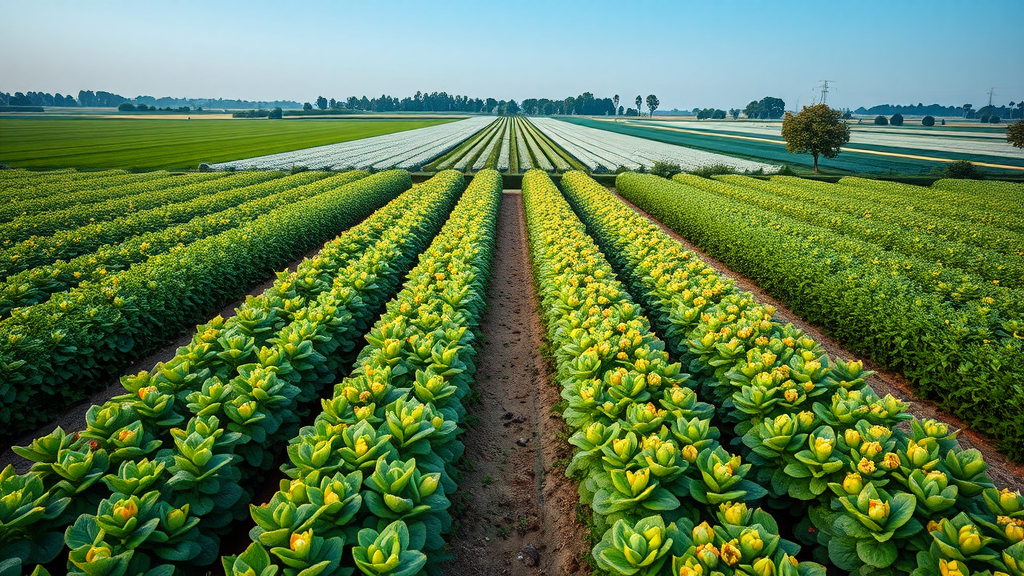
Imagine standing in front of a screen that shows a living, breathing replica of your farm: every soil moisture probe, every greenhouse sensor, every tractor and irrigation valve represented as a stream of data that updates in real time. You can change the weather in this virtual world, test a new irrigation schedule, or simulate an outbreak of disease, and see what would happen before a single seed is affected in the real field. This is the promise of digital twin technology, a concept born in aerospace and manufacturing that is now migrating rapidly into agriculture, and a major new analysis suggests the migration is accelerating faster than almost anyone expected.
A team of researchers led by Kashif Khaqan of Federation University Australia, working with colleagues at Adelaide University and partners in industry, has published one of the most comprehensive maps to date of the scientific literature on digital twins in agriculture. Their bibliometric analysis, published in the journal Discover Agriculture, examined 657 Scopus-indexed publications spanning 23 academic disciplines and 87 countries. The headline finding is a striking surge of activity: more than four-fifths of all relevant documents identified in the dataset were published in just the last three years of the study period, with 2025 alone contributing 216 papers, or nearly 33 percent of the total. What was once a niche curiosity has become one of the most dynamic research frontiers in agricultural science.
The study defines a digital twin as a closed-loop system in which real-time data, decision-making, and automated actions continuously interact with and influence a physical asset. This is what separates a true twin from an ordinary computer model. A crop simulation can be run once and left alone; a digital twin is fed constantly by Internet of Things sensors measuring soil properties, microclimates, crop status, and equipment performance, and its outputs flow back into the physical world as irrigation commands, machinery adjustments, or management alerts. The researchers argue that this bidirectional connection gives digital twins a level of fidelity and usefulness that traditional modelling and simulation approaches cannot match, effectively turning a farm into a system that can be rehearsed, predicted, and optimised before decisions are executed in the field.
The numbers behind the analysis reveal where the intellectual centre of gravity currently sits. China leads global output with 118 publications, representing 17.9 percent of the total and attracting 1,129 citations, followed by India with 105 papers and the United States with 66. The United States ranks second in citations with 1,209, while Australia, despite a smaller share of publications, has accumulated the highest total citations at 1,371, suggesting outsized influence per paper. On the institutional stage, Wageningen University & Research in the Netherlands stands out as the single most productive organisation with 21 publications, ahead of China’s Ministry of Agriculture and China Agricultural University. The top five countries together produced more than half of the entire corpus, and 45 of the 87 publishing nations met a threshold of at least five shared collaborations, indicating a genuinely international but unevenly distributed research network.
Perhaps the most revealing part of the study is its keyword co-occurrence analysis, which distilled 4,726 author keywords down to 105 that appeared at least ten times, and then clustered them into five interconnected themes. The first cluster captures the technological backbone: artificial intelligence, big data, cyber-physical systems, real-time monitoring, decision support systems, network security, and predictive maintenance. The second focuses on digital crop management, where machine learning, deep learning, and reinforcement learning allow twins to improve their predictions of crop growth, irrigation needs, and environmental conditions over time, with particular strength in controlled environments such as greenhouses. The third cluster highlights sensing and autonomy: drones, remote sensing, 3D reconstruction, agricultural robots, edge computing, and blockchain. The fourth links the technology to climate-smart agriculture, sustainability, life cycle assessment, food security, and climate change adaptation. The fifth centres on the IoT-driven ecosystem of sensors and connected devices that underpins agriculture 4.0.
Dominance by computer science is both the engine and the weakness of the field. Computer Science accounts for 62.2 percent of publications and Engineering for 48.5 percent, while Agricultural and Biological Sciences contributes just 23.7 percent. The authors read this as a disciplinary imbalance: the machinery of digital twins is being built faster than agronomists and practitioners can apply it. Journal patterns tell a similar story. Computers and Electronics in Agriculture leads the field with 21 articles and 867 citations and a journal impact factor of 8.9, while broader outlets such as Agriculture and Applied Sciences fill out the top tier. Conference papers, at 36 percent of the corpus, slightly outnumber research articles at 32 percent, a signature of a young field still working out its methods in real time.
The gaps are as informative as the clusters. Keywords associated with disease management, climate resilience, agricultural supply chains, and advanced decision-support systems appeared less frequently and linked weakly to the core themes. In other words, most existing digital twins are good at watching and predicting, but poor at deciding. The analysis identifies decision support and disease management as the key research deficits, and the authors call for decision-oriented frameworks that close the loop from sensor data through simulation to a concrete, defensible recommendation for the farmer. On the research side, they argue that twins enable scenario testing without risking crop loss, allow controlled experiments on plant-soil-microbe interactions and pest propagation, and could eventually be aggregated into regional and global networks for supply chain optimisation and food security planning, provided that standardised protocols for data collection, integration, and validation are established.
For practice, the pathway to adoption runs through high-value and controlled environments first. The study suggests farmers and agribusinesses begin with greenhouses, orchards, and farms that already have sensor infrastructure, where twins can deliver measurable gains in precision irrigation, nutrient management, yield forecasting, and input-use efficiency. Integration with existing farm management systems, autonomous machinery, and supply chain processes extends the benefits toward traceability and sustainability. But the barriers are real: high implementation costs, technological complexity, a shortage of expertise, interoperability problems between hardware and software platforms, and unresolved questions of data security and privacy. The authors point to pilot deployments, cost-effective sensor networks, user-friendly interfaces, and training programmes as the practical instruments for widening adoption beyond large commercial operations to smallholders.
Policy emerges as the decisive variable. Because digital twins depend on real-time data, sensor networks, and robust connectivity, countries with strong national innovation strategies and Industry 4.0 investment, such as China, dominate output, while many smallholders in lower-income regions cannot afford the underlying infrastructure. The study recommends subsidies, grants, low-interest financing, and shared equipment schemes to prevent diffusion from being confined to industrial-scale farming, alongside interoperability standards developed with industry bodies and universities, and clear regulations on data privacy and ownership to build farmer trust. The analysis has limitations worth noting: it relies on a single database, English-dominated literature, and a deliberately narrow search string pairing digital twin with agriculture, which may exclude adjacent work using terms like smart farming or cyber-physical systems. Yet the trajectory is unmistakable. In a world of tightening water, unstable weather, and rising food demand, the ability to rehearse a bad harvest virtually before it happens may prove one of agriculture’s most consequential tools, and the research community is clearly betting that the twin will soon be as fundamental to a farm as the soil beneath it.
Subject of Research: Bibliometric analysis of digital twin applications in agriculture
Article Title: Exploring digital twins in agriculture with current applications and implications for research, policy and practice
Article References: Khaqan, K., Gautam, P., Paudel, B., Liang, S., Van Duc Long, N., Parvin, M. I., Munigoti, K., Sasanelli, N., Hessel, V., & Sandhu, H. (2026). Exploring digital twins in agriculture with current applications and implications for research, policy and practice. Discover Agriculture, 4(1), Article 278. https://doi.org/10.1007/s44279-026-00760-8
Image Credits: AI Generated
DOI: 10.1007/s44279-026-00760-8
Keywords: digital twins, agriculture, bibliometric analysis, smart farming, Internet of Things, artificial intelligence, precision agriculture, climate-smart agriculture, machine learning, drones, IoT sensors, agricultural policy
Cite Scienmag News
Alan Morgan. (September 23, 2026). Virtual farms, real data: digital twins are quietly reshaping agriculture. Scienmag. https://scienmag.com/virtual-farms-real-data-digital-twins-are-quietly-reshaping-agriculture/
Alan Morgan. "Virtual farms, real data: digital twins are quietly reshaping agriculture." Scienmag, 23 September 2026, https://scienmag.com/virtual-farms-real-data-digital-twins-are-quietly-reshaping-agriculture/. Accessed 23 September 2026.
Alan Morgan. "Virtual farms, real data: digital twins are quietly reshaping agriculture." Scienmag. September 23, 2026. https://scienmag.com/virtual-farms-real-data-digital-twins-are-quietly-reshaping-agriculture/


