


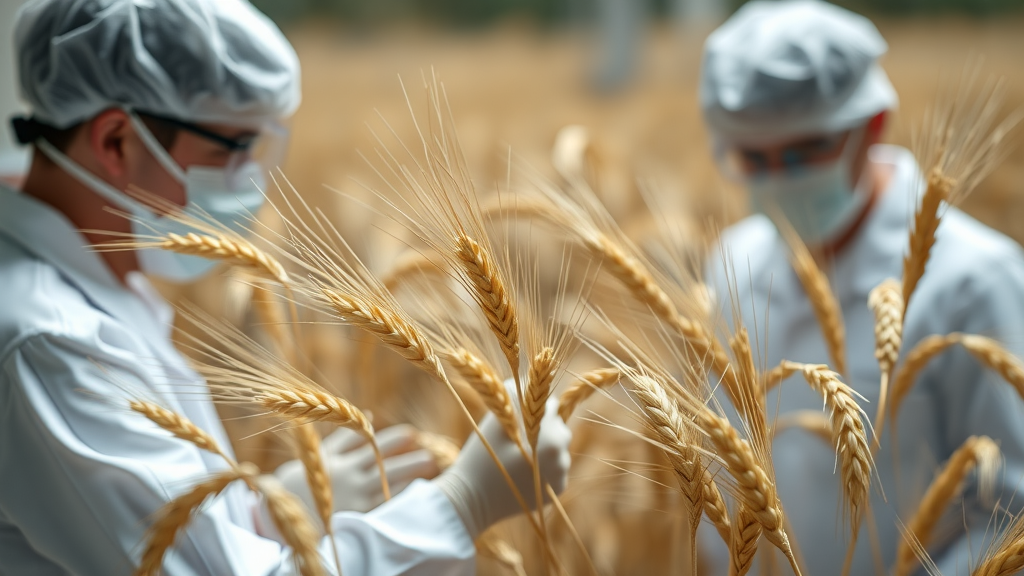
As climate change tightens its grip on the world’s breadbaskets, a team of Indian wheat scientists has delivered one of the most detailed audits yet of the genetic raw material that could keep wheat alive when the rains fail. Working at the ICAR-Indian Institute of Wheat and Barley Research in Karnal, the researchers screened 42 diverse hexaploid wheat lines, spanning conventional varieties, synthetic hexaploids, and the ancient Indian dwarf wheat Triticum sphaerococcum, combining field-based phenotyping with molecular marker analysis to separate genuinely drought-tolerant lines from those that merely look resilient under favorable conditions. The study, published in the Indian Journal of Genetics and Plant Breeding, arrives at a moment when wheat, the staple crop feeding roughly a third of humanity, faces intensifying terminal drought across South Asia and beyond.
The logic behind the study is deceptively simple. Drought tolerance is not a single trait but a symphony of characteristics, from the timing of flowering to the architecture of the root system, the persistence of green leaf area, and the ability to fill grain when water becomes scarce during the critical grain-filling window. Breeding programs that select on yield alone under irrigated conditions routinely discard the very alleles that could save a crop under stress. To avoid that trap, the team measured twelve traits covering phenology, grain yield components, and physiological performance, growing the lines under both normal and moisture-stressed conditions so that each genotype could be scored for how gracefully it degraded under drought.
Analysis of variance revealed substantial differences between genotypes, between watering conditions, and, crucially, in the genotype-by-condition interaction, the statistical signature that tells breeders which lines change rank when stress is imposed. High heritability estimates and strong genetic variability for yield, phenological, and yield-contributing traits indicated that much of the observed variation was genetically controlled rather than environmental noise. That matters because heritability is the fuel of selection: traits with high heritability respond predictably to breeding, meaning the diversity uncovered in this panel can be reliably channeled into new varieties rather than dissolving into field-to-field variation.
To classify the lines, the researchers turned to the drought susceptibility index, a classic metric introduced by Fischer and Maurer that quantifies how much a genotype’s yield falls relative to the mean response of the whole trial when water is withheld. A low or negative index marks a line that maintains yield under stress. On this basis, 25 of the 42 genotypes were classed as drought tolerant and 17 as susceptible. Six lines stood out as highly tolerant: SPH66, SPH91, SYN42, SYN9, MACS6222, and DBW327. Several of these carry the SYN prefix, signaling synthetic hexaploid wheat, engineered by recombining durum wheat with wild goatgrass relatives to reintroduce genetic diversity from the D genome that decades of elite breeding have eroded.
The provenance of these materials is itself a story. Modern bread wheat carries three genomes, labeled A, B, and D, but the D genome donor, Aegilops tauschii, contributed only a narrow slice of its diversity at the original speciation event. Synthetic hexaploids, made by crossing durum wheat with Aegilops tauschii and then doubling the chromosome complement, act as a bridge that funnels fresh alleles for root vigor, stress tolerance, and disease resistance into the breeding pool. Meanwhile, Triticum sphaerococcum, the ancient Indian shot-wheat, represents an independent hexaploid lineage adapted over centuries to the subcontinent’s erratic monsoon margins. Finding that lines from both sources top the drought rankings validates the strategy of mining exotic germplasm rather than reshuffling the same exhausted elite gene pool.
On the molecular side, the team fingerprinted the accessions with simple sequence repeat markers, the workhorse microsatellites of wheat genetics. Polymorphism information content values ranged from 0.28 for the marker Xcfd43 to 0.70 for Xgwm111, while allelic richness varied from two to five alleles per locus. PIC values above 0.5 are considered highly informative for diversity work, so markers like Xgwm111 proved especially powerful at distinguishing genotypes. The spread of allele numbers per locus, while modest, is typical of SSR surveys and sufficient to resolve relationships among lines and, more importantly, to test whether the molecular grouping mirrors the field performance.
It did, to a striking degree. When the researchers built cluster diagrams from the phenotypic data and again from the molecular data, a set of tolerant genotypes, including SPH 37, SPH 38, SPH 44, SPH 48, SYN42, SYN56, and SYN87, consistently grouped together in both dendrograms. Concordance between morphological and molecular clustering is not guaranteed; often the two reflect different histories, one shaped by selection for agronomic performance and the other by neutral drift at marker loci. Here, the overlap suggests that the tolerant lines share genuine genetic determinants of drought adaptation, not merely superficial resemblance. For breeders, these genotypes can now serve as donor parents, crossed into elite backgrounds with reasonable confidence that their resilience has an inheritable basis.
The most forward-looking result came from association analysis linking markers to drought tolerance. The team detected five significant allelic associations involving the markers Xgwm484, Xwmc517, Xwmc702, and Xgwm108, implying that specific alleles at these microsatellite loci track functional variation in drought response. Because SSR markers are cheap, robust, and easy to score in any breeding lab, they can be deployed immediately in marker-assisted selection, allowing programs to track drought-tolerance alleles through crossing generations without waiting for a drought season to test every progeny row. The markers effectively become lighthouses, letting breeders hold on to tolerance alleles even when the environment refuses to cooperate with field screening.
The economics of this approach explain why breeding is often described as the cheapest climate adaptation available. Irrigation infrastructure demands capital, energy, and water that many wheat-growing regions simply do not have, and agronomic fixes like mulching or conservation tillage can only partially offset a water deficit during flowering and grain filling. A cultivar that yields reliably under terminal drought, by escaping stress through early flowering, tolerating it through deep roots and osmotic adjustment, or maintaining photosynthesis in a stay-green canopy, embeds resilience directly in the seed. Once released, it multiplies and spreads at essentially no recurring cost, which is precisely why the identification of diverse, genetically distinct drought donors is so consequential for food security projections.
The study also carries a cautionary note for genebanks and prebreeding programs. Seventeen of the 42 accessions proved susceptible, a reminder that diversity by itself is not adaptation, and that exotic germplasm must be evaluated under realistic stress conditions before its alleles are trusted. The Karnal team’s two-tier strategy, phenotypic classification anchored by the drought susceptibility index and validated by molecular clustering and marker associations, offers a template that other national programs can replicate with locally adapted germplasm. As heat and drought increasingly overlap across the Indo-Gangetic Plains and other major wheat zones, the tolerant synthetics, SPH lines, and sphaerococcum accessions cataloged here represent more than academic entries in a germplasm ledger. They are candidates for the parentage of the next generation of drought-resilient varieties, and the markers now linked to their tolerance give breeders a molecular map for getting there before the climate does.
Subject of Research: Genetic diversity and drought tolerance in hexaploid wheat using phenotypic and SSR marker analysis
Article Title: Assessing Genetic Diversity and Drought Adaptive Potential in Diverse Hexaploid Wheat Accessions
Article References: Assessing Genetic Diversity and Drought Adaptive Potential in Diverse Hexaploid Wheat Accessions. (n.d.). https://doi.org/10.1007/s44489-026-00027-y
Image Credits: AI Generated
DOI: 10.1007/s44489-026-00027-y
Keywords: wheat, drought tolerance, genetic diversity, SSR markers, synthetic hexaploid wheat, Triticum sphaerococcum, drought susceptibility index, marker-assisted selection, plant breeding, food security, germplasm, PIC
Cite Scienmag News
Alan Morgan. (September 23, 2026). Scientists Hunt Hidden Drought Genes in Ancient and Synthetic Wheats. Scienmag. https://scienmag.com/scientists-hunt-hidden-drought-genes-in-ancient-and-synthetic-wheats/
Alan Morgan. "Scientists Hunt Hidden Drought Genes in Ancient and Synthetic Wheats." Scienmag, 23 September 2026, https://scienmag.com/scientists-hunt-hidden-drought-genes-in-ancient-and-synthetic-wheats/. Accessed 4 October 2026.
Alan Morgan. "Scientists Hunt Hidden Drought Genes in Ancient and Synthetic Wheats." Scienmag. September 23, 2026. https://scienmag.com/scientists-hunt-hidden-drought-genes-in-ancient-and-synthetic-wheats/


