


One of the longest-standing ambitions in analytical chemistry is a sensor that can look at a complex biological mixture and simply tell you what is in it. Mass spectrometry does this superbly, but it demands bulky instrumentation, extensive sample preparation and expert interpretation. Now, researchers report in Nature Biotechnology that a single engineered protein nanopore can identify members of four fundamentally different classes of biomolecules—amino acids, nucleoside monophosphates, saccharides and peptides—at the same time, reaching a classification accuracy of 98.7% when coupled to machine learning. In a demonstration that will turn heads across biotechnology, the same sensor also performed compositional analysis of native glycopeptides, the heavily decorated protein fragments that carry much of the sugar code of life.
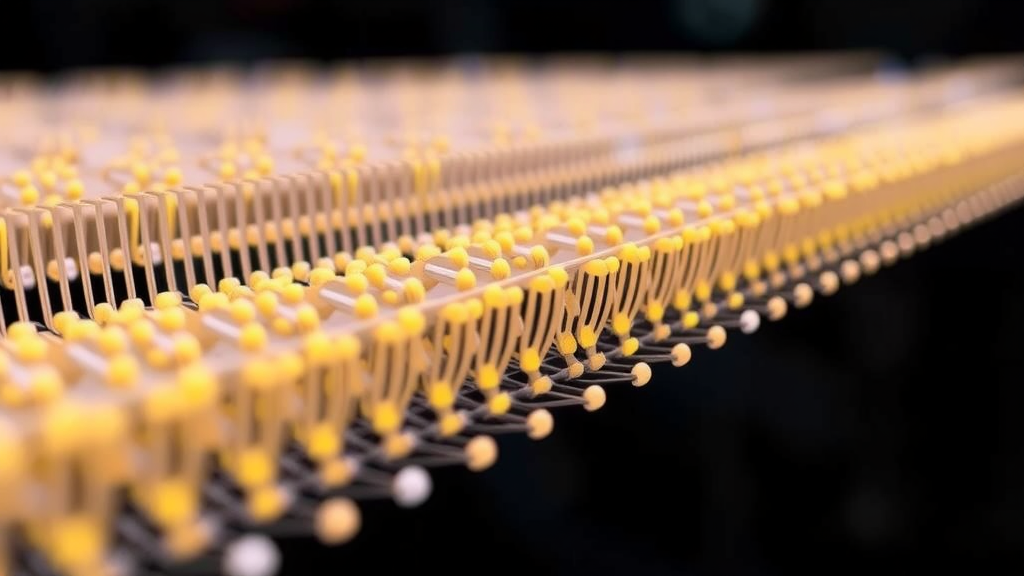
The heart of the device is MspA, a porin from the soil bacterium Mycobacterium smegmatis that has already earned a storied reputation in DNA sequencing. MspA forms a stable, conical pore roughly one nanometre wide at its constriction, a scale at which a single small molecule can obstruct the flow of ions and produce a characteristic electrical signature. When a voltage is applied across a membrane containing the pore, analytes that wander into the aperture transiently block or modulate the ionic current, and the resulting blips carry fingerprints of the molecule’s size, shape, charge and chemistry.
The problem has always been versatility. Nanopores are exquisitely selective, which is a virtue for detecting one target molecule but a liability when the target is unknown. Different chemical classes interact with the pore environment in different ways: saccharides are neutral and hard to trap, amino acids span a dramatic range of charge and hydrophobicity, and nucleotides carry dense negative charges that make them rush through too quickly to be read. Earlier engineered pores succeeded with individual analyte classes—discriminating all twenty proteinogenic amino acids in one design, or distinguishing monosaccharides in another—but no single pore had tackled all of them at once.
The new work solves this by grafting a chemical adapter into the pore. The team modified MspA with a maleimido-C2-FPBA moiety, a benzaboronic acid derivative attached through a short linker to a defined site inside the pore lumen. Boronic acids are famous in chemical biology for forming reversible covalent complexes with cis-diols, the pairing of hydroxyl groups found abundantly on sugars. But the adapter does more than catch carbohydrates. Inspired by iminoboronate chemistry, the reversible interaction between boronic acids and nitrogen-containing functional groups allows the adapter to transiently capture amines as well, slowing the passage of amino acids and peptides so that their signals can be recorded.
The result is a pore that no longer lets any of these small molecules simply tumble through. Instead, each analyte is repeatedly captured, held and released at the adapter site, producing long trains of current fluctuations rather than a single fleeting blip. Amino acids produce residence events whose depths and durations reflect their side chains; nucleoside monophosphates generate distinct blockade patterns shaped by their base and phosphate; saccharides, bound through their diols, yield slow, stuttering signals; and peptides produce composite signatures reflecting both their terminal amines and their residue composition. Crucially, all four classes can be present in the same solution and still be told apart, because their event statistics cluster in separate regions of feature space.
Distinguishing those clusters is where machine learning enters. The researchers extracted features from thousands of individual events—mean and variance of the blockade current, dwell times, recurrence rates and higher-order statistics of the fluctuation patterns—and trained classifiers on labelled mixtures. Using a few-shot learning strategy, which requires only a small number of labelled examples per analyte, the system assigned unseen events to the correct analyte with 98.7% accuracy across the four chemical classes. The approach is notable for its data efficiency: instead of demanding enormous training sets, the engineered pore’s physically distinct binding chemistry produces such characteristic signals that a handful of reference measurements per molecule suffices.
The most striking demonstration involves glycopeptides, molecules that marry a peptide backbone to one or more covalently attached glycans. Glycopeptides are central to biology—most secreted and membrane proteins carry them—and their analysis is a major bottleneck in proteomics, typically requiring enzymatic release of the sugars and elaborate liquid chromatography tandem mass spectrometry workflows. Because the FPBA adapter engages the cis-diols of the glycan while the pore constriction senses the peptide, the sensor reads both parts of the molecule in one event. The team showed that the device could determine the compositional makeup of native, unlabelled glycopeptides, distinguishing variants that differ in their sugar content without any prior chemical derivatization.
Experts in bioanalytical chemistry will recognize how much engineering subtlety underlies this apparent simplicity. The site-specific attachment of the adapter required a genetically introduced handle in the MspA protein, and the linker length and chemistry had to be tuned so that analytes of wildly different sizes—from a single amino acid of around one hundred daltons to glycopeptides several times larger—could all access and interact with the boronic acid. The ionic current readout itself is straightforward, but converting raw fluctuation trains into reliable chemical identities demands rigorous control of pH, salt concentration and voltage, conditions the authors establish and characterize in the study.
The broader significance lies in what a practical four-class nanopore sensor could enable. A benchtop or even portable device that identifies metabolites, nucleotides, sugars and peptide fragments from a crude mixture would be transformative for point-of-care diagnostics, metabolic flux studies, quality control in biopharmaceutical manufacturing and the emerging field of glycomics. It also complements the rapid progress in nanopore peptide sequencing, where related engineered pores have recently been used to read stepwise-shortened peptides, and with nanopore single-molecule chemistry more generally, which now extends far beyond its nucleic-acid origins. A universal small-molecule reader, in other words, no longer seems fanciful.
Challenges remain before the technology migrates from research lab to routine use. Real biological samples contain hundreds of analytes, some present at vanishingly low concentrations, and the classifier’s performance on such dense, unbalanced mixtures will need to be demonstrated. Sensor lifetime, throughput and the standardization of pore fabrication will also matter for adoption. But the conceptual hurdle has been cleared: a single chemically versatile protein pore, read by a modest machine-learning model, can simultaneously name molecules from four different chemical worlds. As nanopore sensing matures, the humble ionic-current trace is quietly becoming one of the most information-dense signals in all of analytical science.
Subject of Research: An engineered MspA nanopore sensor that simultaneously identifies amino acids, nucleoside monophosphates, saccharides and peptides, including native glycopeptides, using machine-learning classification.
Article Title: A versatile nanopore identifies four classes of analytes simultaneously
Article References: A versatile nanopore identifies four classes of analytes simultaneously. (2026). Nature Biotechnology. https://doi.org/10.1038/s41587-026-03322-x
Image Credits: AI Generated
DOI: 10.1038/s41587-026-03322-x
Keywords: nanopore sensing, MspA, biosensor, machine learning, amino acids, saccharides, peptides, nucleoside monophosphates, glycopeptides, single-molecule detection, bioanalytical chemistry, chemical biology
Cite Scienmag News
Ophelia Keating. (September 20, 2026). Engineered nanopore reads amino acids, sugars, peptides and nucleotides at once. Scienmag. https://scienmag.com/engineered-nanopore-reads-amino-acids-sugars-peptides-and-nucleotides-at-once/
Ophelia Keating. "Engineered nanopore reads amino acids, sugars, peptides and nucleotides at once." Scienmag, 20 September 2026, https://scienmag.com/engineered-nanopore-reads-amino-acids-sugars-peptides-and-nucleotides-at-once/. Accessed 20 September 2026.
Ophelia Keating. "Engineered nanopore reads amino acids, sugars, peptides and nucleotides at once." Scienmag. September 20, 2026. https://scienmag.com/engineered-nanopore-reads-amino-acids-sugars-peptides-and-nucleotides-at-once/


