


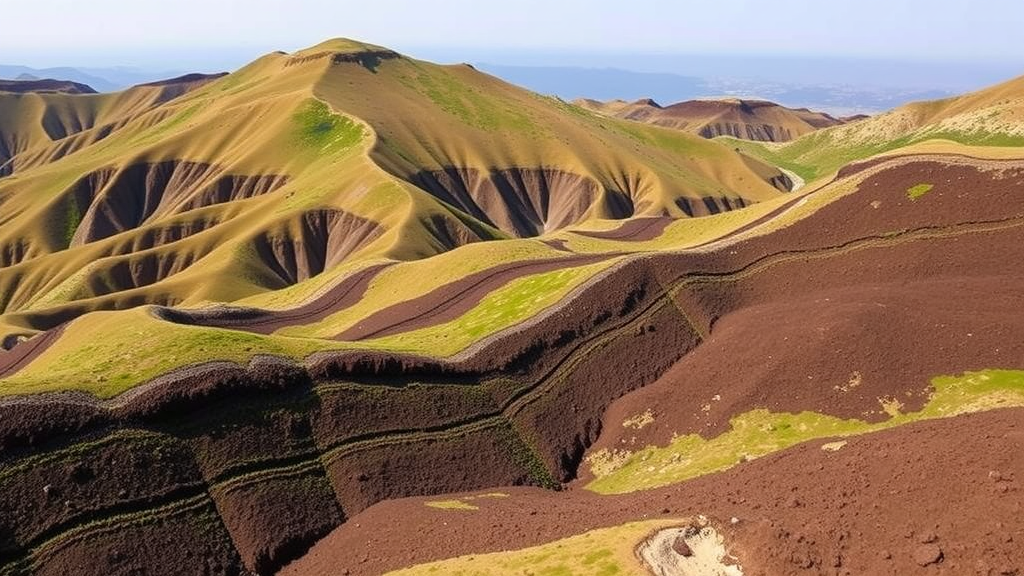
Soils hold more carbon than the atmosphere and all living vegetation combined, yet the mechanisms that lock organic matter away for centuries or millennia remain stubbornly difficult to pin down. A new study from the Ciuc intramontane depression in the Eastern Carpathians of Romania offers a strikingly clear illustration of how two very different soil-forming environments, separated by only a few kilometers, can achieve organic carbon enrichment through entirely distinct pathways. By comparing a thick, dark Phaeozem on a river terrace with a calcium-rich peat Histosol in the adjacent floodplain, researchers have documented profile-scale evidence for two contrasting expressions of carbon preservation within the same cool, enclosed mountain basin.
The study, published in the journal Discover Soil, focuses on two soil profiles located near the city of Miercurea Ciuc along the Olt River valley. The first, designated Profile P1, sits on the roughly 20-meter terrace of the Olt River under long-term arable cultivation and was classified as a Cambic Hortic Chernic Phaeozem. The second, Profile P2, lies in the floodplain itself beneath permanent grassland dominated by moisture-loving grasses and sedges, and was classified as a Sapric Histosol of the Eutric, Fluvic variety. The sites are approximately three kilometers apart, sharing a similar climate but occupying fundamentally different positions in the landscape.
The Phaeozem profile proved remarkable in its own right. It exhibits a humus-rich sequence extending to a depth of 80 centimeters, with soil organic carbon concentrations exceeding two percent throughout the humic horizons and remaining at 1.51 percent even in the transitional AB horizon below the ploughed layer. The surface Ap horizon is very dark greyish brown, riddled with earthworm channels and granular structure shaped by decades of ploughing and bioturbation. Beneath it, two dark humic horizons collectively meet the strict diagnostic criteria for a chernic horizon, the signature feature of chernozemic soils. Deeper still, the profile transitions into cambic horizons showing incipient clay-humus coatings on ped faces and secondary carbonate accumulation at depth, with numerous filled animal burrows, known as krotovinas, threading down to about one meter.
One of the most intriguing findings concerns the boundary between the humic sequence and the underlying cambic material at approximately 80 centimeters. Particle-size analysis revealed a sharp textural change at this depth: clay content drops from 27.1 percent in the AB horizon to 14.8 percent in the underlying Bw horizon, while the silt-to-clay ratio jumps from 1.09 to 2.91 and remains elevated throughout the deeper horizons. On its own, this might suggest a major geological discontinuity. However, portable X-ray fluorescence measurements told a different story. The major oxide composition of the profile, including silicon, aluminum, calcium and iron oxides, remains relatively stable from top to bottom, and calculated titanium-to-zirconium ratios show no abrupt shift at the humic-cambic boundary. The authors interpret this combination of evidence as indicating that the soil developed in compositionally related but granulometrically stratified terrace sediments, subsequently integrated into a single profile by pedogenic processes and intense biological mixing.
This interpretation points toward a polygenetic model of soil development, in which successive phases of sediment accumulation and soil formation overlapped during the Holocene. The darker subsurface humic horizon may represent a relict feature inherited from earlier phases of soil formation, or a buried and welded horizon related to episodic sedimentation. Earthworm activity, long recognized as a major driver of chernozem formation and homogenization, appears to have played a central role in vertically redistributing organic matter and progressively welding the sedimentary units together. The researchers also considered whether the profile might preserve evidence of an earlier hydromorphic, waterlogged stage, a model previously proposed for chernozemic soils in the Ciuc Depression, but no diagnostic relict gleyic features were identified in this particular profile, leaving that broader regional hypothesis unconfirmed by the present data.
The floodplain Histosol tells a completely different carbon story. Profile P2 contains a 55-centimeter-thick sequence of strongly decomposed sapric peat overlying gleyic, water-affected loamy sand alluvium, with the groundwater table visible near the base of the excavation pit. Soil organic carbon in the sapric horizons exceeds 17 percent, roughly eight times the concentration found in the Phaeozem’s humic horizons. Here, preservation is achieved not through organo-mineral associations in a well-drained mineral matrix, but through persistent water saturation, which limits oxygen availability and suppresses microbial decomposition. The near-neutral to slightly alkaline reaction, high base saturation and high cation exchange capacity of the peat all point to a base-rich, groundwater-fed environment known as a minerotrophic fen.
The geochemistry of the Histosol yielded one of the study’s most thought-provoking results. Portable X-ray fluorescence revealed unusually high calcium concentrations in the peat horizons, with calcium oxide values ranging from 7.15 to 13.24 percent. Yet the carbonate contents measured by the classical Scheibler gas-volumetric method were surprisingly low, at only 1.42 to 2.38 percent calcium carbonate equivalent. When both measurements were converted to elemental calcium equivalents, the comparison indicated that an estimated 86 to 94 percent of the calcium in the sapric horizons exists in non-carbonate forms. In the mineral substratum below, by contrast, carbonate-bound calcium becomes relatively more important, accounting for more than half of the estimated total calcium in the deepest gleyic horizon. The specific forms of this non-carbonate calcium, whether exchangeable on cation exchange sites, organically complexed, or associated with fine mineral particles, cannot be resolved from the available dataset, but the pattern is consistent with the calcium-mediated organo-mineral interactions thought to reinforce organic matter preservation in groundwater-fed fen systems.
The significance of calcium in soil carbon dynamics extends well beyond this single profile. While research on soil organic carbon stabilization has traditionally emphasized acidic soils and the role of aluminum and iron minerals, calcium has received comparatively less attention, particularly in alkaline environments. Exchangeable calcium is widely recognized to correlate positively with soil organic carbon concentration and its resistance to oxidation, yet the underlying mechanisms remain incompletely understood. Proposed pathways include cation bridging between organic molecules and mineral surfaces, calcium-facilitated aggregation, and direct interactions with organic functional groups. The Ciuc Histosol, with its coexistence of very high organic carbon, elevated calcium, near-neutral pH and high base saturation, is consistent with such calcium-mediated stabilization, though the authors are careful to note that this remains a plausible interpretation rather than a directly demonstrated process. Direct chemical fractionation, extraction of exchangeable cations or spectroscopic analyses would be needed to confirm the specific calcium pools involved.
The broader context of the study is equally compelling. Peatlands hold approximately one third of the global terrestrial organic carbon pool, yet most research has concentrated on the ombrotrophic bogs of northern latitudes, leaving mid-latitude minerotrophic fens comparatively understudied. Intramontane depressions of the Eastern Carpathians, with their cold-air pooling, persistent thermal inversions, shallow groundwater tables and thick lacustrine-alluvial sedimentary fills, create conditions favorable for organic matter preservation over millennial timescales. In the Ciuc Depression specifically, minerotrophic fens and chernozemic soils occur in close spatial association, covering roughly 10,000 hectares, about 15 percent of the basin, along the Olt River terraces and alluvial fans. This co-occurrence under a single climate regime makes the depression a natural laboratory for comparing contrasting pedogenic pathways of carbon enrichment.
The authors emphasize that the two profiles should be viewed as complementary case studies rather than a statistically replicated soil-landscape sequence, since geomorphic position, drainage, sedimentary history, parent material, land use and vegetation all vary simultaneously between the sites. Even so, the comparison demonstrates how integrating field profile description, standard physico-chemical analyses and portable XRF geochemical screening can identify sedimentary, pedogenic and geochemical patterns at the profile scale in intramontane basins. The team notes that future work across the full Giurgeu-Ciuc-Brasov depression chain, combined with bulk density measurements and full-depth carbon determinations, would allow landscape-scale carbon stocks to be quantified. As climate and hydrological regimes shift, understanding where and how mountain basins store their carbon becomes an increasingly urgent question, and these Romanian profiles provide a detailed snapshot of the mechanisms at work beneath some of Europe’s least-studied carbon-rich landscapes.
Subject of Research: Pedogenic controls on soil organic carbon accumulation in Phaeozem and Histosol profiles of the Ciuc intramontane depression, Eastern Carpathians, Romania
Article Title: Pedogenic controls on organic carbon accumulation in Phaeozem and Histosol profiles of the Ciuc intramontane depression, Eastern Carpathians, Romania
Article References: Pîrnău, R. G., Roșca, B., Vasiliniuc, I., Secu, C. V., Patriche, C. V., Keresztesi, Á., & Szép, R. (2026). Pedogenic controls on organic carbon accumulation in Phaeozem and Histosol profiles of the Ciuc intramontane depression, Eastern Carpathians, Romania. Discover Soil, 3(1), Article 163. https://doi.org/10.1007/s44378-026-00322-w
Image Credits: AI Generated
DOI: 10.1007/s44378-026-00322-w
Keywords: soil organic carbon, Phaeozem, Histosol, pedogenesis, Eastern Carpathians, intramontane depression, minerotrophic fen, portable X-ray fluorescence, calcium stabilization, chernic horizon, peat preservation, Ciuc Depression
Cite Scienmag News
Alan Morgan. (September 20, 2026). Hidden Carbon Vaults: Romanian Mountain Soils Reveal Two Distinct Paths to Long-Term Organic Storage. Scienmag. https://scienmag.com/hidden-carbon-vaults-romanian-mountain-soils-reveal-two-distinct-paths-to-long-term-organic-storage/
Alan Morgan. "Hidden Carbon Vaults: Romanian Mountain Soils Reveal Two Distinct Paths to Long-Term Organic Storage." Scienmag, 20 September 2026, https://scienmag.com/hidden-carbon-vaults-romanian-mountain-soils-reveal-two-distinct-paths-to-long-term-organic-storage/. Accessed 4 October 2026.
Alan Morgan. "Hidden Carbon Vaults: Romanian Mountain Soils Reveal Two Distinct Paths to Long-Term Organic Storage." Scienmag. September 20, 2026. https://scienmag.com/hidden-carbon-vaults-romanian-mountain-soils-reveal-two-distinct-paths-to-long-term-organic-storage/


