


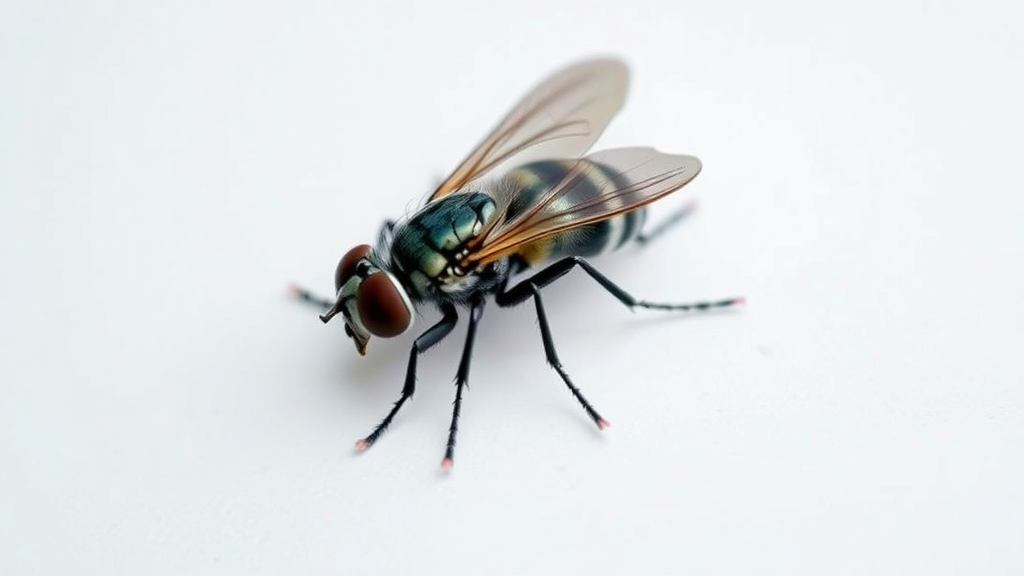
Forensic investigators have long relied on the insects that colonize dead bodies to reconstruct the circumstances of death, but a new discovery from southern Italy shows just how much remains to be learned about the tiny creatures that gather on human remains. Researchers examining the body of a woman found in an abandoned building have documented, for the first time anywhere in the world, the fly species Fannia lineata breeding on a human cadaver. The finding, published in the International Journal of Legal Medicine, not only expands the known repertoire of corpse-colonizing insects but also delivers a practical tool that could sharpen the estimates of time since death in future criminal cases across Europe and beyond.
Forensic entomology, the discipline that applies knowledge of insect taxonomy, biology, ecology and physiology to legal investigations, rests on three main pillars. The first is temperature-dependent development: insects grow at predictable rates that vary by species and population, so if investigators know the temperatures experienced by the earliest colonizers, they can estimate a minimum post-mortem interval, abbreviated minPMI, for relatively recent deaths. The second is the well-established pattern of colonization, in which different insect species arrive at a cadaver in a broadly predictable sequence, allowing estimates of longer post-mortem intervals based on the community of insects present on the remains. The third is habitat and phenology specificity, meaning that some species occupy particular environments or appear only in certain seasons, which can help determine the season of death in historical cases and even reveal whether a body was moved from one location to another after death.
Among the insects that matter most in this field, two orders dominate: the flies, or Diptera, which are typically the first to arrive, and the beetles, or Coleoptera, which follow later. Within the flies, families such as Calliphoridae, the blowflies, and Sarcophagidae, the flesh flies, have received enormous scientific attention because they are conspicuous, abundant and relatively well studied. Other families, including Muscidae, Fanniidae, Piophilidae and Phoridae, are consistently found on human and animal cadavers worldwide, yet some of their members remain poorly understood in terms of biology, distribution and habitat preferences. The genus Fannia, small dark flies measuring just three to four millimeters, belongs to this understudied group, and its taxonomy continues to challenge specialists even as its forensic relevance becomes increasingly clear.
The Fanniidae are a family of small to medium-sized flies with a worldwide distribution, once lumped together with the Muscidae and now recognized as a distinct family comprising more than 300 species across five genera. The genus Fannia alone contains around 400 described species, of which 80 are listed in Europe. Its larvae are saprophagous, feeding on decaying organic matter, and have been reported from birds’ nests, animal burrows, fungi and excrement. The flies also have medical significance because certain species can cause gastrointestinal, urogenital and traumatic myiasis, the infestation of living tissue. Roughly 20 to 25 Fannia species have been recorded from pig cadavers used in field experiments as human decomposition models, but only a handful, including Fannia canicularis, Fannia fuscula, Fannia leucosticta, Fannia manicata, Fannia monilis, Fannia nigra, Fannia pusio and Fannia scalaris, have ever been found on human remains in Europe. In Italy, only F. scalaris and F. canicularis had been commonly reported from human cadavers, always in the larval stage, until now.
The new case came to light when entomological samples were collected during the crime scene inspection following the discovery of a body in an abandoned building in southern Italy, with additional sampling performed during the post-mortem analysis. The body lay on the floor of a room with partially open windows and was in an advanced state of decomposition, partially mummified and partially skeletonized. Combining circumstantial evidence with entomological analysis, the investigators estimated that death had occurred seven to eight months before the body was found. The specimens were collected and processed according to established best-practice guidelines, observed and photographed with a stereomicroscope, preserved in 80 percent ethanol, and identified using the available literature alongside comparison with previously identified samples held in a reference collection.
What the team found was a remarkably complex insect community: sixteen taxa in total, spanning nine species of Diptera from the families Calliphoridae, Muscidae, Fanniidae, Sphaeroceridae and Phoridae, six species of Coleoptera from the families Dermestidae, Cleridae and Ptinidae, and one species of Lepidoptera from the family Tineidae, the clothes moths. Among the flies, only Hydrotaea capensis was present as larvae, while all the other fly taxa were represented by puparia, the hardened barrel-shaped casings that fly larvae form when they pupate, found both closed and open. The beetles, by contrast, appeared as both larvae and adults. Every taxon collected was already well known from Italian modern and archaeo-funerary cases and from field experiments with pigs and other animal models, with one striking exception: several puparia of Fannia lineata, a species that, based on an extensive literature search, had never before been recorded from a human cadaver.
The composition of the entomofauna allowed the researchers to estimate that colonization began in spring, a conclusion that agreed with the circumstantial evidence available in the case. Previous records of F. lineata fit this picture. According to the standard taxonomic literature on European Fanniidae, the species has been found in bird nests, in rabbit burrows and in vertebrate cadavers throughout Europe, though rarely. In Italy, an earlier study had collected the species from pig cadavers in an advanced state of decay, recovering an adult from an exposed pig carcass and larvae from a buried pig that was regularly exhumed to study how disturbance affects the colonization of buried bodies. The new human case is therefore consistent with the species’ apparent association with advanced decomposition, while dramatically extending its documented range of substrates.
Beyond the record itself, the study’s most valuable contribution may be morphological. Fannia larvae are characterized by a dorsoventrally flattened body armed with fleshy processes and by posterior spiracles raised on stalk-like processes in the anal region, but while the adults and larvae of European Fanniidae have been well described, puparia have remained poorly documented. This gap matters because puparia often represent the majority of fly findings in old cases and in archaeological contexts such as crypts and tombs, and because puparia can undergo physical alterations during pupariation, including contraction that partially obscures fine details, while features like oral sclerites are not consistently visible in empty puparia. The researchers therefore described the puparium of F. lineata in detail, noting a suite of diagnostic characters: the puparia are smaller than those of the two Fannia species previously known from Italian human cadavers; dorsolateral processes are absent; the six posterior processes are smooth and unbranched; the dorsomedian posterior processes are smaller than the others; a thickened arched area connects the two dorsal processes on the seventh abdominal segment; the posterior spiracles protrude less than in F. canicularis and F. scalaris; and the distance between the two posterior spiracles is twice the space between each spiracle and the lateral edge of the segment.
To make these characters usable in practice, the authors also provided an identification key for the larvae and puparia of the Fannia species collected from human cadavers in Italy, allowing forensic analysts to distinguish F. lineata from its more familiar congeners even when only puparial remains are available. The team emphasizes that the finding highlights the need for further research into the habitat preferences, phenology and developmental rate of F. lineata, a species that, despite being only occasionally encountered, may provide additional information useful for answering the questions posed by magistrates in forensic contexts. As climate change continues to shift both the phenology and the distribution of necrophagous insects, and as forensic entomology gains ground in courtrooms around the world at very different speeds depending on the country, discoveries like this one quietly expand the forensic toolkit. A fly barely four millimeters long, overlooked for more than a century since its description in 1895, has now formally joined the ranks of insects that can testify, silently and precisely, about the circumstances of human death.
Subject of Research: First forensic record of the fly Fannia lineata on a human cadaver and description of its puparium for species identification.
Article Title: Contributions to the identification of Fannia lineata (Stein, 1895) (Diptera: Fanniidae) in forensic contexts: first record in a human cadaver
Article References: Vanin, S., Carta, G., Scopetti, M., & Santurro, A. (2026). Contributions to the identification of Fannia lineata (Stein, 1895) (Diptera: Fanniidae) in forensic contexts: first record in a human cadaver. International Journal of Legal Medicine. https://doi.org/10.1007/s00414-026-03967-y
Image Credits: AI Generated
DOI: 10.1007/s00414-026-03967-y
Keywords: forensic entomology, Fannia lineata, Fanniidae, puparium identification, post-mortem interval, human decomposition, Southern Italy, Diptera, minimum PMI, insect succession, forensic science, identification key
Cite Scienmag News
Gavin Prescott. (September 20, 2026). Tiny Fly Found on Human Corpse for First Time Could Transform Forensic Timelines. Scienmag. https://scienmag.com/tiny-fly-found-on-human-corpse-for-first-time-could-transform-forensic-timelines/
Gavin Prescott. "Tiny Fly Found on Human Corpse for First Time Could Transform Forensic Timelines." Scienmag, 20 September 2026, https://scienmag.com/tiny-fly-found-on-human-corpse-for-first-time-could-transform-forensic-timelines/. Accessed 4 October 2026.
Gavin Prescott. "Tiny Fly Found on Human Corpse for First Time Could Transform Forensic Timelines." Scienmag. September 20, 2026. https://scienmag.com/tiny-fly-found-on-human-corpse-for-first-time-could-transform-forensic-timelines/


