


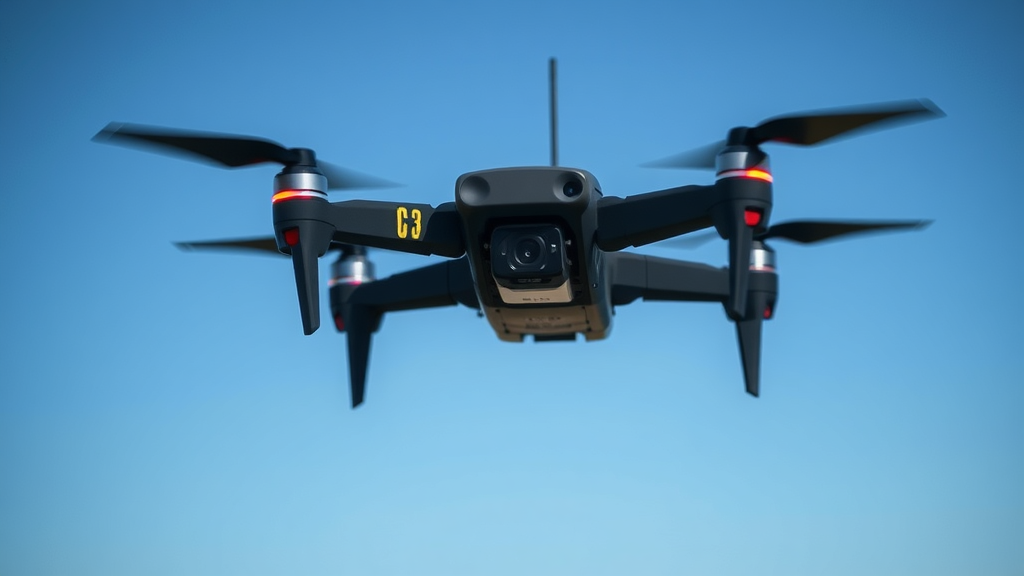
Unmanned aerial vehicles have become indispensable tools for environmental monitoring, disaster relief, and logistics, yet the task of teaching a drone to chart its own course through a complex three-dimensional world remains one of the hardest problems in autonomous flight. A new study published in the International Journal of Aeronautical and Space Sciences presents a hybrid artificial intelligence approach that promises to make drone path planning faster to learn, smoother to execute, and cheaper to fly. The method, developed by Jianhua Liu, Haitao Zhou, Xia Lei, Xiaoguang Tu, Houqiang Hua, and Xiaofan Wang, combines classical physics-based guidance with modern deep reinforcement learning, and it delivers measurable gains in convergence speed and energy efficiency over conventional learning-based planners.
The core challenge the researchers set out to solve is deceptively simple to state: given a start point and a goal in a cluttered 3D environment, generate a trajectory that is short, smooth, dynamically feasible, and energy-efficient, all at the same time. These objectives frequently conflict with one another. The shortest path may hug obstacles so tightly that a real aircraft could not safely follow it. The smoothest path may waste energy in wide, sweeping arcs. Traditional optimization methods can balance these goals but often struggle in unknown or changing environments, where they must be re-run from scratch whenever conditions shift.
Deep reinforcement learning has emerged in recent years as an attractive end-to-end alternative. In this paradigm, an artificial intelligence agent learns to fly by trial and error, receiving rewards for progress toward the goal and penalties for collisions, erratic motion, or excessive energy use. Over many training episodes, the agent internalizes a policy that maps what it observes directly to the actions it should take. The appeal is obvious: once trained, such a policy can react to new situations in milliseconds without recomputing a full trajectory. The drawback, as the new paper emphasizes, is that learning from scratch is painfully slow. Random exploration in a vast three-dimensional action space means the agent spends most of its early training bumping into obstacles or wandering aimlessly, a problem the authors describe as blind exploration combined with low sample efficiency.
To inject common sense into this process, the team turned to the artificial potential field, a concept that has guided robot navigation since the 1980s. In an artificial potential field, the goal exerts an attractive force that pulls the vehicle toward it, while obstacles exert repulsive forces that push it away. The drone is imagined as a ball rolling downhill on a landscape sculpted by these forces, and at every instant the field suggests a sensible direction of travel. The elegance of the approach is that the guidance is state-dependent: as the drone’s position and surroundings change, the forces change with them, always pointing toward safer, more productive regions of space.
Rather than replacing the learning algorithm with this classical method, the researchers fused the two. The state-dependent forces generated by the artificial potential field are integrated directly with the policy of a Soft Actor–Critic agent, a state-of-the-art deep reinforcement learning algorithm prized for its stability and its ability to balance exploration against exploitation. Soft Actor–Critic maximizes both the expected reward and the entropy, or randomness, of the agent’s behavior, which prevents it from collapsing prematurely into a mediocre strategy. By blending the potential field’s heuristic push into the action-selection process, the hybrid system no longer explores blindly. From the very first training episode, the agent is nudged in directions that the physics suggests are promising, while retaining the freedom to deviate when the heuristic is wrong, as it can be in local minima where attractive and repulsive forces cancel out.
The second innovation addresses a different weakness: memory. Standard actor–critic networks treat each moment in isolation, deciding what to do based only on the current observation. A flying vehicle, however, is a dynamical system whose future depends on its recent past. A sudden change in heading that was perfectly safe at low speed may be catastrophic at high speed, and the network cannot know the difference if it has no access to the sequence of states that led to the present moment. To capture these temporal dependencies, the authors embedded a long short-term memory, or LSTM, structure into both the actor and the critic networks. LSTMs are recurrent neural networks equipped with gating mechanisms that allow them to retain information over many time steps and to forget what is no longer relevant, giving the agent an effective working memory of its own flight history.
The practical consequence of this architectural choice is smoother, more dynamically feasible trajectories. Because the policy can perceive trends, accelerations, and oscillations in the state sequence rather than single snapshots, it learns to produce control commands that flow naturally from one to the next, avoiding the jerky, high-frequency corrections that plague memoryless policies and that translate directly into wasted energy and mechanical stress on real airframes. The combination of potential field guidance and recurrent memory gives the method its name: APF–LSTM–SAC.
The team validated the approach in comprehensive tests within complex simulated three-dimensional environments, comparing it against pure deep reinforcement learning baselines. The results were striking. The hybrid method achieved improvements in convergence speed of at least 15.14 percent, meaning the agent reached competent flight policies substantially faster than its unguided counterparts, and it reduced energy consumption by at least 10.36 percent, a figure that matters enormously for battery-powered aircraft whose mission endurance is measured in minutes. Faster training also carries a practical dividend: fewer simulated flight hours are needed before a policy is deployable, which lowers the computational cost of developing autonomous capabilities for new vehicle types or new environments.
The significance of the work extends beyond the specific percentages. It exemplifies a growing trend in robotics toward physics-informed machine learning, in which decades of classical control theory and heuristic reasoning are used to scaffold, rather than be replaced by, modern data-driven methods. Pure learning systems must rediscover from scratch lessons that engineers already know, such as the fact that obstacles should be avoided and goals approached. By encoding those lessons as inductive biases inside the learning pipeline, researchers can preserve the adaptability of reinforcement learning while dramatically shrinking the search space the algorithm must explore. The potential field component supplies a sensible prior; the LSTM supplies temporal awareness; and the Soft Actor–Critic framework supplies robust, entropy-regularized optimization that can gracefully reconcile the two.
The authors note that the datasets generated and analyzed during the study are available from the corresponding author on reasonable request, and the work was supported by the National Natural Science Foundation of China, the CAAC Key Laboratory of General Aviation Operation, and the Fundamental Research Funds for the Central Universities. As drones take on ever more ambitious roles, from delivering medical supplies to surveying disaster zones, the ability to plan safe, efficient three-dimensional trajectories autonomously will only grow in importance. Hybrid approaches like APF–LSTM–SAC suggest that the fastest route to capable autonomous flight may not be to make learning algorithms bigger, but to make them wiser, by letting the accumulated physics of navigation light the way through the darkness of blind exploration.
Subject of Research: UAV three-dimensional path planning using artificial potential field guidance and an LSTM-enhanced Soft Actor–Critic deep reinforcement learning algorithm
Article Title: UAV 3D Path Planning Based on Artificial Potential Field Guidance and LSTM-Enhanced Soft Actor–Critic
Article References: Liu, J., Zhou, H., Lei, X., Tu, X., Hua, H., & Wang, X. (2026). UAV 3D Path Planning Based on Artificial Potential Field Guidance and LSTM-Enhanced Soft Actor–Critic. International Journal of Aeronautical and Space Sciences. https://doi.org/10.1007/s42405-026-01292-7
Image Credits: AI Generated
DOI: 10.1007/s42405-026-01292-7
Keywords: UAV path planning, deep reinforcement learning, artificial potential field, Soft Actor–Critic, long short-term memory, drone navigation, trajectory optimization, energy efficiency, 3D path planning, autonomous flight, machine learning, robotics
Cite Scienmag News
Katie Riggs. (September 13, 2026). Physics-Guided AI Teaches Drones to Fly Smarter in Three Dimensions. Scienmag. https://scienmag.com/physics-guided-ai-teaches-drones-to-fly-smarter-in-three-dimensions/
Katie Riggs. "Physics-Guided AI Teaches Drones to Fly Smarter in Three Dimensions." Scienmag, 13 September 2026, https://scienmag.com/physics-guided-ai-teaches-drones-to-fly-smarter-in-three-dimensions/. Accessed 13 September 2026.
Katie Riggs. "Physics-Guided AI Teaches Drones to Fly Smarter in Three Dimensions." Scienmag. September 13, 2026. https://scienmag.com/physics-guided-ai-teaches-drones-to-fly-smarter-in-three-dimensions/


