


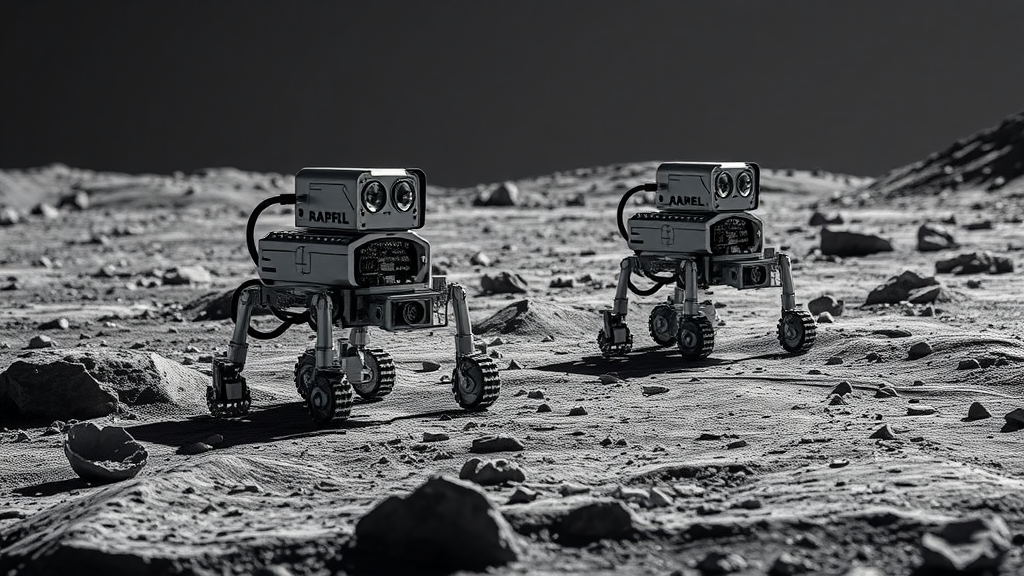
The next era of lunar exploration is no longer a distant vision. China and Russia are jointly advancing the International Lunar Research Station program, the United States is pressing forward with Artemis, and Europe and Japan have each articulated long-term ambitions ranging from a Moon Village to a lunar industrial economy. As these plans mature, the missions they describe have grown far more complex than the unmanned scientific surveys of previous decades. Future crews and robotic systems will be asked to extract and use local resources, build infrastructure on the lunar surface, and maintain equipment across years of continuous operation. According to a recent study published in Space: Science & Technology, a research team led by Wang Xiaowei of the China Academy of Launch Vehicle Technology argues that this transformation hinges on one decisive capability: moving lunar robots from pre-programmed machines that merely execute ground commands to genuinely intelligent systems that can perceive, decide, and act on their own in one of the harshest environments humans have ever attempted to occupy.
The scale of the challenge becomes clear when the current state of the art is examined honestly. Existing lunar and Mars missions still depend overwhelmingly on pre-programmed command sequences and teleoperation from Earth, an approach that imposes severe latency penalties and leaves robots nearly helpless when conditions deviate from expectations. The study identifies five core technical problems that must be solved before large-scale lunar development becomes practical: multi-task high-precision manipulation, autonomous navigation and obstacle avoidance, self-learning interactive collaboration, adaptation to extreme environments, and high-reliability long-duration operation. Each of these problems is magnified by the lunar setting itself, where abrasive dust, extreme temperature swings, radiation, and complex illumination near the poles combine to degrade sensors, mechanisms, and electronics. The authors contend that systematically integrating artificial intelligence, deep learning, large-scale models, and embodied intelligence into lunar robot design has become the critical bottleneck for the entire enterprise of lunar exploration and development.
To organize this vast technical landscape, the research team proposes a developmental roadmap grounded in the phased milestones of human lunar activity. In the first stage, the programmed robot era, machines operate through pre-programmed commands and ground teleoperation, a mode suited to the unmanned scientific exploration phase that has defined lunar robotics to date. The second stage, the intelligent robot era, is subdivided into three hierarchical levels: weak intelligence, intelligence, and general intelligence. These levels correspond respectively to the unmanned lunar research station phase, the lunar base phase, and ultimately a lunar community phase in which fully autonomous operations become the norm. The capability demands evolve in step with these phases, from basic mobility and single-arm manipulation in early surveys, to multi-task autonomous operations at a research station, to complex assembly, construction, and human-robot collaboration at a base, and finally to fully intelligent autonomous behavior across an entire lunar settlement.
At the heart of the paper is a technological framework the authors describe through an anatomical metaphor: a brain, a cerebellum, and a body. The brain serves as the robot’s core command center, receiving external information, planning actions, and generating instructions. It encompasses multimodal perception and information fusion, autonomous mission planning and decision-making, large-model reasoning, path planning and obstacle avoidance, health monitoring, cloud computing and intelligent chips, and human-robot and swarm collaboration. The cerebellum handles fine-grained regulation of motion, translating high-level commands into real-time adjustments based on the robot’s current state; its technologies include autonomous navigation and localization in complex terrain, multi-arm collaborative compliant control, and reinforcement learning-based motion control. The body is the executor, and it demands high-torque long-life modular joints, high-mobility multi-modal locomotion mechanisms, versatile end effectors, high-specific-energy distributed power systems, wireless power transmission, and environment-adaptive design. Together, these three layers define what the authors call an intelligence plus new energy empowerment philosophy for lunar robotics.
One of the most demanding technical problems the team tackled is visual perception in the lunar south pole region, where low sun angles produce long shadows, harsh contrast, and terrain surfaces with repetitive, low-texture features that confound conventional stereo matching. To address this, the researchers developed a visual perception algorithm built on a lightweight deep network. In preliminary experiments, the algorithm achieved stable feature extraction and matching under varying illumination conditions and accurately recovered depth information in scenes with repetitive textures, enabling high-precision mapping and localization even in the difficult lighting regimes expected near the poles. The authors emphasize that this capability lays a direct foundation for autonomous navigation on the lunar surface, since a robot that cannot reliably build a map of its surroundings and locate itself within that map cannot plan a safe path, avoid hazards, or execute any of the construction and maintenance tasks that future missions will require.
Manipulation is the second pillar of the team’s prototype verification work. The researchers established a ground verification platform comprising an equivalent manipulator, an end quick-change mechanism, a controller, and a multifunctional tool kit, and employed a nonlinear compliant control method to achieve high-precision position tracking and contact force buffering at the end effector. Through 50 repeated measurements of position accuracy and 30 repeated measurements of orientation accuracy, the locking precision of the end quick-change device was verified in all three directions to meet the requirements for fine manipulation. This matters because lunar construction will demand that robots swap tools, grasp irregular objects, assemble structures, and interact safely with both equipment and humans, all while absorbing contact forces that would otherwise damage rigid mechanisms or destabilize the robot itself. Compliant control, in other words, is the difference between a machine that can only push and pull and one that can genuinely build.
Mobility across unstructured lunar terrain forms the third pillar. The team’s wheel-leg hybrid locomotion subsystem uses four independent deployable mechanisms, each chain offering three degrees of freedom, allowing the robot to switch between wheeled travel and legged climbing as conditions demand. In a vehicle body lifting experiment, the robot stably raised its chassis from a squatting posture through coordinated wheel-leg motion in approximately 10 seconds, with motor current and torque feedback remaining within safe operating ranges and no jamming at the joint pivots. The mechanism effectively climbed a slope of 20.2 degrees and traversed a 28.3 millimeter step, a height exceeding twice the wheel diameter, demonstrating favorable adaptability to the rocks, craters, and loose regolith that characterize the lunar surface. These results suggest that hybrid locomotion could give future lunar robots the versatility to handle terrain that would defeat purely wheeled rovers.
Based on this body of analysis and experimentation, the study closes with three development recommendations. First, the authors call for a unified technical framework and a consensus on technology classification for lunar intelligent robotics, clearly defining the functional scope and technical metrics for each intelligence level so that progress can be measured and compared. Second, they advocate a phased advancement strategy: near-term breakthroughs in weak-intelligence technologies to build practical engineering application capabilities, followed by medium-to-long-term development of full intelligence and general intelligence. Third, they urge the formulation of international industry standards covering overall system design, interface specifications, and environmental adaptability, so that robots built by different nations can interoperate and collaborate on shared lunar infrastructure. Without such standards, they warn, the fragmented development of national systems could undermine the cooperative vision that programs like the International Lunar Research Station are meant to embody.
The significance of this work extends well beyond any single robot design. By mapping mission phases to intelligence levels, and intelligence levels to concrete technologies in perception, decision-making, motion control, and actuation, the study offers a systematic reference framework for the planning, technological development, and engineering application of robotic systems in the construction of lunar research stations and lunar bases. It also frames a broader transition now underway across the space sector, in which the tools of modern artificial intelligence, from deep learning to large-scale models to embodied intelligence, are being pulled out of terrestrial laboratories and pressed into service in deep space. If the roadmap the authors describe proves accurate, the robots that build humanity’s first permanent footholds on the Moon will not be remotely piloted machines awaiting instructions from Earth, but autonomous partners capable of working, adapting, and surviving alongside the explorers they serve. The groundwork for that transition, the study suggests, is being laid today.
Subject of Research: Development and key technologies of intelligent robotic systems for lunar exploration and base construction
Article Title: Prospect and research progress of lunar intelligent robot technology
Article References: Prospect and research progress of lunar intelligent robot technology. (n.d.). Original publication
Image Credits: AI Generated
DOI: Not provided
Keywords: lunar robots, artificial intelligence, autonomous navigation, lunar base, embodied intelligence, compliant control, wheel-leg locomotion, visual perception, human-robot collaboration, International Lunar Research Station, Artemis program, space robotics
Cite Scienmag News
Denise Maddox. (September 13, 2026). Lunar Robots Edge Closer to Intelligence as Researchers Map the Path from Programmed Machines to Autonomous Explorers. Scienmag. https://scienmag.com/lunar-robots-edge-closer-to-intelligence-as-researchers-map-the-path-from-programmed-machines-to-autonomous-explorers/
Denise Maddox. "Lunar Robots Edge Closer to Intelligence as Researchers Map the Path from Programmed Machines to Autonomous Explorers." Scienmag, 13 September 2026, https://scienmag.com/lunar-robots-edge-closer-to-intelligence-as-researchers-map-the-path-from-programmed-machines-to-autonomous-explorers/. Accessed 4 October 2026.
Denise Maddox. "Lunar Robots Edge Closer to Intelligence as Researchers Map the Path from Programmed Machines to Autonomous Explorers." Scienmag. September 13, 2026. https://scienmag.com/lunar-robots-edge-closer-to-intelligence-as-researchers-map-the-path-from-programmed-machines-to-autonomous-explorers/


