


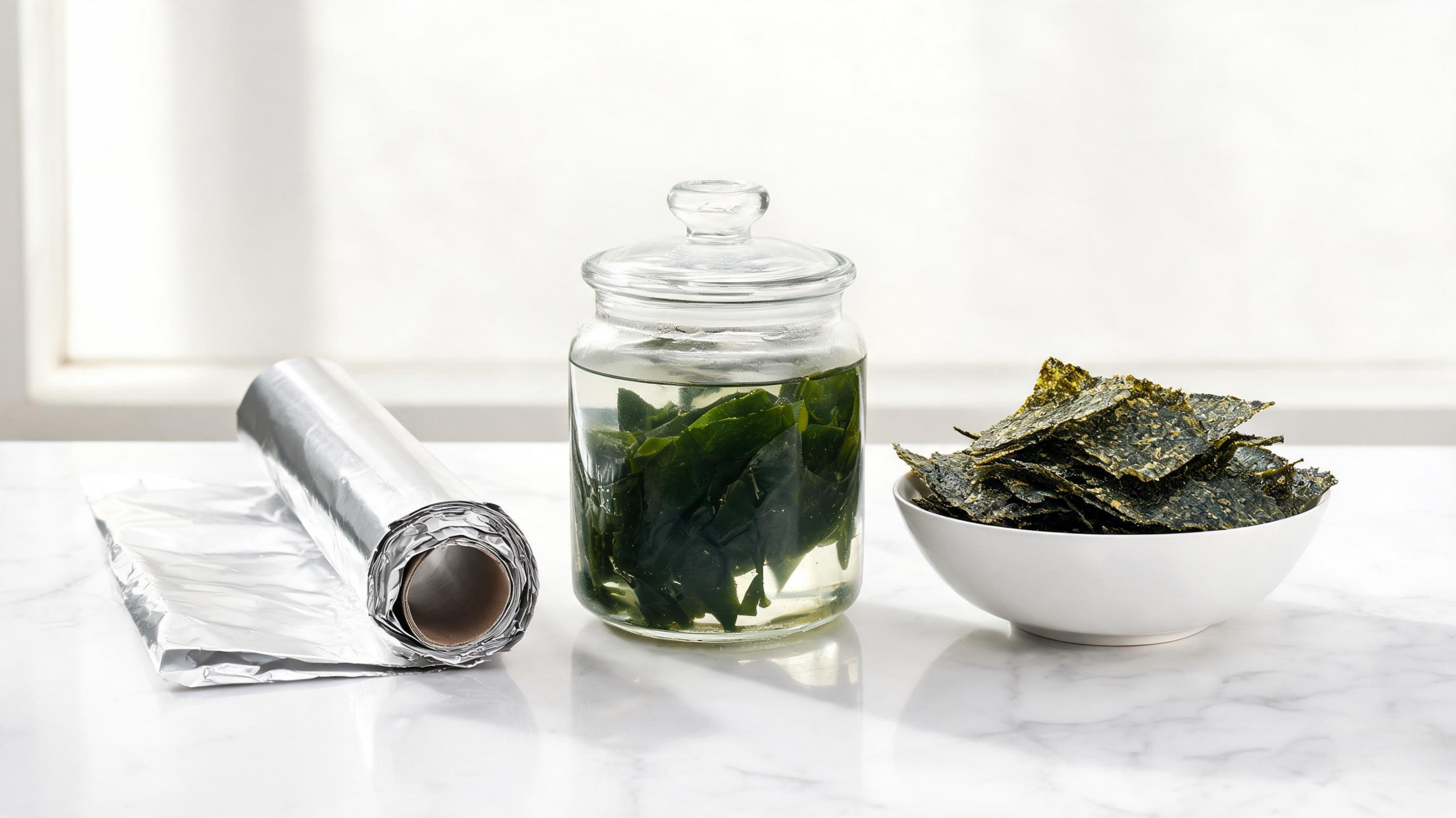
Wakame, the tender brown seaweed prized in kitchens from East Asia to California, has a flavor problem. Between the moment it leaves the water and the moment it reaches a consumer’s fork, this nutrient-rich alga can drift from bright and briny to fishy, rancid, and dull. That drift is more than a nuisance; it is one of the main reasons ready-to-eat wakame products struggle on store shelves. A new open-access study published in the journal Blue Biotechnology has now mapped, molecule by molecule, exactly how pickling routines and packaging choices sculpt the aroma and taste of ready-to-eat wakame, and the results point to a surprisingly simple conclusion: how you season and wrap seaweed matters as much as the seaweed itself.
The research team, led by Si-Jia Lin and corresponding author Xu-Hui Huang of Dalian Polytechnic University in China, set out to identify the volatile compounds responsible for both the beloved and the objectionable notes in wakame, and then to track how those compounds respond to two commercial levers: progressive pickling and packaging material. China produced 206,100 tons of wakame in 2022, and global output has climbed steadily since 2012, so even small improvements in flavor retention carry substantial commercial weight. The team’s central question was whether the off-odors that plague the industry could be tamed through processing rather than through additives or breeding.
To do this, the researchers combined classical sensory evaluation with an arsenal of instrumental techniques. Gas chromatography-mass spectrometry revealed 55 volatile compounds in the samples, including 19 aldehydes, 10 alcohols, 6 ketones, 5 acids, and 4 esters. Aldehydes, with their characteristically low odor thresholds, emerged as the dominant contributors to wakame’s smell, accounting for 35.2 percent of the volatile profile, followed by alcohols at 16.6 percent and ketones at 13.1 percent. Using odor activity values, a metric that weighs a compound’s concentration against the concentration at which humans can detect it, the team narrowed the field to 18 decisive odorants. Among these were hexanal, (E)-2-nonenal, (E)-2-decenal, beta-cyclocitral, caryophyllene, and 1-octen-3-one, each imparting everything from grassy and oily notes to floral, fruity, earthy, and mushroom-like character.
The experimental design was rigorous. Ready-to-eat wakame supplied by a commercial producer in Liaoning was washed, desalted, blanched at 90 degrees Celsius for two minutes to protect color, and then subjected to two sequential seasoning steps: a first pickling at 10 degrees Celsius for two hours in a 4 percent salinity solution, and a second pickling for half an hour at 0.5 percent salinity. Samples were then sealed either in aluminum foil bags or in polyethylene terephthalate, or PET, casings, sterilized, and stored at 4 degrees Celsius. Six sample categories captured the full matrix of two packaging types across three processing stages. Thirty trained panelists scored smell, taste, color, and texture, while an electronic nose fitted with ten metal oxide semiconductor sensors and an electronic tongue capable of distinguishing 25 taste scales provided objective corroboration.
The sensory and colorimetric data told a nuanced story about salt. Proper pickling turned wakame greener, a effect the researchers attribute to chlorophyll forming more stable complexes with metal ions such as sodium from sodium chloride. Elevated salt also suppresses enzymatic activity and microbial growth by lowering water activity, slowing the oxidation reactions that generate stale aromas. But there is a tipping point. The second pickling round damaged pigment, darkened color, and softened texture, with hardness dropping significantly after the first seasoning and gumminess falling significantly after the second. The lesson, the authors suggest, is that moderate salinity preserves quality while excessive salinity destroys it, a balance producers must strike carefully.
On taste, the electronic tongue revealed that progressive pickling reduced bitterness, a trait traced to mannitol, algin, bitter amino acids, and bitter peptides in the seaweed. As salt levels rose, bitter amino acid content fell, and panelists’ umami, sweet, and salty scores climbed. The electronic nose, meanwhile, recorded rising responses from sensors sensitive to nitrogen oxides and sulfur compounds, reflecting the way salt disrupts cell structures and releases nitrogenous material. Panelists noted declining fishy, rancid, and overripe aromas as pickling progressed, and principal component analysis separated the samples almost perfectly, with cumulative contribution rates of 99.72 percent for odor and 99.66 percent for taste.
The quantitative volatile data were even more striking. After progressive pickling, the content of beta-cyclocitral, a signature algae-derived odorant, surged from 2.52 to 485.42 nanograms per gram, while caryophyllene, a pleasantly floral and fruity sesquiterpene, rose from 1.35 to 578.05 nanograms per gram. These increases enriched wakame’s characteristic marine aroma and helped mask off-notes. Simultaneously, the levels of undesirable compounds declined: 1-octen-3-one, an earthy, metallic ketone formed by oxidation of unsaturated fatty acids, dropped from 641.4 to 371.5 nanograms per gram in aluminum foil packages and from 725.66 to 459.08 nanograms per gram in PET, while fishy (E)-2-nonenal in foil-packaged wakame fell from 11 to 3.21 nanograms per gram.
Packaging proved to be the quiet hero of the study. Aluminum foil, with its low permeability to gases and water vapor and its complete opacity to light, preserved more of the volatile compounds that make wakame appealing while blocking the migration of oxidation-promoting substances into the food. Foil-packaged wakame retained higher hardness, stickiness, and resilience, showed greener color, and contained compounds such as (E,E)-2,4-heptadienal, 1-heptanol, and (E)-3-hexen-1-ol that were undetectable in the PET samples. Beta-cyclocitral levels in foil-packaged wakame reached 485.42 nanograms per gram compared with just 128.67 nanograms per gram in PET. In total, foil-packaged samples after double seasoning contained 16 key odorants against 14 in their PET counterparts, and panelists judged the foil samples more aromatic and less fishy.
To verify that these 18 compounds truly drive wakame’s aroma, the team built six aroma recombination models by adding the key odorants at their measured concentrations to an odorless wakame matrix, and then performed omission tests in which single compounds were removed and 15 panelists ran triangle tests to detect the difference. In freshly processed samples, removing hexanal, (E)-2-nonenal, (E)-2-decenal, or 1-octen-3-one produced significant to highly significant perception changes, confirming their importance. After pickling, beta-cyclocitral became the standout, while compound interactions grew so complex that individual omissions became harder to detect, a phenomenon the authors attribute to synergies among the expanding roster of odorants.
The practical implications are immediate for a global seaweed industry seeking to convert health-conscious consumers into repeat buyers. Choose packaging that blocks oxygen, moisture, and light; calibrate salt levels to stabilize pigment and suppress microbes without wrecking texture; and accept that progressive seasoning, done judiciously, can flip wakame’s chemistry from off-odor generator to flavor enhancer. As seaweed moves from niche health food to mainstream sustainable protein source, studies like this one show that flavor is not an accident of nature but a controllable outcome of engineering, one aluminum foil bag at a time.
Beyond the headline findings, the study’s methodology offers a window into how modern flavor science increasingly operates. By pairing trained human panels with electronic nose and electronic tongue instruments, the researchers followed a growing trend in food analysis sometimes called sensory omics, in which machine-based readings are calibrated against human perception to produce reproducible, quantifiable flavor fingerprints. This dual approach helps offset the subjectivity and fatigue inherent in panel work, since each taster in the study fasted for three hours beforehand and evaluated samples in isolated compartments under controlled lighting and temperature.
The findings also sit within a broader body of research on seaweed preservation. Earlier work on kelp showed that higher salt concentrations and lower temperatures reduce alginate lyase activity, an enzyme that degrades cell wall polysaccharides and accelerates quality loss. Comparable strategies, including the combination of natural antioxidants with fermentation to remove fishiness from fresh kelp, have been reported by other Chinese research groups, suggesting that salt-mediated enzyme inhibition is a recurring theme across brown algae processing.
Priorities for future work follow naturally from these results. Because plastic packaging can permit oxygen and moisture migration that drives oxidation, comparative studies of barrier materials, including glass, multilayer films, and foil laminates, may refine packaging recommendations further. Extending shelf-life trials beyond laboratory storage to real distribution conditions, and testing whether the same pickling thresholds hold for other commercially farmed seaweeds, would help translate this molecular map into industry-wide standards for one of the world’s fastest-growing aquaculture sectors.
Subject of Research: How pickling methods and packaging materials affect the flavor quality of ready-to-eat wakame
Article Title: Effect of pickling and packaging difference on characteristic flavor quality of ready-to-eat wakame
Article References: Lin, S.-J., Zhang, T.-T., Guo, Y., Zhang, K., Qin, L., & Huang, X.-H. (2026). Effect of pickling and packaging difference on characteristic flavor quality of ready-to-eat wakame. Blue Biotechnology, 3(1), Article 8. https://doi.org/10.1186/s44315-026-00059-9
Image Credits: AI Generated
DOI: 10.1186/s44315-026-00059-9
Keywords: wakame, pickling, flavor, volatile compounds, aluminum foil, PET packaging, seaweed, beta-cyclocitral, caryophyllene, off-odor, electronic nose, food quality
Cite Scienmag News
Drew Townsend. (September 10, 2026). Aluminum Foil and Careful Pickling Hold the Key to Better-Tasting Seaweed Snacks. Scienmag. https://scienmag.com/aluminum-foil-and-careful-pickling-hold-the-key-to-better-tasting-seaweed-snacks/
Drew Townsend. "Aluminum Foil and Careful Pickling Hold the Key to Better-Tasting Seaweed Snacks." Scienmag, 10 September 2026, https://scienmag.com/aluminum-foil-and-careful-pickling-hold-the-key-to-better-tasting-seaweed-snacks/. Accessed 10 September 2026.
Drew Townsend. "Aluminum Foil and Careful Pickling Hold the Key to Better-Tasting Seaweed Snacks." Scienmag. September 10, 2026. https://scienmag.com/aluminum-foil-and-careful-pickling-hold-the-key-to-better-tasting-seaweed-snacks/


