


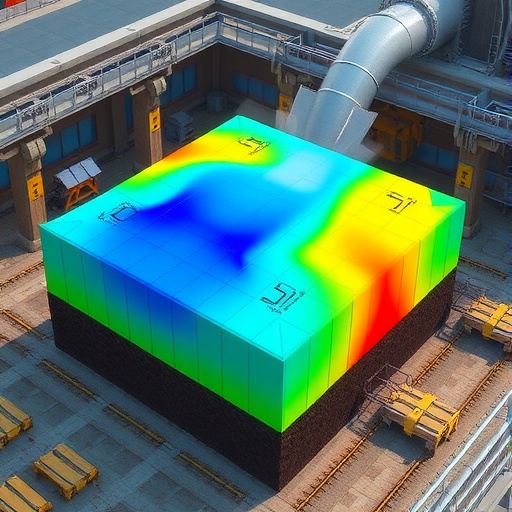
When the magnitude 9.1 Tohoku earthquake struck off the coast of Japan on March 11, 2011, the instruments embedded deep within the Fukushima nuclear power plants recorded something extraordinary: a dense, building-by-building portrait of how a massive, deeply buried structure actually responds when the ground beneath it lurches. More than a decade later, an international team of engineers has mined those recordings to answer a question that has quietly worried seismic designers for years: are the simplified code formulas we use to predict floor shaking inside critical facilities actually trustworthy? The answer, published in the Bulletin of Earthquake Engineering, is a cautious but revealing no—and the study offers a new, observationally grounded way to fix the problem.
The research, led by Yakub Adeyemi Muniru, Elia Voyagaki, Agathoklis Giaralis and Tadahiro Kishida, focuses on Peak Floor Acceleration, or PFA, the maximum acceleration experienced at a given level within a structure during an earthquake. PFA matters enormously because the components most likely to fail in a nuclear plant during shaking are not the reinforced concrete walls but the nonstructural systems attached to them: electrical cabinets housing the switches and relays that allow a plant to shut down safely, piping supports, and other acceleration-sensitive hardware. Engineers typically estimate the force on such components as the product of their mass and the peak acceleration at their location, which makes accurate PFA prediction the linchpin of nonstructural seismic design. In a nuclear power plant, getting it wrong in either direction carries a cost—underestimate the shaking and safety systems may fail; overestimate it and designs become needlessly expensive.
The complication is that nuclear plants are not ordinary buildings. Reactor structures are typically embedded 10 to 30 meters into the ground—between 20 and 40 percent of their height—which means the soil surrounding and supporting them fundamentally alters both the intensity and the frequency character of the shaking that reaches the structure. This phenomenon, soil–structure interaction (SSI), is largely ignored by the simplified amplification-factor approaches found in modern seismic codes, which multiply the free-field peak ground acceleration by a height-dependent factor assumed to be independent of the frequency content of the incoming motion. For ordinary low-rise buildings on shallow foundations this shortcut is tolerable. For a structure whose foundation sits twelve meters below grade on stiff rock, the earth itself filters and modifies the motion before the building ever feels it.
To quantify just how far the codes drift from reality, the team turned to an unusually rich dataset: 74 horizontal acceleration time histories recorded at the Fukushima No. 1 and No. 2 nuclear power plants during the 2011 Tohoku earthquake, captured by 96 triaxial accelerometers distributed across the buildings, their foundations, and adjacent geotechnical downhole arrays. The records are remarkable in their intensity. At Fukushima No. 1, peak acceleration reached 0.54 g in the free field and 0.85 g at the structure; at Fukushima No. 2, the free field recorded 0.4 g while the roof surged to 1.36 g—meaning the building amplified ground motion more than threefold at its highest level. Strong shaking lasted roughly 110 seconds, with the P-wave arriving at 35 seconds and the destructive S-wave at about 90 seconds. The structures themselves rise about 66 meters above ground with embedment depths of 12 to 13 meters, founded on rock with a shear wave velocity of roughly 470 meters per second.
The first stage of the analysis benchmarked three code-based prediction approaches against the recorded PFAs at 22 instrumented locations in two horizontal directions. The results exposed a systematic, and somewhat uncomfortable, spread. FEMA P-58 and Eurocode 8 overpredicted horizontal floor accelerations by about 20 percent on average, while the NEHRP 2020 provisions and ASCE 7-22 underpredicted them by about 12 percent. All biases fell within a ±16 percent envelope—respectable for ordinary buildings, the authors note, but hardly reassuring for facilities where the margin between safe shutdown and catastrophic component failure is measured in fractions of a g. Critically, none of these formulas account for either SSI or the frequency content of the incoming ground motion, two effects the Fukushima data show to be deeply intertwined.
The researchers then built a more rigorous framework around random vibration analysis, a frequency-domain technique that computes structural response by combining the Fourier amplitude spectrum of the ground motion with transfer functions describing how the foundation and the structure modify motion at each frequency, together with the root-mean-square duration of the shaking. Their most striking finding concerned the SSI transfer functions themselves. When derived purely from theory—classical analytical models for base-slab averaging and embedment effects, of the kind developed by Mylonakis and colleagues—the transfer functions badly mismatched the data. The empirical, data-derived transfer functions extracted from the Fukushima records began attenuating high frequencies above roughly 0.9 Hz, while the analytical models did not begin their decline until about 2 Hz. Using the unmodified analytical functions led to a substantial 27 percent overprediction of floor accelerations across the board.
The solution was elegantly pragmatic. The team introduced two calibration coefficients, alpha and beta, into the classical analytical formulations—coefficients that govern, respectively, the corner frequency at which the SSI transfer function starts to decay and the constant level it settles to at high frequencies. Rather than deriving these coefficients from first principles or measurable soil properties alone, the researchers calibrated them against the empirical transfer functions computed from thirteen foundation-level recording locations at the two plants. When the recalibrated analytical transfer functions were fed back into the random vibration analysis, prediction errors collapsed to under 1 percent on average, with all predicted values falling within ±20 percent of observations. The data, in other words, can breathe new accuracy into the physics-based models without abandoning their mathematical structure—a middle path between purely theoretical and purely statistical approaches.
Equally important was discovering what does not matter. The team found that faithfully modeling frequencies above 10 Hz was unnecessary, because coherence analysis showed the free-field and foundation recordings were essentially uncorrelated in that band; signals above 10 Hz could be discarded with negligible penalty. Variations in ground-motion duration also proved far less influential than expected: even when durations derived from free-field records were used in place of in-structure durations—differences of up to 23 percent—PFA predictions shifted by only about 3 percent. The SSI transfer function, by contrast, dominated the error budget. For the Fukushima records, modelling the soil’s filtering effect accurately mattered far more than any other refinement in the analysis chain.
The final phase of the study pushed beyond the single Tohoku event. Using point-source stochastic ground motion simulations for hypothetical sites in stable continental regions, spanning magnitudes from 3 to 7.5 and source distances from 1 to 300 kilometers, the researchers ran a parametric study exploring how SSI interacts with kappa, the regional parameter that controls high-frequency amplitude decay in ground motions. The results revealed a strong coupling: SSI effects could modify floor accelerations by factors between 0.2 and 0.8, with the magnitude of that modification depending systematically on earthquake size and the regional kappa value. High-frequency attenuation and soil–structure interaction are not independent contributors to structural demand but locked together in a feedback that no code-based formula currently captures. A plant sitting on geology that strips high frequencies quickly will experience SSI filtering very differently from one on hard, high-kappa rock, even if the two structures are otherwise identical.
The implications ripple outward from Fukushima. Nuclear plants across seismically active regions were designed using exactly the simplified approaches this study has now quantified, and many house deeply embedded structures where SSI effects are at their strongest. The authors are careful to state the limits of their evidence: the quantitative biases they report derive from a single enormous earthquake at two sites with similar geology and structure, so the numbers apply strictly to that class of event and foundation. But the qualitative conclusions—that SSI transfer functions must be constrained by observation, that classical analytical models overstate high-frequency transmission for embedded structures, and that code biases of up to 20 percent lurk in standard practice—are expected to generalize broadly. For the engineers responsible for ensuring that electrical cabinets keep their relays closed and cooling pumps stay coupled to their piping during the next great quake, the message from the Fukushima records is clear: the ground beneath a critical facility is not a passive bystander in its seismic performance, and only by listening to what real earthquakes tell us about that soil can we predict—and prevent—the failures that matter most.
Cite Scienmag News
Violet Maxwell. (September 7, 2026). Soil-structure interaction effects on Fukushima reactor floor acceleration assessed. Scienmag. https://scienmag.com/soil-structure-interaction-effects-on-fukushima-reactor-floor-acceleration-assessed/
Violet Maxwell. "Soil-structure interaction effects on Fukushima reactor floor acceleration assessed." Scienmag, 7 September 2026, https://scienmag.com/soil-structure-interaction-effects-on-fukushima-reactor-floor-acceleration-assessed/. Accessed 7 September 2026.
Violet Maxwell. "Soil-structure interaction effects on Fukushima reactor floor acceleration assessed." Scienmag. September 7, 2026. https://scienmag.com/soil-structure-interaction-effects-on-fukushima-reactor-floor-acceleration-assessed/


