

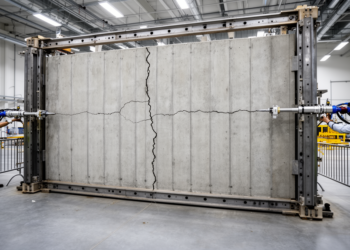
Full-scale lab tests reveal how precast concrete joints survive earthquakes
A hybrid experimental and numerical study shows that precast concrete frames with nib connections remain largely safe in moderate earthquakes ...
A hybrid experimental and numerical study shows that precast concrete frames with nib connections remain largely safe in moderate earthquakes ...

New three-dimensional simulations show that inclined pile groups grow stiffer under vertical seismic loading than vertical groups, because tilting weakens ...
A new parametric study shows that a two-to-three-meter geotechnical seismic isolation layer of rubber-soil mixtures offers the best balance of ...
A new study in the Bulletin of Earthquake Engineering shows that the choice of spatial coherency model strongly influences soil-structure ...
Researchers have developed a convergent analytical model that couples shear deformation with layered, displacement-dependent earth pressures, predicting deep excavation wall ...
A new numerical study shows that slow-moving landslides fundamentally alter the seismic response of pile-supported bridge piers, underscoring the need ...
New direct shear experiments show that water immersion strips up to 35 percent of the bond strength between polymer-stabilized soil ...
A new probabilistic study shows that flood scour can leave bridge pile-group foundations with an 82 percent likelihood of seismically ...
Ring shear testing quantifies how peak and residual interface strength develop between concrete and cement-treated soil in composite foundation piles, ...
When the magnitude 9.1 Tohoku earthquake struck off the coast of Japan on March 11, 2011, the instruments embedded deep ...

Embark on a thrilling journey of discovery with Scienmag.com—your ultimate source for cutting-edge breakthroughs. Immerse yourself in a world where curiosity knows no limits and tomorrow’s possibilities become today’s reality!