


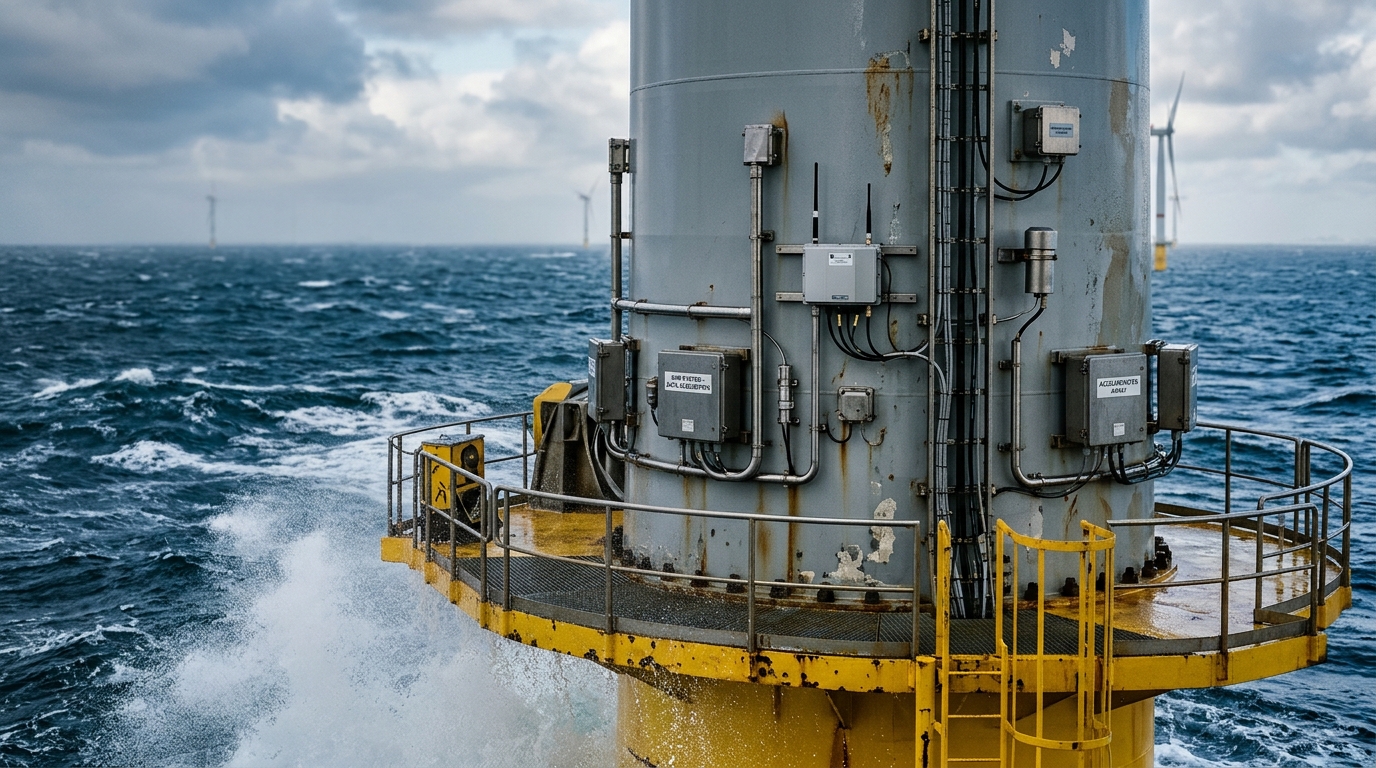
Offshore wind turbines operate at the edge of their mechanical limits, battered by wind, waves, and corrosive salt air while quietly accumulating the fatigue damage that could one day bring them down. A team of French researchers has now unveiled a new computational method that lets engineers calibrate the physics-based digital models of these massive structures directly from real sensor data, even when that data is noisy and the models themselves are crude. The work, published in Advanced Modeling and Simulation in Engineering Sciences, extends a mathematical framework known as the modified Constitutive Relation Error, or mCRE, into the multi-physics world of offshore wind energy for what the authors describe as the first application of this concept to complex coupled problems beyond acoustics.
The challenge that motivated the study is familiar to anyone tracking the rapid growth of offshore wind. Turbines have grown steadily in size and capacity over the last decade, now representing roughly 15 percent of low-carbon electrical power generation sources, and their higher productivity potential compared to onshore machines comes from stronger and steadier winds at sea. But performing at efficiency limits with ever-increasing size means more severe loadings, and sudden structural failure can occur as fatigue damage accumulates. Classical visual inspection is difficult, costly, and insufficient in such a harsh environment, so operators increasingly rely on onboard sensing and numerical modeling to understand structural behavior and make safe maintenance decisions through customized digital twins.
Existing approaches to model calibration each carry drawbacks. Purely data-driven methods built on statistics and machine learning demand large amounts of data and produce black-box models lacking interpretability and extrapolation capability. High-fidelity physics-based simulations are computationally expensive and prone to modeling error when built on overly conservative hypotheses. Hybrid strategies that combine the consistency of physics with enrichment from sensor data have gained popularity as a convenient trade-off in reliability, cost, and robustness, and the mCRE approach belongs to this third category.
The mCRE concept, initiated in earlier work by some of the same community, works by splitting all a priori knowledge about an engineering problem into two parts. The reliable part, such as balance equations and sensor locations, is strongly enforced and defines an admissibility space for the mechanical fields being sought. The uncertain part, including constitutive laws, boundary conditions, and measured data values, is released and satisfied only at best, which naturally accounts for model bias and measurement noise. The method then minimizes an energy-based functional through an iterative two-step process: a localization step that finds optimal admissible mechanical fields for fixed parameters, followed by a correction step that updates parameters via gradient descent with the fields held fixed. Confidence intervals on identified values can be recovered through post-processing of the Hessian matrix.
What makes the new contribution significant is the extension of this framework to multi-physics offshore wind modeling. The researchers, Antoine Roussel, Ludovic Chamoin, Jean-Philippe Argaud, and Pierre Bousseau, treat each fluid-structure interaction interface as a specific and potentially nonlinear constitutive relation that is assumed unreliable and relaxed during identification, with a suited error metric attached. In their idealized representation, aerodynamic loading from the rotor is modeled with a Bernoulli-type drag law applied at the tower top, while hydrodynamic loading from waves and current on the cylindrical foundation follows the Morison law. The coefficients governing these laws, along with structural connection and soil stiffness parameters, become the uncertain quantities to be calibrated.
The physical model itself follows industrial standard practice: a steel soft-stiff tower on a concrete gravity-based substructure, discretized as a 3D Timoshenko beam finite element model in the frequency dynamics regime. Wind velocity is treated as stationary with an exponential spatial profile, and wave kinematics follows first-order Airy theory computed from a discretized JONSWAP spectrum. Only mean wind speeds over intervals of several minutes are considered, which the authors note is sufficient for the final objective of calibrating the thrust coefficient. The overall list of interaction coefficients feeding the calibration includes the aerodynamic thrust coefficient, hydrodynamic drag and mass coefficients, a connection stiffness, and a soil rotational stiffness, all of which may evolve over the operating period and vary between structures and sites.
Before touching real data, the team validated the framework on academic examples with synthetic data generated from the direct model with known reference parameters, adding random Gaussian noise to outputs evaluated at five virtual inclinometers. Three calibration cases were tested. In the first, calibrating only the hydrodynamic mass coefficient, the process starting from an initial guess of 0.5 converged to a final value of 1.0391 against a reference of 1, in five iterations under 5 percent noise. In the second, calibrating the aerodynamic thrust coefficient from an initial guess of 0.05, the method converged to 0.0951 against a reference of 0.1, again in five iterations. A third case simultaneously calibrated five parameters spanning equipment mass, Rayleigh damping properties, soil stiffness, and the hydrodynamic mass coefficient, revealing that the dominant calibration parameters in the structural response were the soil stiffness and the hydrodynamic mass coefficient, with the minimum of the functional centered around the reference values.
The real test came with in situ measurements from an industrial demonstrator located off the coast of the United Kingdom, a soft-stiff turbine rated at 8.6 megawatts with a rotor speed of 10.5 revolutions per minute. The dataset comprises 4 terabytes of operation data, more than 95 percent of it high-frequency inclinometer data, supplemented by a wave buoy, a nacelle-mounted met mast with anemometer, 35 strain gauges sampling at 200 hertz, and SCADA operational records. The researchers calibrated the model using two specific frequency peaks: the continuous component of the fore-aft response tied to averaged wind loading, and the first side-side mode between 0.15 and 0.3 hertz tied to wave loading. Careful directional arrangement of the sensors allowed wind and wave responses to be decoupled, isolating the wave signal from parasitic effects such as turbine harmonics and tower shadow.
The hydrodynamic calibration applied the process independently to 27 individual 30-minute data sequences, each run starting from 10 distinct initial parameter guesses and completing within a few seconds thanks to the simplicity of the model. The connection stiffness calibrated smoothly to a normalized value of 0.73 across sequences, while the hydrodynamic mass coefficient showed marked variability across sea states, pointing to dependencies not captured by the semi-empirical Morison law, which was originally formulated for sinusoidal current-induced loading rather than wave-induced loading. The soil stiffness proved sensitive to initial guesses, suggesting the selected data did not sufficiently activate that parameter. Averaging over the six most reliable sequences yielded final normalized values of 0.2 for soil stiffness, 0.73 for connection stiffness, and 1.85 for the hydrodynamic mass coefficient, and the natural frequency of the calibrated model was verified to match the frequency observed in longer time samples from the data.
The framework also demonstrated a built-in model selection capability by comparing two competing representations of the connection between the foundation caisson and the steel shaft, one using rigid elements and one adding a local stiffness term. Both models identified the same hydrodynamic loading, but the difference in optimized mCRE values was approximately constant across all sequences with lower values for the second model, which the authors interpret as strong evidence that it better captures the physics in the available data. On the aerodynamic side, the team calibrated the thrust coefficient from 312 ten-minute sequences and constructed an in situ thrust curve that closely matched the supplier-provided curve, though with a slight upward offset at medium to high wind speeds suggesting the turbine may experience slightly higher thrust loads than design specifications anticipate. The authors caution that this emerging trend requires longer-term and more stable analyses to confirm, noting that the supplier curve was not obtained with the same turbine and structure and lacks data points. The datasets analyzed in the study are not publicly available due to commercial and industrial interests, though some may be available from the corresponding author on reasonable request.
Subject of Research: A robust multi-physics model calibration method for offshore wind turbines using the modified constitutive relation error concept with in situ sensor data
Article Title: An extension of the modified constitutive relation error concept for the robust multi-physics offshore wind turbine model calibration from in situ data
Article References: Roussel, A., Chamoin, L., Argaud, J.-P., & Bousseau, P. (2026). An extension of the modified constitutive relation error concept for the robust multi-physics offshore wind turbine model calibration from in situ data. Advanced Modeling and Simulation in Engineering Sciences, 13(1), Article 2. https://doi.org/10.1186/s40323-026-00319-8
Image Credits: AI Generated
DOI: 10.1186/s40323-026-00319-8
Keywords: offshore wind turbines, model calibration, constitutive relation error, digital twin, structural health monitoring, fluid-structure interaction, data assimilation, thrust coefficient, hydrodynamic loading, soil-structure interaction, inverse problems, sensor data
Cite Scienmag News
Faith Mcneil. (November 6, 2026). Calibrating Offshore Wind Turbine Models from Real-World Sensor Data. Scienmag. https://scienmag.com/calibrating-offshore-wind-turbine-models-from-real-world-sensor-data/
Faith Mcneil. "Calibrating Offshore Wind Turbine Models from Real-World Sensor Data." Scienmag, 6 November 2026, https://scienmag.com/calibrating-offshore-wind-turbine-models-from-real-world-sensor-data/. Accessed 20 November 2026.
Faith Mcneil. "Calibrating Offshore Wind Turbine Models from Real-World Sensor Data." Scienmag. November 6, 2026. https://scienmag.com/calibrating-offshore-wind-turbine-models-from-real-world-sensor-data/




