


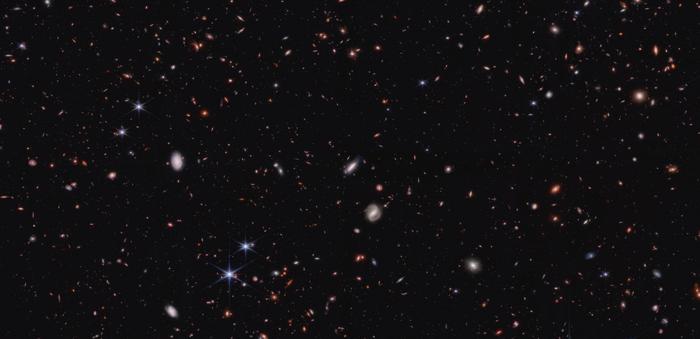
When astronomers got their first glimpses of galaxies in the early universe from NASA’s James Webb Space Telescope, they were expecting to find galactic pipsqueaks, but instead they found what appeared to be a bevy of Olympic bodybuilders. Some galaxies appeared to have grown so massive, so quickly, that simulations couldn’t account for them. Some researchers suggested this meant that something might be wrong with the theory that explains what the universe is made of and how it has evolved since the big bang, known as the standard model of cosmology.

Credit: NASA, ESA, CSA, S. Finkelstein (University of Texas)
When astronomers got their first glimpses of galaxies in the early universe from NASA’s James Webb Space Telescope, they were expecting to find galactic pipsqueaks, but instead they found what appeared to be a bevy of Olympic bodybuilders. Some galaxies appeared to have grown so massive, so quickly, that simulations couldn’t account for them. Some researchers suggested this meant that something might be wrong with the theory that explains what the universe is made of and how it has evolved since the big bang, known as the standard model of cosmology.
According to a new study in the Astronomical Journal led by University of Texas at Austin graduate student Katherine Chworowsky, some of those early galaxies are in fact much less massive than they first appeared. Black holes in some of these galaxies make them appear much brighter and bigger than they really are.
“We are still seeing more galaxies than predicted, although none of them are so massive that they ‘break’ the universe,” Chworowsky said.
The evidence was provided by Webb’s Cosmic Evolution Early Release Science (CEERS) Survey, led by Steven Finkelstein, a professor of astronomy at UT Austin and study co-author.
Black Holes Add to Brightness
According to this latest study, the galaxies that appeared overly massive likely host black holes rapidly consuming gas. Friction in the fast-moving gas emits heat and light, making these galaxies much brighter than they would be if that light emanated just from stars. This extra light can make it appear that the galaxies contain many more stars, and hence are more massive, than we would otherwise estimate. When scientists remove these galaxies, dubbed “little red dots” (based on their red color and small size), from the analysis, the remaining early galaxies are not too massive to fit within predictions of the standard model.
“So, the bottom line is there is no crisis in terms of the standard model of cosmology,” Finkelstein said. “Any time you have a theory that has stood the test of time for so long, you have to have overwhelming evidence to really throw it out. And that’s simply not the case.”
Efficient Star Factories
Although they’ve settled the main dilemma, a less thorny problem remains: There are still roughly twice as many massive galaxies in Webb’s data of the early universe than expected from the standard model. One possible reason might be that stars formed more quickly in the early universe than they do today.
“Maybe in the early universe, galaxies were better at turning gas into stars,” Chworowsky said.
Star formation happens when hot gas cools enough to succumb to gravity and condense into one or more stars. But as the gas contracts, it heats up, generating outward pressure. In our region of the universe, the balance of these opposing forces tends to make the star formation process very slow. But perhaps, according to some theories, because the early universe was denser than today, it was harder to blow gas out during star formation, allowing the process to go faster.
More Evidence of Black Holes
Concurrently, astronomers have been analyzing the spectra of “little red dots” discovered with Webb, with researchers in both the CEERS team and others finding evidence of fast-moving hydrogen gas, a signature of black hole accretion disks. This supports the idea that at least some of the light coming from these compact, red objects comes from gas swirling around black holes, rather than stars – reinforcing Chworowsky and their team’s conclusion that they are probably not as massive as astronomers initially thought. However, further observations of these intriguing objects are incoming, and should help solve the puzzle about how much light comes from stars versus gas around black holes.
Often in science, when you answer one question, that leads to new questions. While Chworowsky and their colleagues have shown that the standard model of cosmology likely isn’t broken, their work points to the need for new ideas in star formation.
“And so there is still that sense of intrigue,” Chworowsky said. “Not everything is fully understood. That’s what makes doing this kind of science fun, because it’d be a terribly boring field if one paper figured everything out, or there were no more questions to answer.”The James Webb Space Telescope is the world’s premier space science observatory. Webb is solving mysteries in our solar system, looking beyond to distant worlds around other stars, and probing the mysterious structures and origins of our universe and our place in it. Webb is an international program led by NASA with its partners, ESA (European Space Agency) and CSA (Canadian Space Agency).
Downloads
Right click any image to save it or open a larger version in a new tab/window via the browser’s popup menu.
View/Download all image products at all resolutions for this article from the Space Telescope Science Institute.
View/Download the research results from the Astronomical Journal .
Media Contacts
Laura Betz – laura.e.betz@nasa.gov, Rob Gutro – rob.gutro@nasa.gov
NASA’s Goddard Space Flight Center, Greenbelt, Md.
Marc Airhart – mairhart@austin.utexas.edu
University of Texas at Austin
Christine Pulliam – cpulliam@stsci.edu
Space Telescope Science Institute, Baltimore, Md.
Related Information
VIDEO: CEERS Fly-through data visualization
ARTICLE: Webb Science – Galaxies Through Time
INFOGRAPHIC: Learn More about black holes
VIDEO: Webb Science Snippets Video: “The Early Universe”
INFOGRAPHIC: What is Cosmological Redshift?
Journal
The Astrophysical Journal
Method of Research
News article
Article Title
Evidence for a Shallow Evolution in the Volume Densities of Massive Galaxies at z = 4–8 from CEERS
Article Publication Date
26-Aug-2024
Cite Scienmag News
Grant Pearson. (August 27, 2024). Webb finds early galaxies weren’t too big for their britches after all. Scienmag. https://scienmag.com/webb-finds-early-galaxies-werent-too-big-for-their-britches-after-all/
Grant Pearson. "Webb finds early galaxies weren’t too big for their britches after all." Scienmag, 27 August 2024, https://scienmag.com/webb-finds-early-galaxies-werent-too-big-for-their-britches-after-all/. Accessed 3 September 2026.
Grant Pearson. "Webb finds early galaxies weren’t too big for their britches after all." Scienmag. August 27, 2024. https://scienmag.com/webb-finds-early-galaxies-werent-too-big-for-their-britches-after-all/

