

Friday, May 8, 2026
Science
No Result
View All Result
  • Login
  • HOME
  • SCIENCE NEWS
  • CONTACT US
  • HOME
  • SCIENCE NEWS
  • CONTACT US
No Result
View All Result
Scienmag
No Result
View All Result
Home Science News Space

Solar panels for NASA’s Roman Space Telescope pass key tests

August 27, 2024
in Space
Reading Time: 2 mins read
0
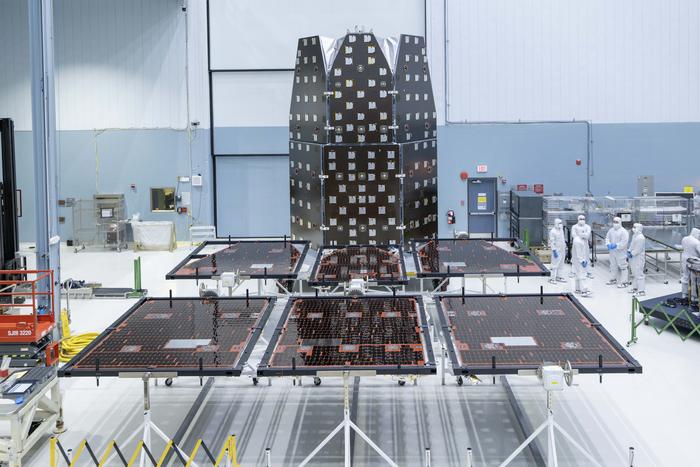
Roman Solar Panels in NASA Goddard Clean Room
67
SHARES
607
VIEWS
Share on FacebookShare on Twitter
ADVERTISEMENT

NASA’s Nancy Grace Roman Space Telescope’s Solar Array Sun Shield has successfully completed recent tests, signaling that the assembly is on track to be completed on schedule. The panels are designed to power and shade the observatory, enabling all the mission’s observations and helping keep the instruments cool.

Roman Solar Panels in NASA Goddard Clean Room

Credit: NASA/Chris Gunn

NASA’s Nancy Grace Roman Space Telescope’s Solar Array Sun Shield has successfully completed recent tests, signaling that the assembly is on track to be completed on schedule. The panels are designed to power and shade the observatory, enabling all the mission’s observations and helping keep the instruments cool.

The Roman team has two sets of these panels –– one that will fly aboard the observatory and another as a test structure, used specifically for preliminary assessments.

Engineers at NASA’s Goddard Space Flight Center in Greenbelt, Maryland, evaluated the test version in a thermal vacuum chamber, which simulates the hot and cold temperatures and low-pressure environment the flight panels will experience in space. Since the panels will be stowed for launch, the team practiced deploying them in space-like conditions.

Meanwhile, a vendor built up the flight version by fitting the panels with solar cells. After delivery to Goddard, technicians tested the solar cells by flashing the panels with a bright light that simulates the Sun.

“We save a significant amount of time and money by using two versions of the panels, because we can do a lot of preliminary tests on a spare while moving further in the process with the flight version,” said Jack Marshall, the Solar Array Sun Shield lead at NASA Goddard. “It streamlines the process and also avoids risking damage to the panels that will go on the observatory, should testing reveal a flaw.”

Next spring, the flight version of the Solar Array Sun Shield will be installed on the Roman spacecraft. Then, the whole spacecraft will go through thorough testing to ensure it will hold up during launch and perform as expected in space.

To virtually tour an interactive version of the telescope, visit:


Share27Tweet17
Previous Post

Star lives and afterlives

Next Post

Webb finds early galaxies weren’t too big for their britches after all

Related Posts

Venus’ Atmosphere Pulses and Ripples: New Discoveries Revealed — Space
Space

Venus’ Atmosphere Pulses and Ripples: New Discoveries Revealed

May 8, 2026
Innovative Predictive Models Assess Plant Extinction Risks Amid Climate Change — Space
Space

Innovative Predictive Models Assess Plant Extinction Risks Amid Climate Change

May 7, 2026
HKU Research Team to Create Short-Wavelength Infrared Spectrometer for China’s Tianwen-3 Mission, Enhancing the Hunt for Martian Life — Space
Space

HKU Research Team to Create Short-Wavelength Infrared Spectrometer for China’s Tianwen-3 Mission, Enhancing the Hunt for Martian Life

May 7, 2026
Giant Black Holes Formed in Dense Star Clusters Through Multiple Violent Mergers, Study Reveals — Space
Space

Giant Black Holes Formed in Dense Star Clusters Through Multiple Violent Mergers, Study Reveals

May 7, 2026
Sharper View of the Universe Revealed Through Supernova Light — Space
Space

Sharper View of the Universe Revealed Through Supernova Light

May 6, 2026
UMass Amherst Astronomer Explores Stellar Nurseries Where Stars Are Born — Space
Space

UMass Amherst Astronomer Explores Stellar Nurseries Where Stars Are Born

May 6, 2026
Next Post
Image A : CEERS Deep Field (NIRCam)

Webb finds early galaxies weren’t too big for their britches after all

  • Mothers who receive childcare support from maternal grandparents show more parental warmth, finds NTU Singapore study

    Mothers who receive childcare support from maternal grandparents show more parental warmth, finds NTU Singapore study

    27641 shares
    Share 11053 Tweet 6908
  • University of Seville Breaks 120-Year-Old Mystery, Revises a Key Einstein Concept

    1044 shares
    Share 418 Tweet 261
  • Bee body mass, pathogens and local climate influence heat tolerance

    678 shares
    Share 271 Tweet 170
  • Researchers record first-ever images and data of a shark experiencing a boat strike

    541 shares
    Share 216 Tweet 135
  • Groundbreaking Clinical Trial Reveals Lubiprostone Enhances Kidney Function

    527 shares
    Share 211 Tweet 132
Science

Embark on a thrilling journey of discovery with Scienmag.com—your ultimate source for cutting-edge breakthroughs. Immerse yourself in a world where curiosity knows no limits and tomorrow’s possibilities become today’s reality!

RECENT NEWS

  • Advancing Artificial Muscles Capable of Bending and Twisting on Demand
  • Advancing Chronic Kidney Disease Management: Clinical Decision Support Tools in Primary Care
  • Research Uncovers Motivations Behind Older Adults’ Use of Cannabis Edibles
  • Physician-Evaluated Safety of AI-Generated Hospital Course Summaries

Categories

  • Agriculture
  • Anthropology
  • Archaeology
  • Athmospheric
  • Biology
  • Biotechnology
  • Blog
  • Bussines
  • Cancer
  • Chemistry
  • Climate
  • Earth Science
  • Editorial Policy
  • Marine
  • Mathematics
  • Medicine
  • Pediatry
  • Policy
  • Psychology & Psychiatry
  • Science Education
  • Social Science
  • Space
  • Technology and Engineering

Subscribe to Blog via Email

Enter your email address to subscribe to this blog and receive notifications of new posts by email.

Join 5,146 other subscribers

© 2025 Scienmag - Science Magazine

Welcome Back!

Login to your account below

Forgotten Password?

Retrieve your password

Please enter your username or email address to reset your password.

Log In
No Result
View All Result
  • HOME
  • SCIENCE NEWS
  • CONTACT US

© 2025 Scienmag - Science Magazine

Discover more from Science

Subscribe now to keep reading and get access to the full archive.

Continue reading
