


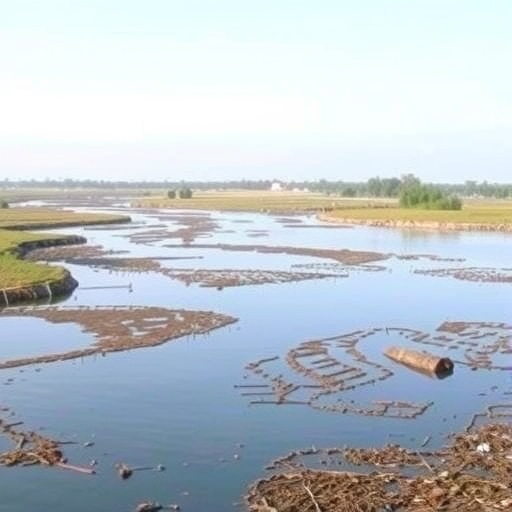
In a village in India’s Kaveri Delta, two paddy farmers live a few kilometres apart on land with identical soils, topography and rainfall. Yet one watches his saplings yellow and die while the other runs his tubewell around the clock and shares fresh water with his neighbours. The difference between them is invisible from the surface: it lies in the salt content of the groundwater beneath their feet. New research published in Hydrogeology Journal shows that this hidden hydrogeological divide is quietly rewriting the caste hierarchy of an entire delta, in ways that neither government statistics nor conventional equity research has captured.
The study, conducted by Tanvi Agrawal of Wageningen University & Research and the Ashoka Trust for Research in Ecology and the Environment, combines political ecology with the emerging interdisciplinary field of socio-hydrogeology. Working in a pseudonymised deltaic village of 672 households, Agrawal spent four periods between September 2023 and May 2024 living among farmers, conducting 103 semi-structured interviews with villagers and 21 with government officials across four administrative levels. Alongside this qualitative work, she carried out a census of 120 agricultural tubewells, measured electrical conductivity in 69 wells as a proxy for salinity, and monitored static groundwater levels in the pre- and post-monsoon seasons. The data were mapped in QGIS and overlaid with caste-wise land operation records drawn from a state agricultural subsidy scheme.
The hydrogeological findings are striking. The village sits in a transition zone between fresh and saline groundwater, roughly 40 kilometres from the coast, where salinity arises from seawater intrusion, geogenic sources and agricultural return flows concentrated by decades of pumping and chemical farming. Farmers, who have no official drilling profiles to consult, have built detailed mental maps of the subsurface from decades of watching sediments extracted during tubewell drilling: 3 to 15 metres of clay, sometimes thin layers of red soil, lime-rich silty clay or gravel, then a thick productive sand layer. They typically drill to 61 metres, below which they know a salty clay layer awaits. Their recall of lithology, validated by the study’s measurements, proved more accurate than the state’s sparse monitoring network, which recorded only about 60 tubewells against the 110-plus actually functioning in the village.
The history of the village’s wells tells a story of chronic resource decline. Irrigation tubewells arrived in 1960 and proliferated in the 1970s, spurred by subsidised electricity that reached the village in 1985. Thirty-metre wells pumped with 5-horsepower monoblock motors at first sufficed, but as water levels fell, farmers dug 3-to-6-metre pits around their wells to lower the pumps. By the early 2000s even that failed, and farmers abandoned 45 shallow wells for 75 new ones drilled 61 metres deep to accommodate submersible pumps of up to 10 horsepower. Farmers’ own salinity measurements chart the deterioration: one reported readings rising from 1,600 microsiemens per centimetre in 1995 to 3,000 by the study period, with salinity arriving in his area around 2013. Paddy, sensitive to salt above roughly 1,800 microsiemens per centimetre, fails under such water; most farmers in the village abandon non-monsoon cultivation once salinity exceeds 2,500.
The social analysis reveals something unexpected. The village’s three main agrarian caste groups occupy distinct socio-economic positions: the Naidus, the dominant landowning elite with holdings of 2 to 10 hectares or more; the Kallars, the middle cultivating caste operating smaller plots of 1 to 4 hectares; and the Pallars, a Dalit community, most of whom hold marginal plots under one hectare or work as landless labourers. Historically, upper castes controlled the best resources, and groundwater decline has been shown elsewhere to reproduce such inequities. But in this village, the emergent geography of salinisation cut across those patterns. Of the seven measured Dalit-owned tubewells, six — 86 percent — yielded fresh water, compared with only 22 of 29 measured middle-caste wells, or 76 percent. Every tubewell exceeding 3,000 microsiemens per centimetre belonged to a non-Dalit owner.
The explanation lies in timing and space, not intention. Tubewell drilling long preceded the spread of salinity, so farmers who drilled decades ago — largely the wealthier and middle castes — found themselves, somewhat unexpectedly, holding wells that had turned salty. Meanwhile, some Dalit households bought land after 2000 in areas that happened to retain fresh groundwater, sometimes with state support through schemes like the Tamil Nadu Adi Dravidar Housing and Development Corporation, which subsidised land purchase and half the cost of a 64-metre well. One Dalit farmer whose father was landless now owns five acres, pumps water at 1,070 microsiemens per centimetre, harvests two or three paddy crops a year and sends his sons to engineering college. By contrast, a middle-caste farmer on the salty side of the village, whose well registers 4,000 microsiemens even in October, has endured repeated harvest failures, mounting debts and a 2,100-dollar loss on a cotton experiment advised by the agricultural department. He cannot sell his land — no one will buy a farm with salt water — and shares his family’s allotted hundred days of public works employment with his wife.
The consequences ripple beyond tubewell owners. Salinisation stunts saplings, cakes white salt around plant bases, promotes algal growth that smothers seedlings and rusts pump machinery, driving up land preparation costs in a region already gripped by what researchers call a profitability crisis. Dalit tubewell owners in the freshwater zone preferentially share irrigation water with Dalit neighbours without wells and hire Dalit labourers rather than mechanical harvesters, extending the benefits of location to the wider community. Dalits make up 47 percent of farmers in the northern freshwater area but only 33 percent in the salty south-east. Over the 2010–2024 period, roughly a third of middle-caste tubewell owners lost the ability to sustain non-monsoon paddy without river water, while more than two-thirds of their Dalit counterparts retained year-round cultivation capacity.
Agrawal frames these findings through the concept of “spatialities of dispossession” — the idea that the processes and outcomes of dispossession are mediated by the spatial properties and relations of resource change itself. Dispossession here is not coercive. No one seized anyone’s well. Instead, state policy played a silent enabling role: officials in the Water Resources Department describe groundwater as a “non-sensitive” concern, government maps depict canals but not aquifers, electricity for agricultural tubewells remains free, and the agricultural engineering department carries annual drilling targets. Meanwhile the delta elite, having accumulated the profits of government-incentivised intensive agriculture since the 1960s Green Revolution, have diversified their incomes through agribusiness, rentals, remittances and urban employment, insulating them from the degradation their pumping helped create. The benefits were privatised; the costs, arriving decades later as salt, fell on those without such cushions.
The theoretical contribution is equally significant. Existing scholarship on groundwater inequity has generally documented how social hierarchies shape access to heterogeneous water resources, or how decline reinforces existing power. This study demonstrates the opposite dynamic: an emergent, spatially uneven environmental change can actively unsettle entrenched caste-class relations. Groundwater’s materiality — its invisibility, its slow degradation along a gradient rather than a single catastrophic loss, its roughly fifty-year lag between pumping and salinisation — means the dispossession it enacts escapes notice until it is too late, and cannot be attributed to individual perpetrators. Yet its spatiality, being partially independent of caste, allowed some historically marginalised farmers to leapfrog their historically privileged neighbours. Spatiality itself, the paper argues, can function as a dimension of intersectionality decoupled from caste and class.
The study has clear limitations and clear implications. The difference between Dalit and middle-caste freshwater access is not statistically significant, and the analysis is confined to a single pseudonymised village; the author deliberately prioritises qualitative, situated analysis of power reconfiguration over statistical inference, arguing that even a handful of cases can generate ripple effects across a community. But the framework travels. Agrawal suggests that similar mediations of dispossession by changing resource spatialities could operate for air pollution, cyclones, forest fires or any environmental change with uneven geography. For a delta of 7,500 square kilometres, nearly 300,000 cultivators and a million labourers across 1,843 villages — where falling water tables and rising salinity are documented delta-wide — the stakes are substantial.
What emerges is a call to take groundwater seriously as a political actor. By grounding groundwater socio-hydrogeologically — attending to its dynamic materiality, its shifting spatiality and its entanglement with policy — the research shows that the water beneath our feet is not a passive backdrop to social life but a participant in shaping who prospers and who fails. As farmers in the Kaveri Delta wait for a river that now flows for only three consecutive days even in the monsoon, the quality of what their borewells deliver may matter more than any scheme announced above ground. The study’s participatory approach, which treated farmers’ embodied knowledge of lithology and salinity as legitimate data, offers one model for making visible the hidden geographies on which rural livelihoods increasingly depend.
Cite Scienmag News
Violet Maxwell. (September 4, 2026). Groundwater extraction drives dispossession across India’s Kaveri Delta. Scienmag. https://scienmag.com/groundwater-extraction-drives-dispossession-across-indias-kaveri-delta/
Violet Maxwell. "Groundwater extraction drives dispossession across India’s Kaveri Delta." Scienmag, 4 September 2026, https://scienmag.com/groundwater-extraction-drives-dispossession-across-indias-kaveri-delta/. Accessed 4 September 2026.
Violet Maxwell. "Groundwater extraction drives dispossession across India’s Kaveri Delta." Scienmag. September 4, 2026. https://scienmag.com/groundwater-extraction-drives-dispossession-across-indias-kaveri-delta/


