


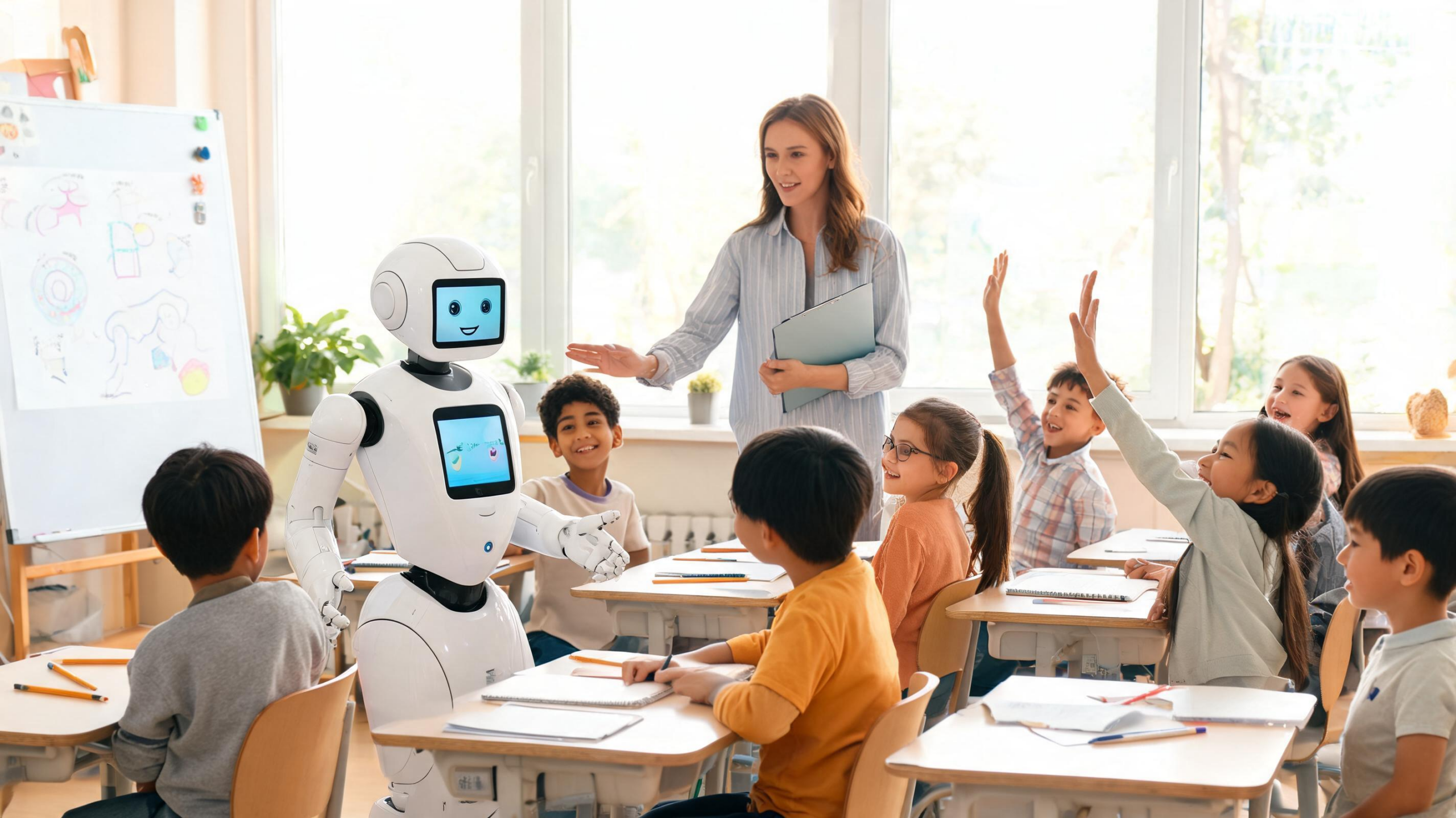
A humanoid robot with a tablet embedded in its chest has been quietly appearing in classrooms across Europe and North America, greeting pupils, quizzing university students, telling stories in mathematics lessons and helping children with autism practise social interaction. Now, the most comprehensive attempt yet to map how this machine is actually being used in formal schooling has concluded that Pepper’s promise is real but heavily conditional: the robot reliably lifts motivation and engagement, yet it cannot operate without constant human supervision, and its educational value appears to depend far more on the teacher and the lesson design than on the hardware itself.
The findings come from a scoping review conducted by Rosabel Martinez-Roig, María Aragonés-González and Miguel Cazorla of the University of Alicante in Spain, published in the Journal of New Approaches in Educational Research. The team searched Scopus, Web of Science, ERIC-ProQuest and Dialnet for peer-reviewed empirical studies published between the robot’s commercial launch in 2014 and 1 March 2026, following the PRISMA-ScR reporting guidelines. Out of 1,448 initial records, and after duplicates were removed and 345 full texts assessed, only 13 studies met all the inclusion criteria. That narrow yield is itself telling: despite more than a decade of commercial availability and enthusiastic marketing, rigorously documented classroom deployments of Pepper remain rare, recent and geographically concentrated.
The technical appeal of the platform is easy to understand. Pepper is a social humanoid designed for human interaction, equipped with cameras, sensors, mobility, speech, gestures and expressive non-verbal cues such as head movements and eye contact. Unlike tablets or desktop tutoring software, social robots embody interaction; they can be perceived by children as social agents capable of reciprocity, which is precisely why researchers have speculated they might serve as tutors, learning companions or even pupils in ‘learning-by-teaching’ scenarios where students consolidate their own knowledge by explaining content to the machine. But the review found a persistent gap between that theoretical versatility and what actually happens in schools, where Pepper’s effective autonomy proved limited in most documented settings.
Geographically, the evidence is dominated by Europe, with nine of the thirteen studies (69.2 percent) conducted there, particularly in Italy, Germany, the Netherlands and Sweden. Germany was the most frequently represented country, with work such as Donnermann and colleagues’ long-term study of adaptive robotic tutors supporting university students with exam preparation and motivation. Four studies were carried out in the United States, including an ethnographic project by LeTendre and Gray that followed adolescents through a project-based learning unit, documenting how students themselves came to understand both the possibilities and the hard limits of human-robot interaction. The first qualifying empirical study did not appear until 2018, four years after the robot’s launch, underlining how youthful this research area remains.
The review reveals a striking imbalance in where and with whom the robot is deployed. Five studies focused on primary education, with children aged six to twelve, while four took place in higher education and two in early years settings; only one examined secondary education. Three studies centred on pupils with special educational needs, particularly autism spectrum disorder, extending a line of research suggesting that the predictable, patient interaction style of social robots can support communication and participation in inclusive contexts. Methodologically, however, the field is dominated by qualitative approaches: eight studies used case studies or interaction analysis, three used mixed methods and only two were predominantly quantitative experiments. Eight of the thirteen studies involved fewer than fifty participants, and not a single large-scale longitudinal study was identified.
Three pedagogical configurations dominated the corpus. In six studies, Pepper acted as a tutor or teaching assistant, delivering guidance, structured feedback or gamified quizzes, including quiz-based university learning in Germany. In four, the robot was cast as a learning partner or tutored agent, a role exemplified by Swedish research in which children taught mathematics to the robot and, in doing so, rehearsed and revised their own reasoning. In three studies, Pepper served as a social mediator in inclusive settings, supporting storytelling and second-language learning among migrant children and pupils with special educational needs. Curricular coverage was diverse but thin: mathematics appeared most often, followed by STEM and programming activities, language learning, social-emotional development in early years, and even a sustainability-focused serious game in which the robot improved Italian children’s attitudes toward recycling.
The benefits reported are consistent across the corpus, though the authors caution against over-interpreting them. Twelve of the thirteen studies — 92.3 percent — documented increased motivation and engagement when the robot was present, with pupils frequently showing more enjoyment than with tablet-based equivalents of the same tasks. Five studies recorded improvements in social skills or communicative participation, including greater verbal engagement in collaborative mathematics. Four reported measurable academic gains, from improved university grades in robot-assisted tutoring to more positive attitudes toward recycling. Three studies noted enhanced sustained attention during structured tasks. Yet the reviewers stress that novelty effects, small samples, short interventions and children’s prior expectations may all inflate these apparent benefits, and that none of the outcomes can be attributed to the robot’s presence alone.
The obstacles documented are equally consistent, and in many ways more illuminating. Technical failures were the most frequently reported limitation, mentioned in ten of thirteen studies: voice recognition struggles with children’s voices and ambient noise, software glitches interrupt activity sequences, and programming demands exceed what most schools can sustain. In more than half the studies, teachers had to provide constant technical supervision, stepping in to repair interactions when the robot misheard a pupil or froze mid-lesson. Curricular integration was weak, with most deployments framed as one-off activities, pilots or limited experiments rather than embedded components of standard teaching. Organisationally, cost, device scarcity and reliance on technical staff constrained uptake, and a small number of studies raised ethical questions about privacy, data collection and the risk of ‘robotised’ teaching, as well as classroom competition over limited robot time.
Perhaps the review’s central insight concerns the teacher. In seven studies, educators served as technical supervisors; in six, they acted as pedagogical mediators who structured activities, allocated interaction turns and regulated participation. Only two studies involved teachers directly in designing the intervention from the start, and just three mentioned any specific training in the pedagogical use of the robot — a gap the authors identify as one of the field’s most significant blind spots. Situations of ‘trouble and repair’, where adult intervention rescued collapsing child-robot interactions, recur throughout the literature, and earlier work in a school for autistic children explicitly framed Pepper as a teaching aid external to the classroom rather than an autonomous instructor. The distinction between the robot’s technical autonomy and its pedagogical autonomy, the authors argue, is critical: its capacity for action is always embedded in human, technical and ethical decisions.
The overall verdict is measured rather than sensational. Pepper’s embodiment, humanoid appearance and multimodal interaction can spark initial interest, but they do not by themselves guarantee meaningful learning; outcomes hinge on instructional design, student profile, technical stability and teacher mediation. The authors call for the field to move beyond technological novelty toward longitudinal studies that test whether early enthusiasm endures, deeper investigation of teacher training and design involvement, and direct comparisons of the robot against tablets, virtual agents and hands-on materials to establish where, if anywhere, it adds unique value. Until then, the evidence suggests that the social robot in the classroom is best understood not as a replacement for teachers but as a demanding, engaging and highly dependent teaching resource — one whose success is written, lesson by lesson, by the humans standing beside it.
The scoping review’s methodological choices help explain both its strengths and its boundaries. By restricting the analysis to a single robotic platform, the authors avoided a common problem in educational technology research, in which reviews lump together devices with very different degrees of physicality, mobility, expressiveness and autonomy, blurring the conditions under which each actually functions. Pepper’s specific configuration, combining a wheeled mobile base with a chest-mounted tablet, speech and gesture, makes it a useful case study in how multimodal embodiment is translated into classroom practice.
The timing of the corpus is also noteworthy. Because the first qualifying study appeared only in 2018, the entire body of empirical evidence postdates the robot’s commercial launch by several years, suggesting that early adoption in schools lagged well behind the platform’s availability. The concentration of research in primary and higher education, with secondary schooling nearly absent, may reflect practical factors such as timetable flexibility, curricular pressure and the willingness of younger children to engage with novel devices, though the review does not establish causal explanations for this distribution.
For practitioners, the most actionable finding may be the recurring pattern of ‘trouble and repair’. Since technical interruptions were near-universal, schools considering deployment should plan for adult supervision as a structural requirement rather than an occasional contingency. The scarcity of teacher involvement in intervention design, noted in only two studies, likewise points toward a simple improvement: co-designing robot activities with educators from the outset, and embedding them within existing curricular units instead of isolated demonstrations.
The authors’ call for comparative research deserves emphasis. Without head-to-head comparisons against tablets, virtual agents or conventional materials, the field cannot determine whether Pepper’s embodied presence produces effects that cheaper technologies cannot replicate, or whether the observed gains reflect novelty and expectation rather than any unique pedagogical property of the robot itself.
Subject of Research: A scoping review of the implementation of the Pepper social robot in formal educational contexts
Article Title: Exploring the implementation of the Pepper social robot in formal education: a scoping review
Article References: Martinez-Roig, R., Aragonés-González, M., & Cazorla, M. (2026). Exploring the implementation of the Pepper social robot in formal education: a scoping review. Journal of New Approaches in Educational Research, 15(1), Article 22. https://doi.org/10.1007/s44322-026-00072-1
Image Credits: AI Generated
DOI: 10.1007/s44322-026-00072-1
Keywords: social robotics, Pepper robot, formal education, scoping review, educational technology, human-robot interaction, inclusive education, teacher mediation, primary education, student motivation, autism spectrum disorder, STEM learning
Cite Scienmag News
Denise Maddox. (September 3, 2026). Pepper the Classroom Robot Boosts Motivation but Needs Teachers at the Helm, Review Finds. Scienmag. https://scienmag.com/pepper-the-classroom-robot-boosts-motivation-but-needs-teachers-at-the-helm-review-finds/
Denise Maddox. "Pepper the Classroom Robot Boosts Motivation but Needs Teachers at the Helm, Review Finds." Scienmag, 3 September 2026, https://scienmag.com/pepper-the-classroom-robot-boosts-motivation-but-needs-teachers-at-the-helm-review-finds/. Accessed 5 October 2026.
Denise Maddox. "Pepper the Classroom Robot Boosts Motivation but Needs Teachers at the Helm, Review Finds." Scienmag. September 3, 2026. https://scienmag.com/pepper-the-classroom-robot-boosts-motivation-but-needs-teachers-at-the-helm-review-finds/


