


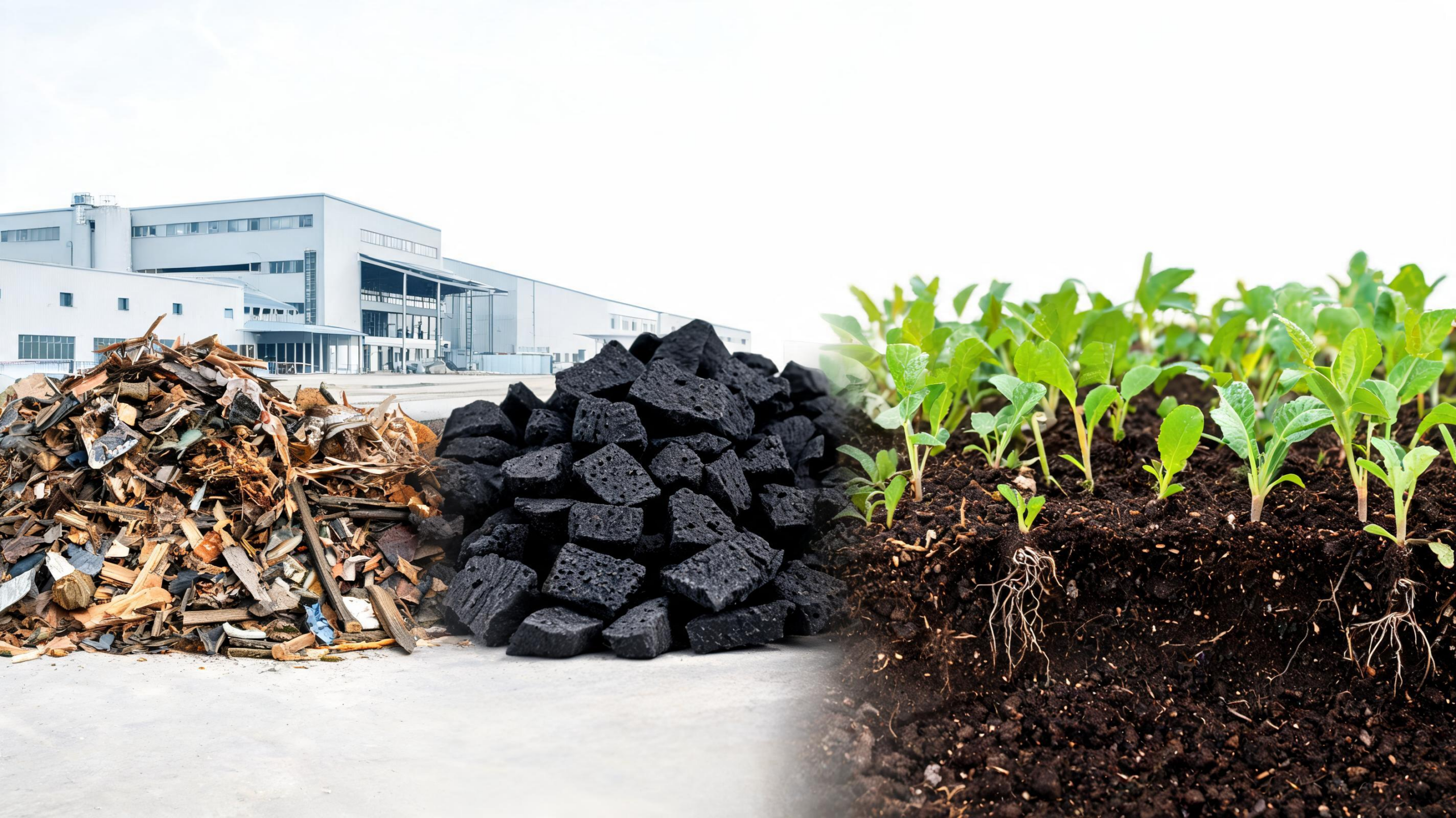
Soil scientists have long understood that the health of agricultural land rests on a delicate biochemical partnership between sulfur and organic matter, but a sweeping new review argues that this partnership has been quietly dismantled across vast stretches of farmland, and that engineered materials derived from industrial waste may hold the key to rebuilding it. The analysis, published in the journal Discover Soil, examines how salinization, organic carbon depletion, and persistent pollution all converge on a single vulnerable point: the sulfur-organic nexus, the web of chemical and microbial interactions that governs how sulfate, the primary plant-available form of sulfur, is retained, cycled, and supplied in soil. When that nexus collapses, the consequences cascade. Sulfate leaches away, base cations such as calcium and magnesium are stripped from the root zone, microbial communities falter, and a negative feedback loop progressively degrades soil quality. The review’s central insight is stark: no single amendment can repair every degradation pathway at once, and restoration efforts succeed only when material selection is matched to soil-specific constraints such as sodicity, pH, texture, and contaminant profile.
The scope of the problem is formidable. The review defines degraded soils operationally as those showing significant decline in chemical fertility, physical structure, biological activity, or contaminant retention capacity, with particular attention to arid and semi-arid agricultural regions where salinization and sulfur depletion are especially acute. Sulfur itself exists in two principal pools: organic sulfur, dominated by amino acids such as cysteine and methionine, which accounts for more than 95 percent of total soil sulfur in undisturbed ecosystems; and inorganic sulfur, chiefly sulfate and elemental sulfur, which controls instantaneous bioavailability. In degraded soils, the loss of organic carbon binding sites and shifts in redox potential diminish sulfate buffering capacity and suppress microbial metabolic flux, effectively constituting a failure of in situ nutrient retention. Surveys across Indian agroecosystems, cited in the review, reveal widespread acute to marginal sulfur deficiency, while long-term studies in semi-arid tropical systems show that accelerated mineralization of organic matter under elevated temperatures initiates a self-reinforcing spiral of carbon and sulfur loss.
At the molecular level, the review highlights the enzymatic machinery that governs sulfur flux. Aryl sulfatase, the rate-limiting catalyst that cleaves ester-sulfate bonds to release plant-available sulfate, alongside urease and dehydrogenase, serves as a sensitive biomarker of sulfur limitation. Integrated nutrient management, the co-application of mineral fertilizers with recalcitrant organic amendments such as farmyard manure, reliably upregulates these enzymes by supplying microbial consortia with stable carbon substrates enriched in functional moieties like sulfoxide groups. Conversely, exclusive nitrogen fertilization acts as an enzyme inhibitor, suppressing both catalytic function and microbial biomass. This mechanistic picture frames the review’s evaluation of engineered interventions: the goal is not merely to add sulfur or carbon, but to restore the coupled reaction network in which organic matter feeds the microbes that transform sulfur into forms plants can use.
Among the most promising feedstocks are industrial byproduct gypsums, calcium sulfate waste streams generated in enormous quantities by coal-fired power plants, phosphate processing, and titanium dioxide pigment manufacture. Flue gas desulfurization gypsum emerges as the benchmark material: with purity of at least 95 percent calcium sulfate dihydrate and low radioactivity below 1 becquerel per gram, it is process-ready for soil application. In sodic soils, its soluble calcium displaces exchangeable sodium from clay surfaces, allowing sodium sulfate to be leached from the profile, reducing the exchangeable sodium percentage and restoring soil flocculation and hydraulic conductivity. Phospho-gypsum, generated at rates of 100 to 280 million tonnes per year, presents a more complicated picture: it contains radium-226, classifying it as technologically enhanced naturally occurring radioactive material, and many jurisdictions ban its agricultural use despite column studies showing leachate concentrations below drinking water standards. The review flags this divergence between regulatory perception and empirical leachability data as a significant unresolved question, noting that emerging streams such as titanium-gypsum and fluoro-gypsum remain largely uncharacterized and would require pre-treatment such as acidity neutralization or hydration activation before field deployment.
Elemental sulfur operates on entirely different kinetics, and the review’s quantitative synthesis of its behavior yields some of the most striking numbers in the analysis. Elemental sulfur is not directly assimilable; it must be oxidized to sulfate by chemoautotrophic bacteria such as Thiobacillus species in a biofilm-controlled reaction on the particle surface. Controlled column studies show that even modest application rates of 0.5 percent by weight induce statistically significant acidification and sulfate release in calcareous soils, and that more than 80 percent of total sulfate yield is generated within just nine weeks, a residence time that aligns favorably with peak crop sulfur demand. Critically, sulfate mobility was approximately 23 percent higher in sandy loam than in clay-rich soils, a texture-dependent mass transfer effect that demands site-specific dosing protocols to avoid leaching losses. In calcareous systems, localized acidification at the sulfur particle surface can boost micronutrient solubility, raising available sulfate by 246 to 1455 milligrams per kilogram, though organic co-amendments can paradoxically reduce culturable sulfur-oxidizer counts through competitive exclusion by heterotrophs.
The review then turns to designer biochar, describing a materials-by-design paradigm in which biochar is transformed from a passive carbonaceous solid into a hierarchical multifunctional reactive platform through sequential physical, chemical, and biological modifications. Ball milling and steam activation increase accessible surface area; acid or alkali treatment introduces carboxyl and hydroxyl groups for metal binding; hydrogen peroxide oxidation selectively grafts oxygen functionality while preserving microporosity; and chitosan coating adds amine groups that capture anionic contaminants such as arsenate and chromate. Sulfonation covalently anchors strong Bronsted acid sites that enhance cation exchange capacity, while biological modification immobilizes viable microbial consortia within the protective pore architecture, creating structured biofilm carriers that accelerate pollutant degradation in the rhizosphere. Sulfonated polymers, including anionic polyacrylamide, round out the organic toolkit as high-molecular-weight flocculants that bridge soil particles to stabilize aggregates and manage surface infiltration, though their effectiveness varies markedly between sandy and clay-rich soils, a texture dependency whose mechanism remains unresolved.
Perhaps the most consequential findings concern hybrid composites that exploit synergy between material classes. Gypsum-biochar composites reduce bulk density from 1.08 to 0.46 grams per cubic centimeter at 50 percent biochar loading, a reduction of more than half, while simultaneously providing calcium-mediated flocculation, sulfate release, and sorption sites for organic contaminants. The trade-off is mechanical: flexural modulus declines above 20 percent biochar, and the literature contains genuine contradictions over whether gypsum competes with phosphorus for sorption sites. Layered double hydroxide-biochar composites add selective anion exchange for arsenate, chromate, and phosphate sequestration, with just 2 percent calcium-aluminum LDH loading achieving 47.85 percent copper and 37.95 percent lead immobilization in soil, while also enriching microbial phyla involved in nitrogen fixation and stress tolerance. On the contamination front, the review describes an elegant sulfidogenesis pathway: in reduced microenvironments within biochar pores, sulfate-reducing bacteria convert sulfur-derived sulfate to sulfide, which precipitates lead, cadmium, and copper as exceptionally insoluble metal sulfides, though whether these precipitates remain stable over decadal timescales under fluctuating redox conditions is unconfirmed.
The review also confronts the emerging frontier of contaminant interference, notably per- and polyfluoroalkyl substances. Certain fluorotelomer sulfonates can engage the sulfur starvation regulon of soil microbes, with the ssuD gene mediating desulfonation under sulfate-limited conditions, directly linking PFAS fate to the sulfur cycle. This metabolic entanglement means that amendment design can no longer consider nutrient dynamics and contaminant behavior in isolation. Environmental trade-offs compound the complexity: gypsum application transiently elevates total dissolved solids and electrical conductivity in pore water, requiring careful salt mass balances to ensure net sodium export exceeds the amendment’s own ionic load, while life cycle assessment frameworks must account for avoided landfill burdens, pyrolysis energy demand, and transportation emissions before circular economy claims can be validated.
The authors conclude that the field has reached a critical juncture: the knowledge base is sufficient to demonstrate promise but insufficient to guarantee long-term efficacy and safety. Flue gas desulfurization gypsum stands as the most mature and field-validated technology for sodicity reclamation, elemental sulfur-biochar composites offer the greatest multifunctionality across pH modulation, nutrient supply, and structure improvement, sulfonated polymers excel at erosion control in coarse soils, and layered double hydroxide hybrids show promise for combined metal remediation and fertility enhancement, albeit with limited field data. The review identifies five research priorities to close the gap between laboratory proof-of-concept and field-scale implementation: multi-year field observatories tracking contaminant stability and microbial succession, predictive kinetic models for sulfur oxidation integrating particle size and buffering capacity, comprehensive PFAS transformation product analysis, standardized reporting of engineering metrics such as exchangeable sodium percentage and saturated hydraulic conductivity, and harmonized life cycle assessments with consistent system boundaries. Whether engineered sulfur-organic amendments become a mainstream pillar of sustainable soil management, the review suggests, will depend on the research community’s ability to resolve these contradictions with interdisciplinary, systems-level rigor.
Subject of Research: Valorization of industrial byproducts and designer biochar to restore sulfur and organic matter interactions in degraded soils
Article Title: A critical review of the valorization of industrial byproducts and designer biochar for restoring sulfur and organic matter interactions in degraded soils
Article References: Abd Zaid, A. (2026). A critical review of the valorization of industrial byproducts and designer biochar for restoring sulfur and organic matter interactions in degraded soils. Discover Soil, 3(1), Article 151. https://doi.org/10.1007/s44378-026-00306-w
Image Credits: AI Generated
DOI: 10.1007/s44378-026-00306-w
Keywords: soil degradation, sulfur cycling, biochar, industrial byproduct gypsum, flue gas desulfurization gypsum, elemental sulfur oxidation, soil organic carbon, sodic soil reclamation, heavy metal immobilization, PFAS remediation, layered double hydroxides, life cycle assessment
Cite Scienmag News
Alan Morgan. (September 3, 2026). Industrial Waste and Designer Biochar Join Forces to Rescue the World’s Dying Soils. Scienmag. https://scienmag.com/industrial-waste-and-designer-biochar-join-forces-to-rescue-the-worlds-dying-soils/
Alan Morgan. "Industrial Waste and Designer Biochar Join Forces to Rescue the World’s Dying Soils." Scienmag, 3 September 2026, https://scienmag.com/industrial-waste-and-designer-biochar-join-forces-to-rescue-the-worlds-dying-soils/. Accessed 3 September 2026.
Alan Morgan. "Industrial Waste and Designer Biochar Join Forces to Rescue the World’s Dying Soils." Scienmag. September 3, 2026. https://scienmag.com/industrial-waste-and-designer-biochar-join-forces-to-rescue-the-worlds-dying-soils/


