

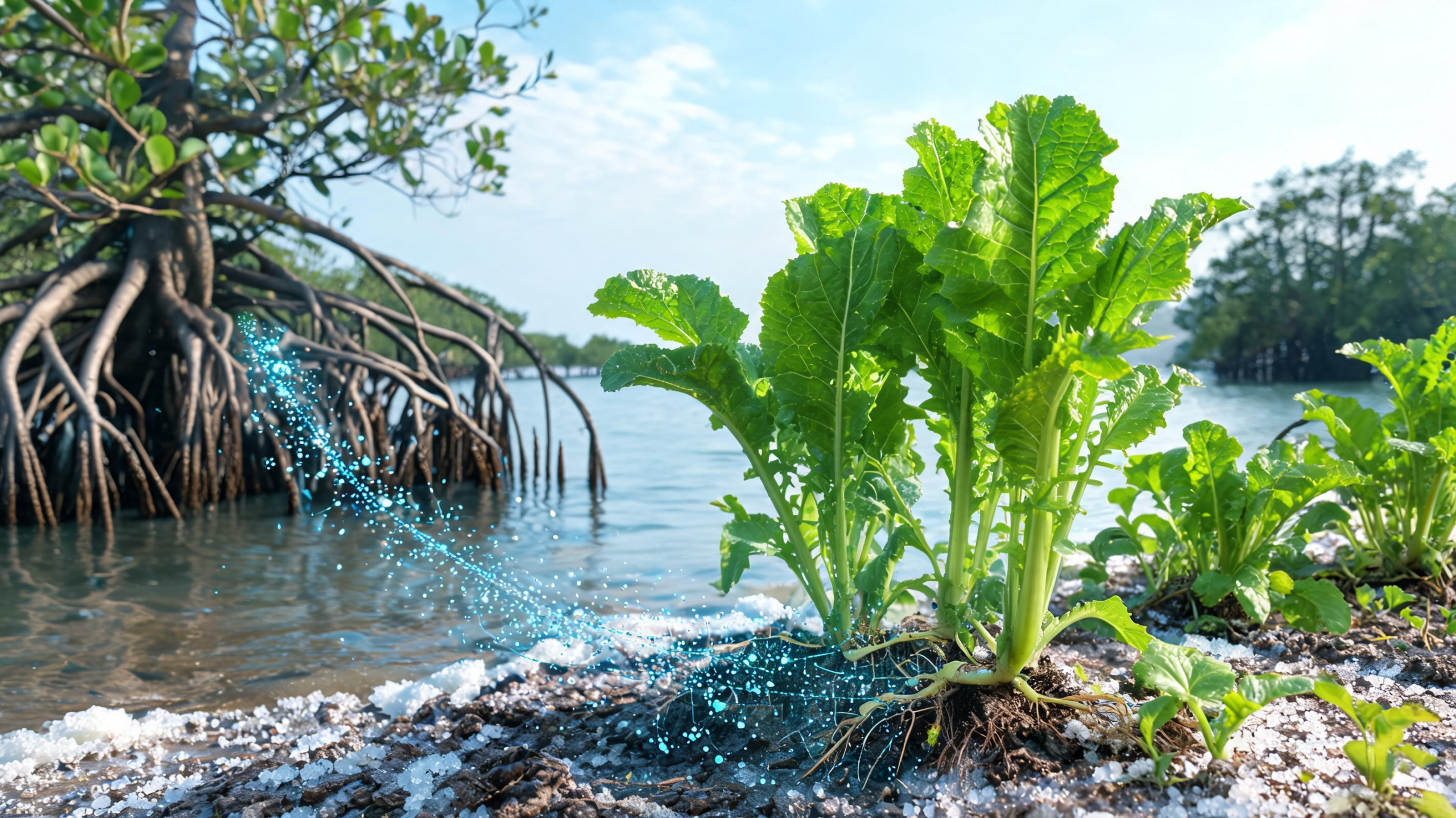
As salt creeps into agricultural soils, a microscopic alliance from India’s mangrove forests may offer mustard plants a better chance of survival. Researchers have isolated salt-tolerant bacteria from mangrove-root soil and used them to improve the early growth of Mustard CS61 (Brassica juncea) under saline conditions. In laboratory and pot experiments, treated plants developed longer roots and shoots, greater seedling vigour and more chlorophyll than untreated plants. A three-strain bacterial consortium produced the strongest response in the seed-germination assay, while individual strains also delivered substantial benefits. The findings suggest that microbes adapted to naturally salty ecosystems could be developed into biological inoculants for crops grown in salt-affected soils. The study, by Manish R. Bhat, Mayur Auti and Prajval Poojary, focuses on a practical agricultural problem: salinity can interfere with water uptake, disturb nutrient balance and damage plant metabolism, especially during germination and early seedling establishment. Rather than relying only on chemical amendments or breeding, the researchers investigated whether beneficial rhizobacteria could help mustard negotiate this hostile chemical environment.
Soil salinity is a growing constraint in coastal regions and irrigated farmland. When soluble salts accumulate around roots, they initially create osmotic stress, making it harder for plants to extract water even when the soil appears moist. As salt ions enter tissues, they can cause ionic toxicity, disrupt membranes and enzymes, trigger oxidative stress and restrict nutrient acquisition. Young seedlings are particularly vulnerable because their root systems and physiological defences are still developing. Mustard is an important oilseed crop in India, but the CS61 variety, like many crops, can experience reduced productivity when exposed to excessive salt. The researchers turned to mangroves because their rhizospheres are shaped by periodic tidal flooding, high salinity, oxygen-poor sediments and fluctuating chemical conditions. Microorganisms that persist there must maintain cellular function under stress, making the mangrove root zone a promising reservoir of bacteria with salt-tolerance traits. The central idea is not that these microbes remove all salt from soil, but that they can help plants tolerate its effects by changing the biological conditions around the root.
The team collected rhizosphere soil from 11 mangrove sites extending from Koparkhairane to Belapur in Navi Mumbai, Maharashtra. From those samples, they recovered 1,263 bacterial isolates. The initial screening narrowed the collection to organisms able to grow with 5 percent sodium chloride, leaving 168 moderately salt-tolerant isolates. At 10 percent sodium chloride, 97 isolates still grew on solid medium. After repeated purification, 36 were confirmed as pure cultures, and a preliminary blood-agar test excluded isolates showing alpha- or beta-hemolysis, which can indicate potentially undesirable biological activity. Seventeen non-hemolytic isolates remained for detailed testing. In liquid medium, all 17 grew strongly at 2, 4 and 6 percent sodium chloride. At higher concentrations, growth varied, and only some strains maintained moderate growth at 10 percent. None grew at 12, 14 or 16 percent in the tested broth conditions. That decline provided a useful physiological boundary: the bacteria were highly salt tolerant compared with ordinary soil isolates, but they were not immune to extreme osmotic pressure.
The surviving isolates were then examined for functions associated with plant growth promotion. These tests looked for traits that could influence nutrient availability, root development or stress responses. Nitrogen-fixation and phosphate-solubilization activity appeared in 82.4 percent of the isolates, potentially helping convert nutrients into forms plants can access. Every isolate produced indole-3-acetic acid, or IAA, a plant hormone involved in cell expansion and the formation of lateral roots, although production levels differed. Five isolates showed strong IAA activity. All isolates also produced ammonia and biosurfactants, while 64.7 percent produced gibberellin-like compounds and 94.1 percent showed protease activity. Cellulose degradation occurred in 58.8 percent, pectin degradation in 35.3 percent and starch hydrolysis in 23.5 percent. Exopolysaccharide production was less common, detected in 11.8 percent of the isolates. Such secreted polymers can sometimes help bacteria and their plant hosts manage water stress by altering the immediate soil microenvironment, although the present study did not establish the contribution of each mechanism inside living plants.
The researchers also tested whether the bacteria could inhibit Aspergillus niger, a fungus used in the study’s laboratory assay as an indicator of antifungal potential. Sixteen of the 17 isolates produced detectable inhibition zones. Three strains stood out because their activity was consistent and pronounced: BJ2, DJ12 and J4. Genetic identification using nearly complete 16S rRNA gene sequences assigned BJ2 to Micrococcus luteus, while DJ12 and J4 were identified as Microbacterium barkeri. Their sequences were deposited in GenBank under accession numbers PX974661, PX974662 and PX974663, respectively. The three strains also showed no inhibitory interaction with one another in a cross-streak compatibility test, an important preliminary condition for combining them. The proposed consortium therefore brought together a Micrococcus strain and two Microbacterium strains with overlapping but not identical functional profiles. The authors note that M. barkeri has been less explored as a plant-growth-promoting bacterium, so its apparent activity in this work warrants additional investigation rather than immediate agricultural deployment.
In the first plant test, surface-sterilized Mustard CS61 seeds were treated with each bacterial strain separately, with an equal-volume mixture of all three, or with sterile water as a control. The seeds were placed on filter paper moistened with 0.85 percent sodium chloride and observed under controlled laboratory conditions. Every treatment reached 100 percent germination within two days, showing that the applied salt concentration did not prevent germination itself. The differences appeared in the seedlings that followed. Relative to the salt-stressed control, BJ2 increased root length by 98.8 percent and DJ12 by 96.4 percent, whereas J4 produced a much smaller 0.9 percent increase. The consortium generated the largest root response, an increase of 240.7 percent. Shoot length rose by 49.7 percent with BJ2, 23.5 percent with DJ12 and 49.4 percent with J4; the consortium increased it by 60.3 percent. Measures combining seedling size and germination, including the seedling vigour index, also improved most strongly with the combined inoculum. The statistical tests indicated significant treatment effects on root and shoot length.
The pot experiment provided a second test under controlled conditions. Mustard seeds were inoculated with the same individual strains or consortium and planted in soil exposed to salinity equivalent to 1 percent sodium chloride. An untreated control and an autoclaved-soil treatment were included. All treatments again reached 100 percent germination within two days, but bacterial inoculation significantly changed subsequent growth. The untreated plants had an average root length of 35.43 millimetres. DJ12 produced the longest roots, averaging 58.37 millimetres, followed by BJ2 at 57.43 millimetres, J4 at 56.57 millimetres and the consortium at 55.60 millimetres. For shoots, J4 performed best at 107.9 millimetres, followed by the consortium at 105.93 millimetres, BJ2 at 104.3 millimetres and DJ12 at 98.33 millimetres, compared with 96.8 millimetres in the control. The autoclaved treatment produced shorter roots and shoots, suggesting that biologically active cells or their ongoing products, rather than sterilized soil alone, were important to the observed response. The study used triplicate treatments, and analysis of variance with Dunnett’s test found highly significant effects for the principal growth measures.
Leaf chemistry and soil measurements added further clues, although they do not yet demonstrate how the inoculants would perform in a farm field. Total chlorophyll reached 0.365 milligrams per gram of fresh tissue in J4-treated plants, compared with 0.131 milligrams per gram in the control and 0.109 milligrams per gram in autoclaved soil. Higher chlorophyll levels may indicate better maintenance of photosynthetic machinery under salt stress, but the experiment did not directly measure photosynthetic rates or yield. After the pot trial, consortium-treated soil contained more measured carbon and nitrogen than control soil: carbon rose from 0.92 to 1.39 milligrams per litre, while nitrogen increased from 2,199.26 to 2,343.17 milligrams per kilogram. The soil pH increased from 6.85 to 7.55, and electrical conductivity rose from 851 to 948 microsiemens per centimetre. These changes are consistent with microbial effects on nutrient cycling, but their long-term significance remains uncertain. The authors propose metagenomic studies to investigate uncultured mangrove microbes and identify genes associated with salt tolerance and plant growth promotion. Field trials will also be needed to test persistence, colonization, compatibility with native soil communities, crop yield and biosafety before the consortium can be considered a reliable agricultural product.
The study’s strongest implication is methodological as well as agricultural: it demonstrates a pipeline for finding stress-adapted bacteria in an ecosystem that is rarely treated as a source of crop inoculants. Screening began with a large isolate collection and combined salt tolerance, plant-growth traits, safety-related hemolysis testing, molecular identification and compatibility testing. That sequence helps distinguish organisms that merely survive salt from candidates with a plausible capacity to interact beneficially with plants. The reported IAA production and cellulase activity are useful indicators, but they are laboratory traits; they do not by themselves prove that the compounds were produced at effective concentrations in the mustard rhizosphere.
The results should therefore be viewed as proof of potential rather than evidence of a ready-to-use biofertilizer. The experiments were conducted under controlled saline conditions, and the measured outcomes focused mainly on germination and early vegetative growth. Longer trials are needed to determine whether improved roots and shoots persist through flowering and seed production, particularly because salt levels, soil texture, temperature and native microbial communities vary substantially in agricultural fields. Future work should also verify strain identity with more discriminating genomic methods, quantify root colonization, test inoculant shelf life and examine whether the consortium remains stable during storage and after application. Comparing treated and untreated plants across several salinity regimes would help separate general growth promotion from genuinely salt-specific protection. Such validation is essential before introducing mangrove-derived strains beyond experimental settings.
Subject of Research: Mangrove-derived plant growth-promoting bacteria improving mustard growth under salinity stress
Article Title: Effect of plant growth promoting rhizobacteria on the growth promotion of Mustard CS61 (Brassica juncea)
Article References: Bhat, M. R., Auti, M., & Poojary, P. (2026). Effect of plant growth promoting rhizobacteria on the growth promotion of Mustard CS61 (Brassica juncea). Discover Biotechnology, 3(1), Article 12. https://doi.org/10.1007/s44340-026-00059-w
Image Credits: AI Generated
DOI: 10.1007/s44340-026-00059-w
Keywords: plant growth-promoting rhizobacteria, mustard, Brassica juncea, salinity stress, mangrove microbiology, Micrococcus luteus, Microbacterium barkeri, bioinoculants, Effect, plant, growth, promoting
Cite Scienmag News
Scienmag. (August 28, 2026). Mangrove Bacteria Boost Mustard Growth Under Salty Conditions. https://scienmag.com/mangrove-bacteria-boost-mustard-growth-under-salty-conditions/
Scienmag. "Mangrove Bacteria Boost Mustard Growth Under Salty Conditions." Scienmag, 28 August 2026, https://scienmag.com/mangrove-bacteria-boost-mustard-growth-under-salty-conditions/. Accessed 28 August 2026.
Scienmag. "Mangrove Bacteria Boost Mustard Growth Under Salty Conditions." Scienmag. August 28, 2026. https://scienmag.com/mangrove-bacteria-boost-mustard-growth-under-salty-conditions/


