


A routine blood test taken during the first trimester may contain an early warning signal for gestational diabetes, according to a prospective cohort study conducted in Xinjiang, China. Researchers found that the ratio between two blood components—uric acid and high-density lipoprotein cholesterol—was strongly associated with the likelihood that a pregnant woman would later develop gestational diabetes mellitus. The ratio, known as UHR, was higher among women who went on to receive a gestational diabetes diagnosis at 24 to 28 weeks of pregnancy. In statistical analyses, participants in the highest UHR group had nearly four times the odds of developing the condition compared with those in the lowest group. The findings raise the possibility that a measurement already available from standard biochemical testing could help clinicians identify higher-risk pregnancies well before conventional screening.
Gestational diabetes mellitus, or GDM, develops when the body cannot produce or effectively use enough insulin to maintain normal blood-glucose levels during pregnancy. Pregnancy naturally changes metabolism: hormones produced by the placenta make tissues more resistant to insulin, ensuring that glucose remains available to the developing fetus. In most pregnancies, the pancreas compensates by increasing insulin production. When that compensation is inadequate, blood glucose rises. GDM is usually evaluated with an oral glucose tolerance test, or OGTT, between 24 and 28 weeks of gestation. That timing is clinically useful, but it also means that women who are already moving toward impaired glucose regulation may remain unidentified for much of the first half of pregnancy. Earlier risk assessment could allow closer monitoring and more timely preventive care, although the new study does not establish that UHR itself causes diabetes or that it should replace the OGTT.
The research team enrolled 1,424 women with singleton pregnancies who attended the First Affiliated Hospital of Shihezi University between May 2022 and December 2024. Participants were recruited during the first trimester and followed from the second trimester into the third. Before 14 weeks of gestation, each woman provided a fasting venous blood sample. The investigators measured serum uric acid and HDL-C, then calculated UHR by dividing the uric acid concentration by the high-density lipoprotein cholesterol concentration. HDL-C is commonly described as “good” cholesterol because it participates in the transport of cholesterol away from tissues and toward the liver for processing. Uric acid is the end product of purine metabolism, produced when the body breaks down compounds found in cells and certain foods. Both molecules are influenced by metabolic, inflammatory and vascular processes, making their relationship potentially informative even though neither measurement alone is a specific test for GDM.
Among the women followed in the study, 7.16 percent developed gestational diabetes. The contrast in UHR between the two groups was pronounced. The median UHR among women diagnosed with GDM was 15.88, with an interquartile range of 12.42 to 19.36. Among those who did not develop the condition, the median was 12.45, with an interquartile range of 10.17 to 15.54. The difference was statistically significant, with a probability value below 0.001. These figures do not mean that a particular ratio automatically predicts an individual diagnosis; rather, they show that the distributions of the marker differed across the cohort. The researchers then used several statistical approaches to determine whether the association remained after accounting for other factors and whether the risk changed progressively as UHR increased.
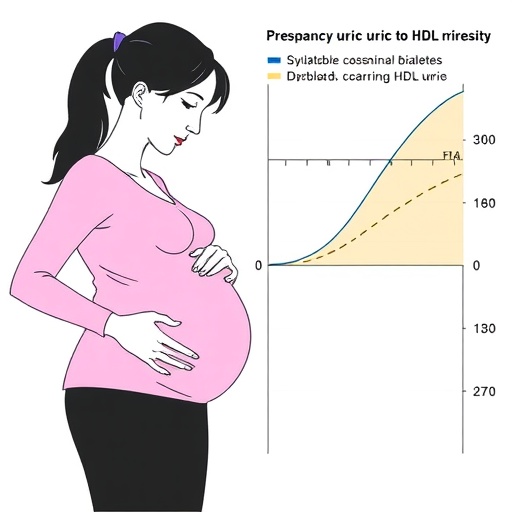
One of those approaches was a restricted cubic spline model, a flexible technique used to examine whether a biological measurement is related to an outcome in a straight line or through a more complicated curve. The analysis showed a significant positive association between increasing first-trimester UHR and the risk of GDM. The overall statistical test produced a P value of 0.002, supporting a relationship across the range of observed UHR values. The investigators also divided participants into four UHR groups, or quartiles, and compared them. After multivariable adjustment, women in the highest quartile had an odds ratio of 3.717 for GDM compared with women in the lowest quartile. The 95 percent confidence interval extended from 1.710 to 8.081, and the associated P value was 0.001. A separate test for trend found that the probability of GDM rose progressively across the quartiles, with P for trend below 0.001.
The biological explanation for the association remains uncertain, but the two components of the ratio offer several plausible clues. Elevated uric acid has been linked in previous metabolic research to oxidative stress, endothelial dysfunction and disturbances in insulin signaling. When uric acid levels rise, the molecule may be associated with changes in cellular redox balance and vascular function, although the precise effects can vary with concentration and physiological context. HDL-C, meanwhile, is not simply a passive cholesterol carrier. HDL particles participate in cholesterol efflux, lipid transport, immune regulation and protection of the vascular lining. Lower or altered HDL-C levels can accompany insulin resistance and broader metabolic dysfunction. A high UHR could therefore reflect the simultaneous presence of increased uric acid and reduced HDL-C, creating a composite signal of metabolic stress that is more informative than either measurement by itself. The study, however, measured association rather than mechanism, so these possible pathways require direct investigation.
The researchers tested the marker’s performance using receiver operating characteristic analysis. This method evaluates how well a measurement distinguishes people who develop a condition from those who do not. Its central summary, the area under the curve, ranges conceptually from no useful discrimination to perfect separation. In this cohort, the UHR achieved an AUC of 0.833 for predicting GDM, a result the investigators reported as superior to the predictive performance of uric acid or HDL-C considered separately. An AUC of 0.833 suggests promising discrimination within the study population, but it does not by itself determine whether the test is ready for clinical use. A useful screening tool must also be calibrated, reproducible across laboratories and populations, affordable, and evaluated at clinically meaningful thresholds. Researchers would need to establish how many women would be incorrectly reassured or unnecessarily monitored at any proposed cutoff.
Subgroup analysis added an important qualification. Among women whose pre-pregnancy body mass index was between 18.5 and 23.9 kilograms per square meter, the researchers observed a positive association between higher UHR and GDM, with an odds ratio of 1.20 and a 95 percent confidence interval from 1.10 to 1.30. This suggests that the ratio may carry information even among women who do not have overweight or obesity before pregnancy—groups that might otherwise be considered at comparatively lower metabolic risk. At the same time, subgroup findings should be interpreted cautiously. A relationship seen in one BMI category may reflect genuine biological differences, statistical variation or the influence of other characteristics associated with that subgroup. The study was conducted at a single hospital and focused on women with singleton pregnancies in Xinjiang, so the results may not apply equally to different ethnic groups, healthcare systems, geographic regions or women with multiple pregnancies.
The strongest potential application of UHR would be as part of a broader early-pregnancy risk model rather than as a stand-alone diagnostic test. The researchers concluded that combining the ratio with traditional risk factors could improve predictive accuracy. Such factors may include maternal age, pre-pregnancy BMI, previous GDM, family history of diabetes and early pregnancy glucose measurements, although the source study does not provide a validated combined scoring system for routine care. Because the OGTT remains the established diagnostic assessment at 24 to 28 weeks, an elevated UHR should not be interpreted as proof that GDM is present. Instead, it could eventually help identify women who merit additional counseling, earlier glucose assessment or closer follow-up—provided that future studies confirm the finding prospectively in larger and more diverse populations. The research was approved by the Ethics Committee of the First Affiliated Hospital of Shihezi University, and participants provided written informed consent. For now, UHR is best viewed as a promising research biomarker: an inexpensive ratio that could turn an ordinary first-trimester blood sample into an earlier glimpse of pregnancy-related metabolic risk, but one that still needs external validation before it can change clinical practice.
Cite Scienmag News
Harold Sullivan. (August 28, 2026). Early-pregnancy uric acid-to-HDL ratio predicts gestational diabetes, prospective cohort study finds. Scienmag. https://scienmag.com/early-pregnancy-uric-acid-to-hdl-ratio-predicts-gestational-diabetes-prospective-cohort-study-finds/
Harold Sullivan. "Early-pregnancy uric acid-to-HDL ratio predicts gestational diabetes, prospective cohort study finds." Scienmag, 28 August 2026, https://scienmag.com/early-pregnancy-uric-acid-to-hdl-ratio-predicts-gestational-diabetes-prospective-cohort-study-finds/. Accessed 10 September 2026.
Harold Sullivan. "Early-pregnancy uric acid-to-HDL ratio predicts gestational diabetes, prospective cohort study finds." Scienmag. August 28, 2026. https://scienmag.com/early-pregnancy-uric-acid-to-hdl-ratio-predicts-gestational-diabetes-prospective-cohort-study-finds/


