


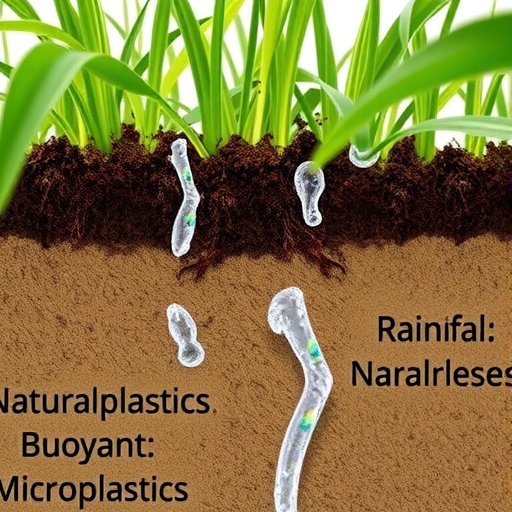
A hidden pathway may be helping buoyant microplastics move deeper into farmland than scientists previously expected: rainfall and irrigation. A new study reports that low-density polyethylene particles, which are light enough to float in water, can penetrate natural soils after being deposited at the surface. The finding challenges a common assumption built into many laboratory experiments—that microplastics enter soil mainly as particles already suspended in water and injected from one side of a test column. In real fields, however, fragments may lie on the ground after plastic mulch breaks down, wastewater solids are applied, or airborne debris settles. Once rain or irrigation begins, the particles can be pulled into the soil profile with flowing water, potentially creating a route toward groundwater and plant-root zones.
The research team developed a modified column experiment designed to reproduce that surface-release scenario. Rather than mixing microplastics into a water suspension and forcing the mixture horizontally or from the bottom of a packed column, the scientists placed buoyant low-density polyethylene particles on the soil surface and applied water from above. They tested the particles in different farmland soil types and used mathematical modeling to track how particles moved, became temporarily trapped, and were later released. The approach was intended to capture the behavior of particles under unsaturated conditions, when soil pores contain both air and water, as well as during wetting events that change the structure of the flow paths.
The experiments showed substantial penetration of buoyant microplastics into soil under both rainfall and irrigation conditions. That result is striking because buoyancy appears, at first glance, to work against downward movement. A particle less dense than water tends to rise or remain at the water surface, but the soil is not an open pool. As water infiltrates through connected pores, it can drag particles into narrow channels, particularly when the particles are small enough to enter the pore network. Surface water can also create thin films and preferential flow pathways around grains. The downward movement therefore depends not only on particle density, but on water flux, pore geometry, particle size, surface chemistry and the evolving balance between forces that retain particles and forces that mobilize them.
To describe that balance, the researchers applied a transport model incorporating mechanisms traditionally used for colloidal particles in porous media. One mechanism is attachment, in which a microplastic collides with a soil grain and remains held by surface forces. Detachment is the reverse process: a change in water chemistry or flow can dislodge a previously retained particle. Straining occurs when a particle becomes physically trapped because it is too large to pass through a pore throat. Blocking can develop when retained particles accumulate and alter the available pathways, potentially redirecting later particles or changing the local permeability. These processes do not simply remove microplastics from the moving water; they can produce pulses of retention and release, meaning particles may remain hidden in soil and then reappear during a later storm or irrigation cycle.
The soil itself strongly influenced the outcome. Buoyant microplastic transport was greater in silt than in silt loam, while silt loam retained more particles. Soil texture controls the size distribution and connectivity of pores: larger, better-connected pathways can permit particles to move farther, whereas finer or more complex structures increase the likelihood of trapping. Yet the relationship is not as simple as “coarser soil means more transport.” A particle must negotiate constrictions, grain surfaces and changes in water saturation, and even small differences in pore architecture can determine whether it travels downward or becomes lodged. The findings suggest that risk assessments based on a single standardized sand or artificially packed medium may fail to represent how microplastics behave in actual agricultural soils.
The study also examined natural organic matter, a chemically complex mixture derived from decomposed plants, microbes and other biological material. The presence of this material increased the transport of buoyant microplastics. Natural organic matter can coat both plastic surfaces and soil minerals, changing their surface charge, wettability and tendency to aggregate. It may act as a stabilizing layer that reduces particle clumping, keeping individual microplastics mobile in infiltrating water. It can also alter the interactions between a particle and a soil grain, weakening attachment or increasing electrostatic repulsion. In practical terms, the chemistry of a living, carbon-rich soil may allow more particles to remain suspended and move through pores than experiments using purified water would predict.
Weathering created another unexpected shift in particle behavior. The researchers found that ultraviolet-photodegraded microplastics traveled farther than pristine particles. Exposure to sunlight can oxidize the polymer surface, breaking or modifying chemical bonds and introducing new functional groups. These changes can increase the particle’s surface charge. When the particles and soil grains carry charges that repel one another, attachment becomes less favorable, allowing more microplastics to remain in the mobile water phase. Photodegradation can also roughen or fracture plastic surfaces, potentially changing their effective size and interaction with soil. The result is a paradox: environmental aging may make plastic fragments physically damaged, but chemically more mobile. A particle that has spent time exposed at the soil surface could therefore be more likely to enter the subsurface during a later wetting event than a freshly released fragment.
The work matters because agricultural soils are not isolated containers; they connect fields with drainage systems, streams, aquifers and crops. Microplastics that move below the surface may be difficult to recover, and retained particles can serve as a delayed source during future wetting and drying cycles. The study does not establish how much plastic reaches groundwater or enters plants under field conditions, nor does it measure ecological or human-health effects. Its importance is more immediate and foundational: it demonstrates that the starting conditions of an experiment can determine whether buoyant particles appear immobile or highly mobile. By combining a surface-release experiment with a model that accounts for attachment, detachment, blocking and straining, the researchers provide a framework for investigating real rainfall and irrigation events. As plastic use in agriculture continues and weather patterns become more intense or irregular, understanding these hidden transport pathways may be essential to predicting where microscopic fragments ultimately accumulate.
Cite Scienmag News
Gideon R. (August 28, 2026). How Rainfall and Irrigation Move Buoyant Microplastics Through Natural Soils. Scienmag. https://scienmag.com/how-rainfall-and-irrigation-move-buoyant-microplastics-through-natural-soils/
Gideon R. "How Rainfall and Irrigation Move Buoyant Microplastics Through Natural Soils." Scienmag, 28 August 2026, https://scienmag.com/how-rainfall-and-irrigation-move-buoyant-microplastics-through-natural-soils/. Accessed 28 August 2026.
Gideon R. "How Rainfall and Irrigation Move Buoyant Microplastics Through Natural Soils." Scienmag. August 28, 2026. https://scienmag.com/how-rainfall-and-irrigation-move-buoyant-microplastics-through-natural-soils/


