


Reinjected Mine Water Barely Closes the Pores of a Deep Sandstone Aquifer, Study Finds
What happens when the enormous volumes of water pumped from a mine are sent back underground? The answer could determine whether deep geological storage becomes a practical way to manage one of mining’s most difficult environmental legacies. A new study of the Liujiagou sandstone aquifer in China suggests that pretreated mine water with high concentrations of dissolved salts may be reinjected with surprisingly little damage to the rock’s ability to transmit fluids. Laboratory experiments, geochemical calculations and pore-scale models indicate that minerals do precipitate when mine water mixes with native groundwater, but the resulting loss of pore space is negligible. At the most reactive mixing condition tested, a one-to-one blend produced 85.22 milligrams of precipitated material per kilogram of porous medium, while estimated porosity reduction remained no greater than 0.0032. The result does not make every aquifer suitable for injection, but it offers a detailed framework for identifying formations in which mine water can be stored without rapidly choking the underground plumbing system.
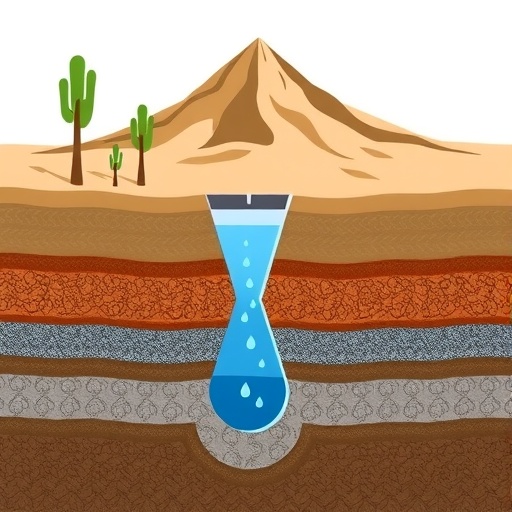
Mine water is often chemically challenging because it has interacted with freshly exposed rock, coal-bearing strata and mineral surfaces over long periods. Its total dissolved solids, or TDS, can be high, meaning that it carries substantial quantities of ions such as calcium, magnesium, sodium, sulfate and bicarbonate. Fluoride can also become a concern in some mining regions. Pumping this water to the surface for treatment or discharge requires energy and infrastructure, and releasing inadequately treated water can alter rivers, soils and groundwater. Deep-well reinjection offers an alternative: water is injected into a confined geological formation, where it can be isolated from sensitive surface environments and potentially recovered or managed underground. Yet the same chemistry that makes mine water difficult to handle can create a hidden engineering threat. When chemically different waters meet in the pores of a sandstone, dissolved constituents may combine into solid minerals, forming scale that narrows pore throats and increases resistance to flow.
The researchers focused on the Liujiagou sandstone aquifer, described as a low-permeability formation in China. “Low permeability” means that water moves slowly through the connected pore network, even when the rock contains abundant microscopic voids. In such formations, the narrow passages connecting larger pores are especially important: a small deposit at a pore throat can have a disproportionate effect on hydraulic conductivity. Permeability is not simply a measure of how much empty space a rock contains; it also reflects the size, shape and connectivity of that space. A porous material can retain substantial porosity yet become much less permeable if its most useful flow channels are narrowed or blocked. That is why the study examined both the amount of solid material formed and where it might accumulate, comparing a simplified homogeneous-deposition model with a pore-throat deposition model that represents the greater hydraulic sensitivity of constricted channels.
The first question was whether the mine water, after pretreatment, was chemically compatible with the receiving aquifer. The study’s comparative analysis found that the treated water generally met water-quality requirements, although modest additional reductions in sulfate and fluoride were indicated. This distinction matters because pretreatment is not only about protecting ecosystems or meeting regulatory limits. It can also control the chemical ingredients available for mineral formation after injection. Sulfate, for example, may participate in the formation of sulfate minerals when it encounters compatible cations under changed conditions. Carbonate minerals can form when calcium or other ions combine with carbonate species, particularly as pH, carbon dioxide conditions and ionic composition shift during mixing. Removing even a relatively small fraction of reactive components may therefore reduce the amount of solid phase that can form underground, though the study’s abstract does not specify the exact treatment process or concentration thresholds.
To determine what mixing could trigger, the team combined laboratory experiments with PHREEQC simulations. PHREEQC is a widely used geochemical modeling platform that calculates aqueous speciation, mineral saturation and potential reactions from water chemistry. The chemistry of groundwater is governed not only by the total concentration of an element but also by the forms in which it exists. A sulfate-bearing solution, for instance, may contain ions whose behavior changes with acidity, temperature and the presence of other dissolved species. A mineral becomes thermodynamically capable of precipitating when the relevant ions reach a saturation state above equilibrium, although actual precipitation can be slowed by kinetic barriers or limited nucleation. By comparing experimental observations with PHREEQC calculations, the researchers could assess which mineral groups were most likely to control the reaction and how precipitation changed across different proportions of mine water and aquifer water.
The strongest mixing-induced precipitation occurred at a 1:1 ratio, where the study measured 85.22 milligrams of precipitated sulfate and carbonate material per kilogram. That peak is scientifically important because the most concentrated mine water is not necessarily the most dangerous mixture. Reactions can intensify at an intermediate composition when ions supplied by two different waters meet in proportions that favor mineral saturation. In the subsurface, the mixing zone would not be a single sharp boundary. Dispersion, diffusion and the geometry of fractures and pores would spread the fluids across a range of compositions. A moving front could therefore pass through locally reactive ratios even if the injected water and native groundwater were individually stable. The study’s identification of the one-to-one mixture as the maximum precipitation condition gives operators a potential warning point: injection designs should account for the chemistry of the mixing zone, rather than evaluating the mine water in isolation.
Despite the precipitation, the modeled impact on the aquifer’s pore space was extremely small. The calculated porosity reduction was no greater than 0.0032, described by the researchers as negligible, and the corresponding effect on permeability was expected to be minimal. Porosity is the fraction of the rock occupied by voids, whereas permeability describes the ease with which fluid can pass through connected voids. These properties are related but not interchangeable. A deposit spread evenly through a porous medium may consume some pore volume without severely disrupting flow. Deposition concentrated at pore throats can be more consequential because flow resistance rises sharply as the effective radius of a narrow channel shrinks. The researchers’ use of both homogeneous and pore-throat models was intended to test these contrasting possibilities. Their results suggest that, for the Liujiagou conditions represented in the study, neither assumed pattern produced a substantial loss of hydraulic function.
The findings nevertheless come with boundaries that are essential for interpreting them. The work evaluates a particular mine-water and sandstone system, not all geological storage sites. Mineral precipitation depends on water composition, temperature, pressure, residence time, flow velocity and the mineralogy of the host rock. Long-term reactions can also differ from short laboratory experiments. A sandstone may initially experience precipitation but later undergo dissolution, or deposits may redistribute as fluids continue to move. Biological processes, suspended particles and changes in injection rate can contribute to clogging as well. The study’s low predicted porosity loss therefore should not be read as proof that deep reinjection is universally safe. Instead, it indicates that hydrochemical screening and pore-scale assessment can distinguish a manageable precipitation risk from a potentially severe one before an injection project is built.
That predictive approach could become increasingly valuable as mining regions look for ways to handle water below ground. The researchers integrated water-chemistry comparisons, laboratory testing, numerical geochemical simulation and pore-structure characterization into a single assessment framework. In practical terms, such a framework could be used to test candidate aquifers, identify problematic mixing ratios and estimate how much mineral deposition a formation can tolerate. It could also help determine whether sulfate or fluoride removal should be increased during pretreatment, and whether injection should be adjusted to avoid creating a particularly reactive chemical front. Monitoring would remain crucial. Operators would need to track injection pressure, flow rates and the chemistry of recovered or observation-well samples, because a gradual rise in pressure could signal increasing hydraulic resistance even before large-scale porosity loss became obvious.
The study turns a dramatic underground risk into a measurable design problem. Mine-water reinjection is often presented as a choice between surface discharge and permanent disposal, but the geology beneath a mine can behave more like a reactive chemical reactor than an inert container. Every injected litre can encounter minerals and groundwater that change its composition, and those reactions can reshape the microscopic pathways that carry fluid. In the Liujiagou sandstone analysis, the chemistry produced a clear precipitation peak, yet the resulting pore blockage was predicted to be too small to meaningfully impair permeability. That combination—detectable mineral formation but minimal hydraulic damage—suggests that high-TDS mine water may be stored in suitable low-permeability sandstone formations when treatment and compatibility are carefully designed. The next challenge is extending these calculations from controlled experiments and models to long-duration field operations, where geological complexity and years of chemical transport will ultimately decide whether the underground strategy remains sustainable.
Cite Scienmag News
Violet Maxwell. (August 28, 2026). Mine-Water Reinjection Alters Hydrochemistry, Sediments, and Groundwater Flow in Tight Sandstone Aquifers. Scienmag. https://scienmag.com/mine-water-reinjection-alters-hydrochemistry-sediments-and-groundwater-flow-in-tight-sandstone-aquifers/
Violet Maxwell. "Mine-Water Reinjection Alters Hydrochemistry, Sediments, and Groundwater Flow in Tight Sandstone Aquifers." Scienmag, 28 August 2026, https://scienmag.com/mine-water-reinjection-alters-hydrochemistry-sediments-and-groundwater-flow-in-tight-sandstone-aquifers/. Accessed 3 September 2026.
Violet Maxwell. "Mine-Water Reinjection Alters Hydrochemistry, Sediments, and Groundwater Flow in Tight Sandstone Aquifers." Scienmag. August 28, 2026. https://scienmag.com/mine-water-reinjection-alters-hydrochemistry-sediments-and-groundwater-flow-in-tight-sandstone-aquifers/


