


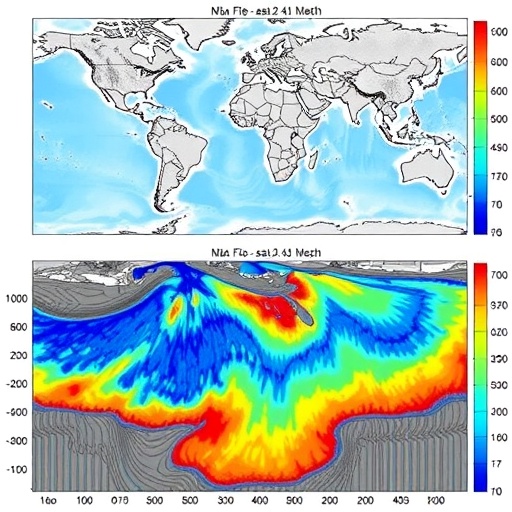
Earthquake scientists have developed a revised computer-simulation method that could make it easier to predict how powerful thrust earthquakes shake the ground, addressing a weakness that has long distorted estimates in an important part of the seismic-frequency spectrum. The approach combines the widely used stochastic extended finite-fault simulation method, known as EXSIM, with a new composite representation of earthquake rupture. Tests involving the 2013 magnitude 6.7 Lushan earthquake in China and six magnitude 6.5-or-greater thrust earthquakes in Japan indicate that the method can reproduce recorded ground motions more consistently from low to high frequencies. The result is not an earthquake-prediction system in the everyday sense: it cannot say when or exactly where the next earthquake will occur. Instead, it is a way to generate physically informed estimates of the shaking that hypothetical or past earthquakes could produce, potentially improving seismic hazard maps, building design, emergency planning and the assessment of regions where large earthquakes are possible but observations remain limited.
The problem begins with the complexity of an earthquake source. A major earthquake does not rupture as a single point that releases energy uniformly. It tears across a fault surface, often over tens or hundreds of kilometres, while different sections slip by different amounts and radiate seismic energy with different strengths. A thrust earthquake occurs when one block of crust is pushed up and over another, commonly at subduction zones where one tectonic plate dives beneath another. These events can generate intense and prolonged shaking, and their shallow portions may produce particularly important long-period motions. To simulate them, researchers divide the fault into many smaller subfaults. Each subfault is assigned properties such as rupture timing, slip, stress drop and radiation behaviour. The individual contributions are then combined after accounting for wave propagation, geometric spreading, attenuation and the response of local geological materials. This finite-fault strategy captures spatial variation that a simpler point-source model cannot.
EXSIM has become a standard tool for this type of calculation because it can produce broadband ground motions without requiring the immense computational resources of a fully dynamic rupture simulation. In a stochastic simulation, the earthquake’s frequency content is represented statistically, typically through a source spectrum that describes how much energy is radiated at different frequencies. Random phases are then used to construct time histories, while the model incorporates distance-dependent path effects and site amplification. The method is especially useful when engineers need many scenarios, including earthquakes that have not yet occurred. Yet the researchers identify a significant limitation in conventional EXSIM calculations: for large thrust earthquakes, it can overpredict ground motion at low to intermediate frequencies. Such frequencies are associated with shaking periods that can strongly affect large buildings, bridges, industrial facilities and sedimentary basins. An overestimate may lead to conservative designs, but it can also misrepresent which structures and locations face the greatest risk.
The source of the bias is linked to the way earthquake spectra are represented. Many small and moderate earthquakes can be approximated with a single corner frequency, a transition in the spectrum associated with the size and duration of the rupture. Large shallow thrust earthquakes, however, often show a double-corner-frequency source model. In simplified terms, the spectrum changes slope at two characteristic frequencies rather than one, reflecting the fact that different parts or scales of rupture contribute distinct energy patterns. A model that does not adequately represent this structure can assign too much energy to the low-to-intermediate-frequency range when it scales the motions of smaller subevents to a larger fault. The issue becomes more pronounced as rupture dimensions, slip distributions and source complexity increase. Rather than treating the discrepancy as a simple correction factor, the new method modifies the fault representation itself, allowing the spatial distribution of high-stress regions to influence the simulated spectrum and the resulting time histories.
Its central innovation is an asperity-distributed stress-drop composite fault model. An asperity is a section of a fault that releases an unusually large amount of stored elastic energy relative to surrounding areas, often because it experiences greater slip or has a higher effective stress drop. In the new representation, these energetic patches are distributed across a composite fault rather than being imposed through a uniform stress-drop assumption. Stress drop is the difference between the shear stress acting on a fault before rupture and the residual stress after slip; it is a key parameter controlling the amplitude and frequency content of radiated waves. By assigning stress drop in a spatially variable way, the model can distinguish concentrated, energetic rupture zones from less active parts of the fault. The approach is designed to preserve the overall scaling of a large earthquake while avoiding the artificial amplification that may arise when every subfault is treated as an equivalent miniature source. It therefore links the statistical efficiency of EXSIM with a more realistic representation of rupture heterogeneity.
The researchers then apply EXSIM in a hybrid configuration with the composite fault model. In practical terms, the calculation retains the stochastic method’s ability to synthesize broadband motions while using the new fault construction to control how source energy is distributed across frequency and space. The simulated waves are compared with recordings from real earthquakes, allowing the method to be evaluated against observed acceleration time histories and their spectral characteristics. The validation includes the 2013 Lushan earthquake, which struck Sichuan Province and is classified as a thrust event, as well as six thrust earthquakes in Japan with moment magnitudes of at least 6.5. Moment magnitude, written Mw, estimates the energy released from the seismic moment and is particularly suitable for large earthquakes because it does not saturate as quickly as some older magnitude scales. Japan provides an especially valuable testing environment because its dense strong-motion networks have recorded numerous earthquakes across varied source, path and site conditions.
Across the case studies, the improved method reportedly produced consistent agreement with observations at both high and low frequencies. The study summarizes this performance with a combined goodness-of-fit value, or CGOF, below 0.35. Goodness-of-fit measures condense differences between simulated and recorded motions into a performance indicator; lower values in this framework signify closer agreement. The result suggests that the revised method avoids the low-frequency overprediction associated with conventional EXSIM while retaining its ability to reproduce higher-frequency shaking. High-frequency waves are especially important for short, stiff structures and for the sharp accelerations that can damage nonstructural components, whereas lower-frequency motions can control the response of taller or more flexible structures. Matching both ranges matters because an earthquake record is not defined by a single peak value. Two sites can experience similar peak acceleration yet impose very different demands on buildings if their spectral energy is concentrated at different periods. A model that captures the full spectrum can therefore provide more useful information for engineering analysis than one that matches only a single intensity measure.
The advance could be particularly important for scenario-based hazard assessments, where researchers simulate earthquakes in places with sparse instrumental records or explore events larger than those observed during the modern monitoring era. Direct observations provide the strongest test of any model, but earthquake catalogues are necessarily incomplete: the largest events are rare, and each fault system has its own geometry, geology and rupture history. Stochastic finite-fault techniques allow scientists to generate suites of plausible motions by varying magnitude, fault dimensions, rupture velocity, stress drop, site conditions and other parameters. The new formulation may broaden the range of thrust-faulting scenarios that can be modelled without systematically exaggerating part of the frequency spectrum. That could help estimate the demand on lifelines, hospitals, transportation corridors and densely populated urban areas near subduction zones. It could also support rapid post-earthquake analysis by enabling researchers to reconstruct likely shaking fields when recordings are unavailable or unevenly distributed.
The method does not eliminate the uncertainties inherent in earthquake simulation. The location and size of asperities cannot generally be known in advance, and stress drop is not a directly observed quantity at every point on a fault. Ground motion is also shaped by three-dimensional geological structures, basin effects, wave scattering and local soil conditions that may not be fully captured in a simplified stochastic framework. The researchers’ validation demonstrates improved performance for the earthquakes and datasets examined, but it does not guarantee equal accuracy for every tectonic setting or magnitude range. In addition, a combined goodness-of-fit score compresses multiple aspects of a waveform into one measure and should be considered alongside spectral shapes, duration, spatial patterns and engineering intensity measures. The value of the work is therefore not that it turns uncertainty into certainty, but that it offers a more physically responsive way to represent a known source-model limitation.
By combining a variable-stress-drop description of asperities with EXSIM, Wanjun Ma and Zhinan Xie provide a route toward more reliable simulations of complex large thrust earthquakes. Their results indicate that the revised framework can reproduce ground motions across the spectrum without sacrificing the speed and flexibility that make stochastic methods attractive. As earthquake engineers increasingly need realistic scenarios for structures and infrastructure exposed to rare but devastating events, such improvements can have consequences far beyond seismological modelling. Better simulations can reveal whether a bridge is vulnerable to short-period pulses, whether a tall building may resonate with long-period basin motion, or how a proposed emergency network might perform under several plausible ruptures. The method is not a crystal ball, but it may give scientists and engineers a clearer, more balanced picture of the shaking that powerful earthquakes can unleash.
Cite Scienmag News
Violet Maxwell. (August 28, 2026). Improved Stochastic Finite-Fault Simulations Applied to Large-Magnitude Thrust Earthquakes. Scienmag. https://scienmag.com/improved-stochastic-finite-fault-simulations-applied-to-large-magnitude-thrust-earthquakes/
Violet Maxwell. "Improved Stochastic Finite-Fault Simulations Applied to Large-Magnitude Thrust Earthquakes." Scienmag, 28 August 2026, https://scienmag.com/improved-stochastic-finite-fault-simulations-applied-to-large-magnitude-thrust-earthquakes/. Accessed 10 September 2026.
Violet Maxwell. "Improved Stochastic Finite-Fault Simulations Applied to Large-Magnitude Thrust Earthquakes." Scienmag. August 28, 2026. https://scienmag.com/improved-stochastic-finite-fault-simulations-applied-to-large-magnitude-thrust-earthquakes/


