


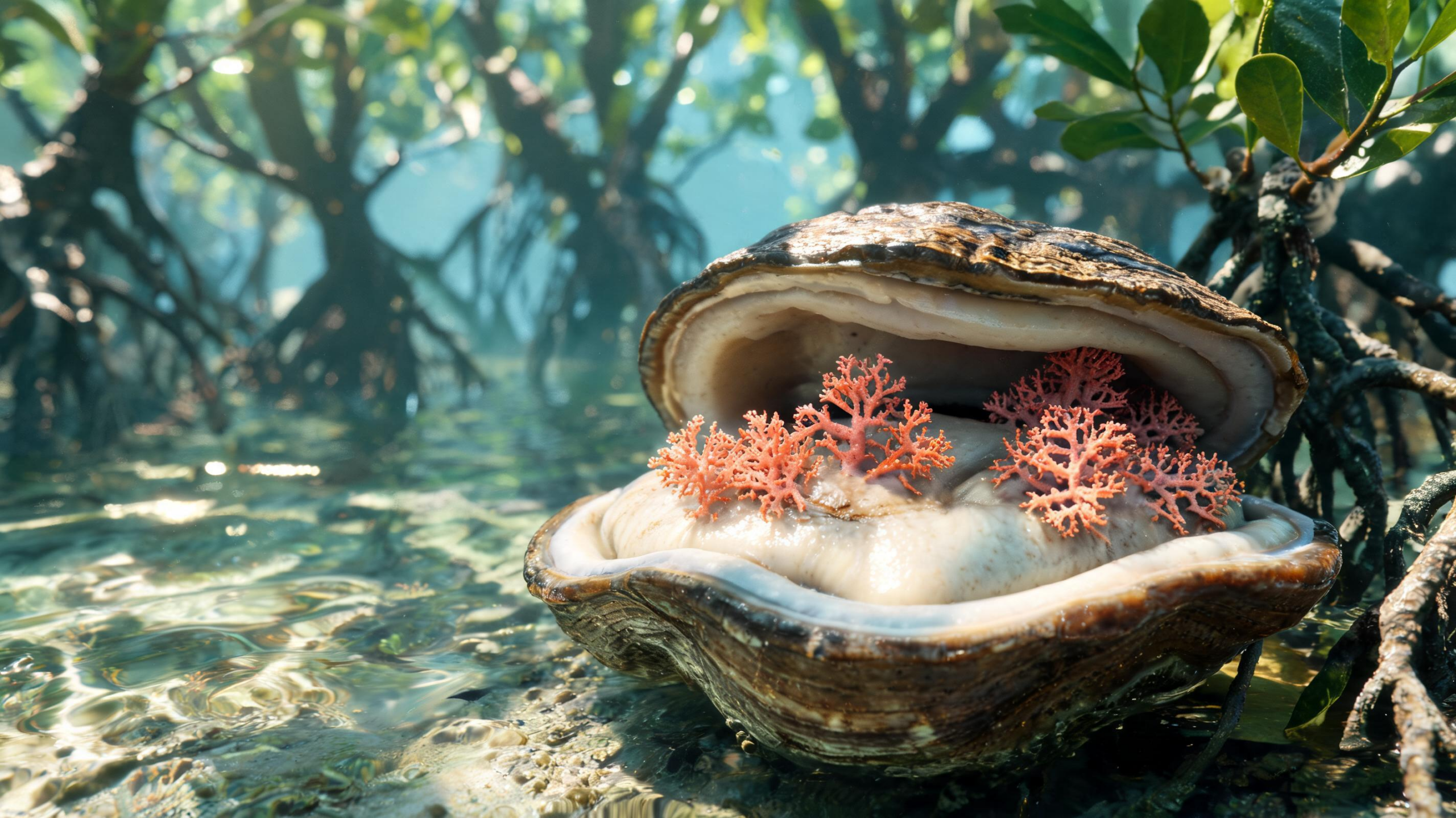
Deep in the mangrove sediments of Madakkara, a small coastal habitat in northern Kerala, India, researchers have uncovered a biological partnership that no one had ever documented before. Eighteen specimens of the mangrove mud clam Geloina expansa, hand-collected from soft, organically rich sediments between July and September 2023, turned out to harbor microscopic golden-brown algal cells embedded within their mantle and gill tissues. These cells, identified morphologically as members of the dinoflagellate family Symbiodiniaceae, are the same group of photosynthetic symbionts famous for powering the world’s coral reefs and giant clams. The discovery, published in the journal Discover Oceans, marks the first time an association between Symbiodiniaceae and a mangrove clam has been reported, and it opens an entirely new window into the hidden symbiotic networks of tropical intertidal ecosystems.
The team, led by P. C. Shamily Catherine of Cochin University of Science and Technology together with Graham Oliver of the National Museum of Wales, had set out on a broader bivalve diversity survey along the Kerala coast. Geloina expansa, first described by Mousson in 1849, is a large, semi-infaunal cyrenoidid clam that lives buried in the soft sediments of mangrove forests across the Indo-Pacific. These animals are remarkable survivors, equipped with thick shells bearing a pale green to black periostracum and a physiology that tolerates low oxygen, elevated organic loads, and wildly fluctuating salinity. Individuals have been reported to survive out of water for nearly two weeks, resuming filtration immediately upon re-immersion. The specimens examined in this study averaged roughly 65 millimeters in shell height, 70 millimeters in length, and 66 grams in total weight.
The environment from which the clams were collected is itself instructive. Water in the tidal channel at the sampling site, located at 11.957631 degrees North and 75.306013 degrees East, registered a temperature of 30 plus or minus 2.5 degrees Celsius, a salinity of 35 plus or minus 0.5 parts per thousand, dissolved oxygen of 3.7 plus or minus 0.5 milligrams per liter, and a slightly alkaline pH of 7.32. The redox potential of minus 39.6 millivolts betrayed the strongly reducing conditions characteristic of mangrove sediments. Sediment analysis classified the substrate as loamy sand, dominated by 77.5 percent sand with 21 percent silt and 1.5 percent clay, and revealed an organically enriched matrix containing 14.26 grams of total organic carbon per kilogram. Such conditions, warm, saline, and nutrient-rich, are exactly the kind that favor both bivalve filtration activity and the proliferation of photosynthetic dinoflagellates.
The pivotal moment came during routine morphological and anatomical examinations. Darkly pigmented regions were noticed in the mantle tissue of the clams, prompting closer inspection. Microscopic sections of the mantle, siphon, and gill tissues revealed distinct golden-brown, globular microalgal cells embedded within the epithelial layer. These structures were abundant in the mantle and occurred at lower densities within the siphons, and, strikingly, they were present in every single one of the eighteen specimens examined. The observations were made on unstained fresh tissue sections using a Leica DM6 epifluorescence microscope with LAS X software, a choice that preserved the natural pigmentation and morphology of the cells.
Under 40-times magnification, the cells appeared spherical to slightly oval, typically measuring 6 to 10 micrometers in diameter. They displayed the golden-brown coloration characteristic of photosynthetic dinoflagellates, with distinct cell walls and internal granules suggestive of chloroplast structures. Their distribution was far from random. The cells were unevenly spread, often forming small clusters along the outer mantle folds, but were conspicuously absent from deeper tissue layers. This consistent localization within the epithelium of the mantle and gills across multiple individuals strongly supports a genuine intracellular endosymbiotic association rather than surface contamination or accidental ingestion of algae during filter feeding.
The researchers attempted to confirm the taxonomic identity of the cells using molecular methods, but repeated attempts were thwarted by extremely low DNA yields from the intracellular algae. As a result, the identification rests on morphological characteristics alone: the spherical to ovoid shape, golden-brown pigmentation, and intracellular occurrence, all of which are consistent with previous descriptions of Symbiodiniaceae. The authors are appropriately candid about this limitation, noting that molecular confirmation, ideally through metabarcoding approaches, will be essential for pinning down the exact genus and species of the symbiont and for understanding its evolutionary relationship to the symbionts of corals and giant clams.
Why does this discovery matter? In well-studied systems, Symbiodiniaceae are ecological powerhouses. In reef-building corals and giant clams of the family Tridacnidae, these algae translocate enormous quantities of photosynthetically fixed carbon to their hosts, often supplying more than 50 percent of the host’s metabolic energy needs. Photosynthesis-irradiance studies on the giant clam Tridacna maxima have shown that over a 24-hour cycle, the symbionts produce more oxygen than the host consumes. The clams, in turn, exercise exquisite control over their algal partners. Daily fluctuations in hemolymph pH, rising during the day as photosynthesis peaks and falling at night, regulate the diffusion of ammonia into the host’s tissues, with more ammonium becoming available to the algae when pH drops. Nitrogen, particularly ammonium, is the key nutrient promoting algal growth, while phosphorus remains strictly regulated by the host. Recent research has even suggested that nitrogen competition is a fundamental mechanism underlying stable host-Symbiodiniaceae partnerships across cnidarians.
Symbiont-bearing bivalves also deploy sophisticated cellular machinery to support their algae. Carbon-concentrating mechanisms involving H+-ATPase and carbonic anhydrase facilitate inorganic carbon uptake for symbiont photosynthesis, and light-enhanced ion transport processes have been linked to shell formation in giant clams. Known examples of Symbiodiniaceae associations extend beyond corals and tridacnids to radiolarians, jellyfish such as the mangrove-associated Cassiopea xamachana, and even flatworms that partner with a different microalga, Tetraselmis convolutae. In giant clams, the algae reside within specialized tubular structures called Z-tubes, and individuals can host multiple genetically distinct symbiont types simultaneously, suggesting flexibility to adjust symbiont communities in response to changing environmental conditions. Yet comparable relationships in bivalves inhabiting mangrove habitats have rarely been investigated, which is precisely what makes the Kerala discovery so significant.
The authors caution that their findings do not provide direct evidence that the Symbiodiniaceae association helps Geloina expansa tolerate desiccation or anoxia, despite the clam’s legendary ability to survive prolonged aerial exposure. Rather, they suggest the association is more likely related to nutritional or physiological enhancement under the warm, saline, nutrient-rich estuarine conditions where these clams live. If the partnership mirrors what is seen in giant clams, the photosynthetic contribution could meaningfully supplement the clam’s filter-feeding diet, contributing to what symbiosis researchers call the CZAR value, the contribution of zooxanthellae to animal respiration. Given the central role mangrove ecosystems play in nutrient cycling, organic matter turnover, and carbon sequestration, an abundant photosynthetic symbiont inside a common mangrove clam could have ripple effects for ecosystem functioning that extend well beyond the individual animal.
The Kerala mangroves, dominated by Avicennia officinalis and Rhizophora mucronata with scattered patches of Ceriops tagal and Sonneratia alba, stabilize shorelines, filter pollutants, nursery juvenile fish and invertebrates, and act as major carbon sinks. Positive species-specific associations between mangrove trees and bivalves, such as Aegiceras floridum with Geloina and Avicennia alba with Saccostrea, hint at tightly woven ecological networks. The discovery of a photosynthetic symbiont inside one of these clams adds an entirely new thread to that web. The researchers emphasize that quantitative estimation of symbiont density, molecular confirmation of symbiont identity, and physiological experiments measuring carbon translocation are the logical next steps. If future work confirms that Geloina expansa derives substantial nutrition from its algal tenants, mangrove conservation efforts may need to account not only for the trees and the sediments but also for the microscopic partnerships humming quietly beneath the mud, a reminder that even in the murkiest corners of tropical coastlines, symbiosis continues to surprise science.
From a methodological standpoint, the Kerala study also illustrates both the power and the constraints of morphology-based symbiosis research in understudied tropical environments. Unstained fresh preparations allowed the investigators to document the natural golden-brown autofluorescence and pigmentation of the algal cells, but low DNA yields from cells buried inside host tissue are a well-recognized obstacle in this field. Intracellular symbionts are often present in small numbers per sample, and host tissue can inhibit polymerase chain reactions, which is why future studies of mangrove bivalves may need to rely on fluorescence in situ hybridization, symbiont culturing, or careful cell isolation before genetic sequencing becomes feasible.
The finding also raises evolutionary questions about how such partnerships arise in estuarine settings. Mangrove tidal creeks experience strong diel and seasonal swings in light, temperature, and salinity, conditions that would seem hostile to photosynthetic dinoflagellates that are famous for their sensitivity to environmental stress in coral reefs. Yet the reducing, organically loaded sediments where Geloina lives did not preclude a stable association across every specimen sampled during the 2023 survey window. Whether the symbionts persist in the clams year-round, are reacquired repeatedly from the water column, or are transmitted vertically during reproduction remains unknown, and each scenario would carry different implications for how resilient the partnership might be to coastal development, pollution, and climate-driven changes in monsoon patterns that shape Kerala’s mangrove waterways.
Subject of Research: Symbiotic association between Symbiodiniaceae dinoflagellates and the mangrove mud clam Geloina expansa in Kerala, India
Article Title: Discovery of Symbiodiniaceae symbiosis in the mangrove mud clam Geloina expansa (Mousson, 1849) from Kerala, India
Article References: Catherine, P. C. S., Oliver, G., Nazar, S. M., P, K. P., & Nandan, S. B. (2026). Discovery of Symbiodiniaceae symbiosis in the mangrove mud clam Geloina expansa (Mousson, 1849) from Kerala, India. Discover Oceans, 3(1), Article 55. https://doi.org/10.1007/s44289-026-00168-8
Image Credits: AI Generated
DOI: 10.1007/s44289-026-00168-8
Keywords: Symbiodiniaceae, zooxanthellae, mangrove ecosystems, Geloina expansa, bivalve symbiosis, dinoflagellates, Kerala, giant clams, endosymbiosis, marine biology, coastal ecology, microscopy
Cite Scienmag News
Gavin Prescott. (September 10, 2026). Scientists Find Coral-Like Algal Symbiosis Hiding Inside a Mangrove Clam. Scienmag. https://scienmag.com/scientists-find-coral-like-algal-symbiosis-hiding-inside-a-mangrove-clam/
Gavin Prescott. "Scientists Find Coral-Like Algal Symbiosis Hiding Inside a Mangrove Clam." Scienmag, 10 September 2026, https://scienmag.com/scientists-find-coral-like-algal-symbiosis-hiding-inside-a-mangrove-clam/. Accessed 4 October 2026.
Gavin Prescott. "Scientists Find Coral-Like Algal Symbiosis Hiding Inside a Mangrove Clam." Scienmag. September 10, 2026. https://scienmag.com/scientists-find-coral-like-algal-symbiosis-hiding-inside-a-mangrove-clam/


