


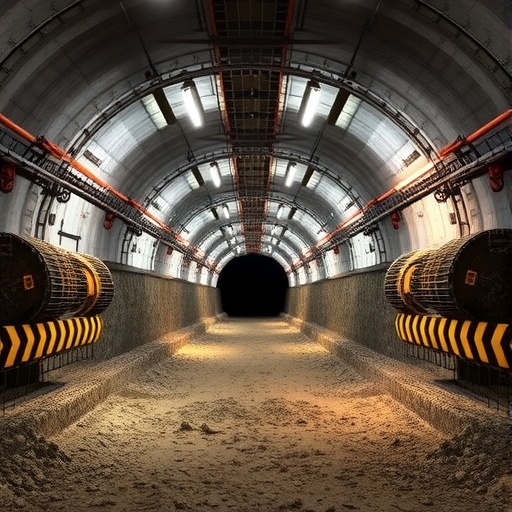
A new earthquake-engineering study of Catania, Sicily, suggests that the seismic safety of an urban tunnel cannot be judged by examining the tunnel alone. The surrounding soil, the rock layers beneath it, and buildings standing at the surface can behave as one mechanically coupled system, reshaping how earthquake energy travels through the ground and how forces accumulate in a tunnel lining. Using detailed computer simulations of a representative section of Catania’s metro network, researchers found that the response of the tunnel–soil–building system depends strongly on the arrangement of geological layers and the frequency content of the earthquake. In some configurations, the nearby building had little measurable effect on forces inside the tunnel. Yet the same study shows why that apparently reassuring result cannot be generalized: a different soil profile or structural arrangement could produce a substantially different outcome.
The analysis focused on a section of the Nesima–Misterbianco underground railway segment near the Si3 borehole. Catania is particularly important for this type of investigation because it combines active seismic hazard with complicated volcanic geology. The modeled tunnel is a reinforced-concrete circular structure 10 meters in external diameter, with a 0.32-meter-thick lining and approximately 17 meters of soil cover in the reference configuration. A four-story reinforced-concrete building sits at the ground surface, initially positioned 20 meters from the tunnel axis. The building is 15.2 meters high and 18.8 meters wide, supported by foundation beams. Beneath the surface, the tunnel crosses materials with sharply contrasting stiffness: a relatively rigid lava layer and more deformable volcanoclastic breccia. That boundary, rather than simply the tunnel’s depth, proved central to the seismic response.
To reproduce the site, Glenda Abate and Angela Fiamingo of the University of Catania built nine two-dimensional finite-element models. The models varied the tunnel’s cover depth and the building’s horizontal offset, while keeping the tunnel geometry fixed. Three earthquake inputs were then applied: a 1990 recorded motion from Sortino, about 50 kilometers from Catania, and synthetic accelerograms representing the historical earthquakes of 1693 and 1818. All were scaled to the same bedrock acceleration of 0.383 times gravitational acceleration, allowing the simulations to isolate the effect of frequency content rather than simply comparing stronger and weaker shaking. The numerical domain extended 80 meters vertically and 300 meters horizontally and was divided into eight soil layers. Special boundary conditions and base dashpots were used to prevent artificial reflections of seismic waves from contaminating the results.
The soil itself was modeled using an equivalent-linear viscoelastic approach, a common engineering method for representing nonlinear behavior without the enormous data requirements of a fully nonlinear simulation. During an earthquake, soil stiffness generally decreases as shear strain increases, while energy dissipation, represented by damping, rises. The researchers iteratively adjusted the shear modulus and damping ratio of each layer according to the strain generated by each earthquake motion. The site’s equivalent shear-wave velocity was about 541 meters per second, placing it in the Italian Building Code’s type-B soil category, while the conventional seismic bedrock was estimated at a depth of 80 meters. Field investigations included boreholes, standard penetration tests, down-hole measurements, horizontal-to-vertical spectral-ratio tests and laboratory sampling. Together, these data allowed the numerical model to represent a real stratified volcanic environment rather than an idealized block of uniform soil.
The most striking result concerned the position of the tunnel relative to the geological boundary. When the tunnel cover was only 7 meters, the entire circular lining remained within the stiff lava layer. Because that material undergoes relatively small earthquake-induced shear strains, the tunnel experienced the lowest bending moments in the simulations. At a 17-meter cover, however, the tunnel crossed a larger portion of the softer volcanoclastic breccia, where deformation was greater and bending moments rose. The transition between the two materials also produced localized peaks in bending demand. This happens because seismic waves do not distort a uniform ground mass in the same way they distort adjacent layers with different stiffness: the interface forces the soil movement to change over a short distance, imposing curvature on the tunnel. Axial forces increased more gradually with depth, but bending forces were especially sensitive to whether a material discontinuity intersected the tunnel.
The earthquake’s frequency content was almost as important as its amplitude. Although the three input motions were normalized to the same bedrock acceleration, they did not produce the same tunnel forces or surface shaking. The 1818 synthetic motion generated the largest bending moments and axial forces, while the 1693 motion generally produced the lowest peak ground accelerations. The explanation lies in resonance and soil nonlinearity. A ground deposit has natural frequencies determined by its thickness and shear-wave velocity. When important frequencies in incoming seismic energy approach those of the soil column, wave amplification can become pronounced. In the simulations, one of the dominant frequencies of the 1818 motion was close to a fundamental frequency of the soil deposit, favoring strong amplification. Larger strains then softened the soil and altered the distribution of seismic energy, demonstrating why earthquake magnitude alone is not enough to predict tunnel demand.
The nearby building had a surprisingly limited influence on the tunnel lining forces in the configurations studied. Moving the building relative to the tunnel produced comparable bending moments and axial forces, and the calculated tunnel response was close to results from earlier models that omitted the building. The researchers attribute this behavior in part to the exceptional stiffness of the lava layer around the tunnel, which appears to isolate the lining from much of the building’s dynamic influence. But the finding is not a universal safety rule. A building changes stresses and boundary conditions in the soil, and its foundations can interact with seismic waves moving between the surface and underground structures. Earlier work by the same researchers, using another Catania metro configuration, found that aboveground structures could significantly modify the coupled response. The new study therefore emphasizes a counterintuitive lesson: the absence of strong interaction is itself a result that must be demonstrated through case-specific analysis, not assumed in advance.
The simulations also revealed a potentially important difference between tunnel-level and surface-level behavior. At the ground surface, the Italian code’s reference peak horizontal acceleration of 0.396 g was consistently lower than the accelerations calculated by the finite-element models. Surface acceleration varied much more with the earthquake record than with the building position or tunnel cover. Along the tunnel alignment, however, peak ground accelerations were generally reduced compared with the free field and the building alignment, indicating a deamplification effect associated with the underground structure. The tunnel did not simply amplify every component of motion; its stiffness and geometry altered the propagation of waves through the surrounding soil. This could affect not only the lining but also the shaking experienced by structures at the surface. Response spectra, which show how oscillators with different natural periods react to an earthquake, displayed similar trends: model geometry had a relatively small influence in this case, whereas the selected seismic input produced clear differences.
To test whether simpler engineering formulas could replace a full numerical model, the authors compared their results with classical analytical solutions developed by Wang in 1993 and by Penzien for circular tunnels in homogeneous soil. The equations estimate lining bending moments and axial forces from tunnel stiffness, soil properties, radius, thickness and maximum shear strain. The researchers adapted the formulas by assigning different material properties and strain levels to the portions of the tunnel crossing each geological layer. This practical approach produced reasonably close estimates of maximum bending moments in several scenarios, making it potentially useful for preliminary screening. However, the Penzien-based calculations substantially underestimated maximum axial forces, and the analytical predictions became less reliable as the contrast between the lava and breccia increased. The formulas also tended to miss the sharper force concentrations generated at the soil interface. For final design, the study therefore supports detailed finite-element analysis, especially where tunnels cross strong geological discontinuities.
The researchers say the findings have direct implications for earthquake-resilient urban infrastructure. Underground railways can reduce congestion, travel times and vehicle emissions, but their resilience depends on more than the strength of the concrete lining. Accurate assessments must account for the tunnel’s depth, the position and stiffness of nearby buildings, the shape of the tunnel, the nonlinear response of soil and the frequency characteristics of plausible earthquakes. In Catania, a tunnel placed entirely within stiff lava behaved differently from one intersecting softer breccia, even when the overall geometry and earthquake intensity were similar. The study does not predict that every tunnel will suffer severe damage, nor does it identify a single universally dangerous configuration. Instead, it shows that geological interfaces can act as hidden controls on seismic demand and that apparently minor changes in tunnel placement may alter the forces imposed on the lining. As cities expand underground, mapping those interfaces may become as important as inspecting the structures built above them.
Cite Scienmag News
Violet Maxwell. (August 26, 2026). Study examines tunnel–soil–structure interactions during dynamic loading in Catania. Scienmag. https://scienmag.com/study-examines-tunnel-soil-structure-interactions-during-dynamic-loading-in-catania/
Violet Maxwell. "Study examines tunnel–soil–structure interactions during dynamic loading in Catania." Scienmag, 26 August 2026, https://scienmag.com/study-examines-tunnel-soil-structure-interactions-during-dynamic-loading-in-catania/. Accessed 3 September 2026.
Violet Maxwell. "Study examines tunnel–soil–structure interactions during dynamic loading in Catania." Scienmag. August 26, 2026. https://scienmag.com/study-examines-tunnel-soil-structure-interactions-during-dynamic-loading-in-catania/


