


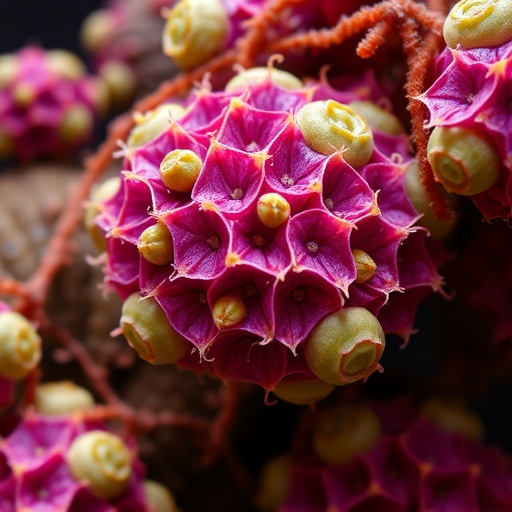
A tropical tree revered in traditional medicine may contain a far more intricate chemical factory than previously understood. In a new study, researchers have combined large-scale chemical profiling with gene-expression analysis to trace how the Kadamba tree, Neolamarckia cadamba, produces monoterpenoid indole alkaloids, or MIAs—specialized plant compounds associated with a wide range of biological activities. The work identifies key enzymes and reveals that the tree’s leaves, bark and fruit operate with markedly different metabolic programs. Although the findings do not yet prove that any particular compound can become a medicine, they offer a molecular map for investigating the tree’s chemistry and potentially reproducing valuable compounds through biotechnology.
Neolamarckia cadamba, also known as Kadam, is a fast-growing tree distributed across parts of South and Southeast Asia. Its bark, leaves, roots and fruits have long been investigated for phytochemicals, and earlier research has linked extracts from the species with antioxidant, antibacterial, anti-inflammatory and other pharmacological effects in laboratory studies. The tree is particularly interesting to plant scientists because it produces indole alkaloids, a chemically diverse family built around an indole structure derived from tryptophan. Some plant-derived indole alkaloids have become important drug leads, but the enzymes and genetic networks that assemble them can be difficult to reconstruct. Before this study, the molecular basis of MIA biosynthesis in N. cadamba remained comparatively unexplored.
To investigate the process, a team led by researchers at Tamil Nadu Agricultural University in India examined three tissues—leaves, bark and fruit—using two complementary approaches. The first was untargeted metabolomics based on gas chromatography–mass spectrometry, or GC-MS. In this technique, chemical constituents are separated according to their physical properties and then fragmented by a mass spectrometer, producing patterns that can be compared with reference libraries. Unlike a test designed to detect only one known molecule, untargeted profiling surveys a broad chemical landscape and can expose unexpected differences between tissues. The second approach was RNA sequencing, which measures messenger RNA molecules and provides a snapshot of which genes are active. Together, the methods allowed the researchers to compare what the plant is making with the molecular machinery it appears to be using.
Across the tissues, the researchers identified 281 metabolites. The fruit displayed the greatest metabolic diversity and contained 74 compounds described as tissue-specific in the study. Among them were flavonoids, pyruvic acid, shikimic acid and quinic acid. These molecules belong to different biochemical classes and participate in processes ranging from carbon metabolism to plant defence. Flavonoids, for example, can absorb ultraviolet radiation and help protect plant cells from oxidative stress, while shikimic acid is a central intermediate in the pathway that produces many aromatic compounds. Shikimic acid is also an industrially important starting material for some antiviral drug production, although its presence in a plant tissue does not mean that the tissue itself is an antiviral treatment.
The chemical profile of the bark and leaves was different. These tissues were relatively enriched in terpenoids, amino acids and fatty acids, compounds that can support growth, membrane formation, signalling and defence. Terpenoids include volatile and non-volatile molecules that plants use to deter herbivores, inhibit pathogens or communicate with other organisms. Fatty acids are fundamental components of cellular membranes but can also serve as precursors for signalling molecules involved in responses to injury and environmental stress. The tissue contrast suggests that the tree does not distribute its specialized chemistry uniformly. Instead, each organ appears to balance metabolism according to its biological role: fruit may invest heavily in compounds affecting attraction, protection or seed-associated physiology, while leaves and bark may emphasize structural maintenance and defence.
The most important clues to MIA production came from the transcriptomic data. The researchers identified expression of several genes that occupy central positions in the known MIA pathway, including tryptophan decarboxylase, secologanin synthase, strictosidine synthase and loganic acid O-methyltransferase. These enzymes act at different stages of a biosynthetic route that draws together two chemical streams. Tryptophan decarboxylase converts the amino acid tryptophan into tryptamine, supplying the indole-derived portion of the molecule. In a separate branch, loganic acid O-methyltransferase modifies loganic acid, while secologanin synthase helps generate secologanin, a monoterpenoid precursor. Strictosidine synthase then catalyses a condensation reaction between tryptamine and secologanin to form strictosidine, a pivotal intermediate from which many downstream MIAs can be assembled.
This pathway is chemically remarkable because it combines building blocks from primary and specialized metabolism. Primary metabolism supplies molecules needed for basic survival, while specialized metabolism modifies them into compounds that can influence interactions with herbivores, microbes, pollinators and the environment. Strictosidine functions as a branching point: after its formation, additional enzymes can reshape its structure through oxidation, reduction, methylation, glycosylation and rearrangement reactions. The result is a large family of alkaloids with distinct biological properties. In N. cadamba, this broader network includes interest in cadambine and related compounds. Finding transcripts corresponding to key pathway enzymes is therefore an important first step, but it is not equivalent to demonstrating that every enzyme is active or that a complete pathway has been experimentally reconstructed in the tree.
To strengthen the RNA-sequencing results, the researchers used quantitative real-time polymerase chain reaction, or qRT-PCR, to validate the expression patterns of selected genes. qRT-PCR measures the abundance of particular messenger RNA sequences by amplifying them through repeated cycles and tracking the signal generated during amplification. It is commonly used as an independent check because RNA-sequencing datasets can contain technical variation arising from sample preparation, sequencing depth and computational processing. The agreement between the transcriptomic analysis and qRT-PCR supports the reliability of the reported tissue-associated expression patterns. Even so, gene expression remains an indirect indicator of biochemical output. Enzymes may require specific cellular conditions, substrates may be limiting, and the final products may be transported or stored in tissues different from where they are synthesized.
The study’s integrated design also points toward a more precise way of studying medicinal plants. A metabolite detected in an extract is not necessarily produced in large quantities, biologically active in humans or safe at a therapeutic dose. Likewise, a gene that is highly expressed may contribute to a pathway without controlling its final output. By comparing metabolite abundance with transcript levels across tissues, researchers can identify correlations that suggest candidate pathway genes and prioritize them for functional tests. The next stage could involve isolating enzymes, introducing candidate genes into laboratory hosts, or using gene-silencing and gene-editing approaches to test whether changing a gene alters the accumulation of a specific alkaloid. Similar strategies have already been used in other plants to reconstitute complex MIA pathways in heterologous systems, where individual reactions can be examined under controlled conditions.
The findings may eventually support metabolic engineering, conservation and more consistent production of plant-derived compounds, but significant hurdles remain. The study surveys three tissues and establishes candidate genes; it does not demonstrate a finished drug, clinical benefit or commercial production process. Many alkaloids occur at low concentrations, can be unstable during extraction and may require enzymes not identified in the initial analysis. Environmental conditions, tree age, season and genetics could also change the chemical profile. The authors have deposited the sequencing data in the NCBI Sequence Read Archive under BioProject PRJNA871050, giving other researchers an opportunity to reanalyse the data and test new hypotheses. For now, the work transforms Kadamba from a plant known mainly through traditional use and chemical extracts into a more tractable molecular system—one whose hidden chemistry can be studied gene by gene.
Cite Scienmag News
Juliet Wilcox. (August 26, 2026). Metabolomic and transcriptomic analyses uncover monoterpenoid indole alkaloid biosynthesis in Neolamarckia cadamba. Scienmag. https://scienmag.com/metabolomic-and-transcriptomic-analyses-uncover-monoterpenoid-indole-alkaloid-biosynthesis-in-neolamarckia-cadamba/
Juliet Wilcox. "Metabolomic and transcriptomic analyses uncover monoterpenoid indole alkaloid biosynthesis in Neolamarckia cadamba." Scienmag, 26 August 2026, https://scienmag.com/metabolomic-and-transcriptomic-analyses-uncover-monoterpenoid-indole-alkaloid-biosynthesis-in-neolamarckia-cadamba/. Accessed 3 September 2026.
Juliet Wilcox. "Metabolomic and transcriptomic analyses uncover monoterpenoid indole alkaloid biosynthesis in Neolamarckia cadamba." Scienmag. August 26, 2026. https://scienmag.com/metabolomic-and-transcriptomic-analyses-uncover-monoterpenoid-indole-alkaloid-biosynthesis-in-neolamarckia-cadamba/


