


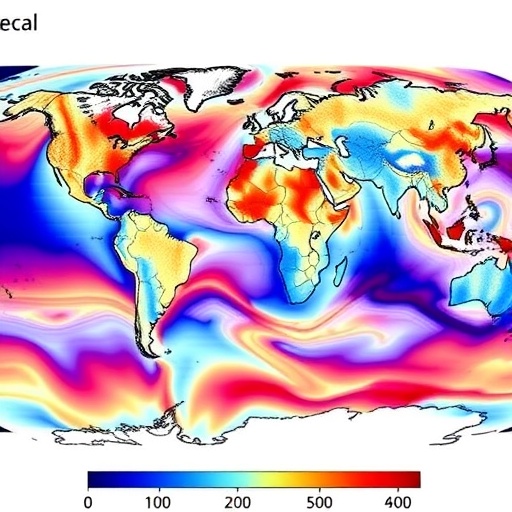
Global ocean wave forecasts have received a major artificial-intelligence upgrade in a study that could reshape how ships, offshore platforms, coastal authorities, and climate scientists prepare for dangerous seas. Researchers from Tsinghua University, the China Renewable Energy Engineering Institute, Beijing Forestry University, and Nanjing University of Information Science and Technology have developed an Intelligent Error Correction Method, or IECM, that uses several interconnected U-Net neural networks to correct errors in forecasts produced by the established WAVEWATCH III wave model. Their results, published in Ocean Dynamics, show that the system can cut global significant wave height errors by as much as half at short forecast ranges. The approach is designed not to replace physics-based ocean modeling, but to learn where those models systematically fall short and apply geographically tailored corrections. That hybrid strategy is increasingly important as society relies on increasingly precise ocean intelligence for international shipping, renewable-energy planning, disaster preparedness, and the operation of offshore infrastructure exposed to rapidly changing wave conditions.
At the center of the research is significant wave height, a standard measure representing the average height of the highest one-third of waves in a sea state. It is widely used to describe wave hazards, estimate vessel motions, and determine whether offshore work can proceed safely. Numerical wave models such as WAVEWATCH III calculate this quantity by simulating how wind-generated waves grow, propagate, interact, and lose energy across the ocean. The model solves complex physical equations involving wind input, wave breaking, nonlinear energy transfers, bottom friction, and the movement of swells over long distances. Yet even advanced models can miss the intensity, timing, or spatial structure of waves, especially during storms and in regions where swells travel across entire ocean basins. Small inaccuracies in atmospheric wind forcing can also become amplified as waves develop and propagate. The new IECM addresses these limitations by treating the numerical forecast as a physically informed starting point and then using deep learning to identify and correct its remaining errors.
The system’s architecture is based on multiple U-Nets, a class of convolutional neural network originally developed for image segmentation but now widely used for geophysical prediction. A U-Net compresses an input field through successive layers that detect broad spatial patterns, then expands it back to the original resolution while using skip connections to preserve fine-scale details. In the IECM framework, different U-Nets are assigned to different ocean regions, allowing each network to learn the local behavior of waves and the characteristic biases of the underlying forecast system. The North Pacific, North Atlantic, and Antarctic Circumpolar Current, for example, experience powerful storms, extensive fetches, and long-lived swells that produce very different error patterns from those found in quieter tropical waters. Instead of forcing one global network to treat every ocean identically, the multi-network design gives the correction system regional specialization while retaining a global forecasting perspective.
A second innovation, called boundary fusion, tackles a familiar weakness of regional deep-learning systems: discontinuities at the edges of their individual domains. If neighboring models make independent predictions, the corrected wave field can show artificial seams, abrupt jumps, or degraded accuracy near the boundaries where one network hands responsibility to another. Such defects are particularly problematic for waves because swell systems do not stop at political, geographic, or computational borders. The researchers therefore introduced a fusion procedure that blends outputs from adjacent U-Nets, smoothing transitions and allowing information to pass continuously across regional boundaries. In effect, the method preserves the benefits of localized expertise without fragmenting the global ocean into disconnected pieces. This is technically significant because convolutional networks are sensitive to the spatial context available during prediction. Boundary fusion helps reconstruct that context and reduces the risk that a forecast becomes less reliable simply because a wave system crosses an artificial edge in the computational grid.
The reported improvements are substantial. Before correction, the average global root mean squared error of WAVEWATCH III significant wave height forecasts was 0.44 meters at a 24-hour lead time, 0.46 meters at 48 hours, and 0.49 meters at 72 hours. After the IECM was applied, those values fell to 0.22, 0.25, and 0.31 meters, respectively. In percentage terms, the reductions were approximately 50 percent, 46 percent, and 37 percent. Root mean squared error measures the typical size of forecast mistakes while giving extra weight to large failures, making it especially relevant for hazardous wave prediction. The results indicate that the neural correction remains effective as the forecast horizon lengthens, although performance naturally declines over time as atmospheric and oceanic uncertainty accumulates. The strongest gains appeared in wave-active regions, including the North Pacific, North Atlantic, and Southern Ocean, where errors in storm-driven waves and long-distance swells can have major operational consequences.
The study also examined extreme wave events, which are among the most difficult conditions for conventional forecasting systems. Such events occur most frequently during winter in the major wave-active basins, when stronger storms generate higher winds and more energetic seas. The IECM markedly reduced forecast errors during these episodes, with particularly strong improvements at the 24-hour lead time. One reason may be the system’s use of Quantile Transformer normalization, a statistical preprocessing technique that reshapes a variable’s distribution before it is supplied to the neural network. Ordinary normalization methods often compress rare, high-amplitude events because extreme waves occupy only a small portion of the historical record. Quantile-based transformation instead maps data according to its rank within the observed distribution, giving the model a more balanced representation of unusually large values. This does not create information that is absent from the data, but it can prevent extreme cases from being treated as statistical outliers and may help the network learn corrections that remain useful during the most dangerous sea states.
To understand why WAVEWATCH III makes its largest mistakes, the researchers conducted sensitivity experiments involving different sources of environmental forcing. Their analysis points to wind forcing errors as a major contributor to inaccurate significant wave height forecasts at mid and high latitudes. Waves respond directly to the speed, direction, duration, and spatial extent of surface winds. If a storm’s winds are underestimated, misplaced, or poorly timed, the resulting wave field can be wrong not only near the storm but across distant ocean regions. Once generated, swells can travel thousands of kilometers, carrying the influence of an initial atmospheric error far beyond its source. During propagation, that error may interact with new wind systems, amplify through additional energy input, or alter the timing of wave arrival. The findings therefore underscore a central principle of ocean forecasting: improving wave predictions requires attention not only to the wave model itself but also to the quality of the atmospheric data driving it.
The research was built using several major environmental datasets. ERA5 reanalysis supplied historical atmospheric and oceanic information, while forecasts from the Global Forecast System and sea-surface wind data from the Copernicus Marine Environment Monitoring Service helped support the analysis of forcing conditions and forecast behavior. Deep-learning correction methods are highly dependent on the consistency of their training and evaluation data, making the choice of reference datasets crucial. A model can appear highly accurate if it is tested on conditions too similar to those used during training, yet perform poorly when exposed to unfamiliar storms, seasons, or ocean regimes. The regional design of IECM offers one response to this challenge by recognizing that the statistics of wave errors vary across the globe. At the same time, the study’s reliance on reanalysis and model-derived products highlights the need for continued validation against independent satellite altimeters, wave buoys, and other observations.
The authors present IECM as an intelligent post-processing system rather than a complete substitute for numerical wave physics. That distinction matters. Physics-based models remain essential because they describe the mechanisms governing wave growth and transformation and can operate under conditions not represented in historical training data. Neural networks, in contrast, are exceptionally good at recognizing recurring relationships in large datasets but may struggle with unprecedented events or changes in the data-generation system. Combining the two approaches can provide a practical balance: WAVEWATCH III supplies a physically plausible forecast, while the multi-U-Net framework learns systematic regional errors and corrects them rapidly. If incorporated into operational systems, such a method could improve warnings for extreme seas, support safer routing and offshore construction, and strengthen estimates of wave-energy resources. Its broader significance lies in demonstrating how specialized artificial intelligence can make mature scientific models more accurate without discarding the physical foundations on which they depend.
The study arrives as researchers worldwide explore increasingly ambitious forms of artificial intelligence for weather, climate, and ocean prediction. Unlike fully data-driven forecasting systems that attempt to generate future states from scratch, IECM focuses on a narrower but highly actionable task: correcting a known forecast product. That makes the system potentially easier to integrate into existing operational workflows, where forecasts are already produced by established numerical models and must be improved without radically changing the infrastructure behind them. The reported reductions in global error are promising, but questions remain about how the method will perform during unprecedented storms, under changing climate conditions, or when atmospheric forecast systems are upgraded. Future work could test the framework with real-time observations, extend it to wave period and direction, and examine whether similar boundary-fusion strategies can improve forecasts of other ocean variables. For now, the results suggest that the next leap in wave forecasting may come not from choosing physics or artificial intelligence, but from teaching both to work together.
Cite Scienmag News
Violet Maxwell. (August 26, 2026). Boundary-Fusion Multi-UNet Improves Global Ocean Surface Wave Prediction Error Correction. Scienmag. https://scienmag.com/boundary-fusion-multi-unet-improves-global-ocean-surface-wave-prediction-error-correction/
Violet Maxwell. "Boundary-Fusion Multi-UNet Improves Global Ocean Surface Wave Prediction Error Correction." Scienmag, 26 August 2026, https://scienmag.com/boundary-fusion-multi-unet-improves-global-ocean-surface-wave-prediction-error-correction/. Accessed 4 September 2026.
Violet Maxwell. "Boundary-Fusion Multi-UNet Improves Global Ocean Surface Wave Prediction Error Correction." Scienmag. August 26, 2026. https://scienmag.com/boundary-fusion-multi-unet-improves-global-ocean-surface-wave-prediction-error-correction/


