


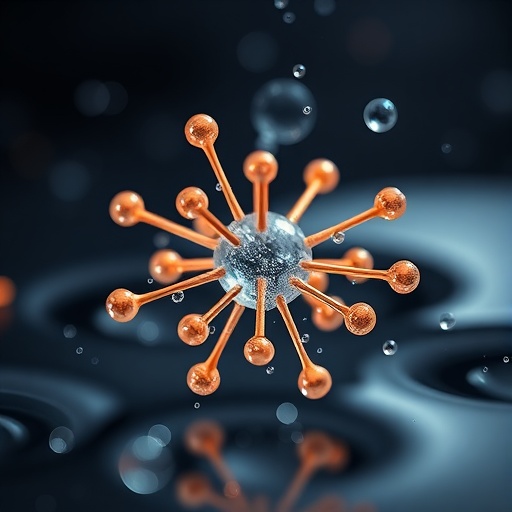
A new study reports a potentially important advance in water disinfection: isolated copper atoms can reorganize themselves during operation and, in doing so, generate hydroxyl radicals with unusual precision. The work, led by Liu, Cao, Jia and colleagues and published in Nature Communications, focuses on a catalytic strategy designed to attack contaminants through one of the most powerful short-lived oxidants known in water chemistry. Hydroxyl radicals are highly reactive molecules capable of rapidly damaging proteins, membranes and genetic material. Their extreme reactivity, however, has always been both their strength and their limitation. If produced in the wrong place or in excessive amounts, they can be wasted in side reactions before reaching a target. The researchers’ central claim is that copper atoms can dynamically reconstruct their local environment to make radical production more controlled, creating a catalyst that may help turn a chemically difficult process into a more efficient route to safer water.
The phrase “single copper atoms” refers to copper species dispersed individually across a supporting material rather than assembled into conventional nanoparticles. At this scale, every copper atom is exposed to its surroundings, and its electronic structure can differ dramatically from that of bulk copper or a copper particle. Such isolated atoms are often described as single-atom catalysts because they provide highly accessible active sites while using very little metal. Their behavior is governed not only by the copper itself but also by the neighboring atoms, chemical bonds and defects in the support. This makes them powerful yet complex catalytic systems. A single atom may change oxidation state, bind water-derived species or interact with oxygen-containing molecules as a reaction proceeds. The new study places that dynamic behavior at the center of the disinfection process rather than treating the catalyst as a fixed, unchanging structure.
The key concept is self-reconstruction. In many catalytic materials, researchers try to preserve the original atomic arrangement throughout a reaction. Under realistic chemical conditions, however, catalysts can restructure as they encounter water, dissolved ions, oxidants and reaction intermediates. Liu and colleagues describe a system in which the copper sites actively reorganize during operation. That rearrangement is not presented simply as degradation; instead, it becomes part of the catalyst’s function. The copper atoms may adopt different coordination environments as the reaction progresses, creating active configurations suited to the formation of hydroxyl radicals. In practical terms, the catalyst appears to adjust its own molecular architecture in response to its surroundings. This offers a departure from the traditional picture of a catalyst as a static platform and highlights why observing materials under working conditions can reveal behavior that is invisible before a reaction begins.
Hydroxyl radicals, written chemically as •OH, are electrically neutral but extraordinarily aggressive oxidants. They react at near-diffusion-controlled rates with many organic molecules, attacking carbon-hydrogen bonds, aromatic rings and unsaturated structures. In a disinfection setting, that chemistry can break down the molecular components of microorganisms and damage the nucleic acids needed for replication. Unlike longer-lived disinfectants, hydroxyl radicals do not persist for long distances in water. They are formed and consumed almost immediately, which means their effectiveness depends strongly on where and how they are generated. A catalyst that produces them directly at an active surface could concentrate the oxidative chemistry near contaminants, potentially reducing wasted oxidant and limiting the formation of unwanted secondary products. The study’s emphasis on “precise” generation reflects this challenge: radical chemistry must be powerful enough to inactivate pathogens but controlled enough to remain efficient and chemically manageable.
Copper is especially interesting for this purpose because it can readily move between oxidation states, most notably copper(I) and copper(II). That redox flexibility allows copper centers to accept and donate electrons during catalytic cycles. In advanced oxidation chemistry, such electron transfers can activate oxygen-containing reactants and create highly reactive intermediates. The exact pathway depends on the catalyst’s structure and on the compounds present in the water, but the basic principle is familiar: copper serves as a molecular-scale traffic controller for electrons. By changing its coordination environment, a copper atom may alter how strongly it binds reactants and how easily it transitions between oxidation states. The researchers’ work suggests that self-reconstruction helps keep those transformations productive, steering the reaction toward hydroxyl-radical formation rather than allowing electrons to become trapped in less useful pathways.
This distinction matters because conventional radical-based water treatment can suffer from poor selectivity and low resource efficiency. Reactive species may react with natural organic matter, dissolved ions or the treatment system itself before they reach harmful microorganisms. Nanoparticle catalysts can also present challenges, including aggregation, loss of active surface area and the possibility that metal components enter treated water. Single-atom designs seek to address some of these limitations by maximizing the number of accessible catalytic sites and reducing the amount of metal required. Yet isolated atoms can be unstable, especially in chemically aggressive environments. The reported self-reconstruction mechanism therefore addresses two problems at once: it may create the most effective configuration for radical generation while helping explain how the copper sites remain active under reaction conditions. Whether that stability is sufficient for large-scale use will depend on long-term testing, metal-release measurements and regeneration studies.
The potential public-health implications are significant because water disinfection must operate across a bewildering range of conditions. Rivers, reservoirs, industrial streams and wastewater contain different mixtures of salts, organic compounds and suspended particles. A treatment chemistry that performs well in purified laboratory water may behave very differently in a real water matrix. Hydroxyl radicals are attractive because they can attack a broad spectrum of contaminants, but their short lifetime makes system design crucial. The catalyst must bring the reactive chemistry close to the target while avoiding unnecessary consumption by background substances. A self-adapting copper catalyst could, in principle, respond to these changing conditions by altering the electronic character of its active sites. That possibility makes the work relevant not only to pathogen inactivation but also to broader efforts to destroy persistent organic pollutants and other difficult-to-remove compounds.
The study also reflects a wider transformation in materials science, where catalysts are increasingly viewed as dynamic participants rather than passive objects. Advanced imaging and spectroscopic techniques now allow researchers to investigate atomic arrangements while reactions are taking place. Such measurements can reveal whether a material keeps its initial structure, forms new bonds or creates temporary active species that disappear when the reaction stops. For single-atom catalysts, this operando perspective is particularly important: the structure identified before exposure to water may not be the structure doing the actual chemistry. By linking atomic rearrangement to hydroxyl-radical production, the researchers connect nanoscale structural change with a macroscopic goal—more effective disinfection. That connection could guide the design of future catalysts in which active sites are deliberately engineered to transform under specific chemical conditions.
Despite the excitement surrounding the result, translating a laboratory discovery into a viral water-treatment technology will require careful validation. Researchers will need to establish how consistently the catalyst performs over repeated cycles, how much copper is released, what energy and chemical inputs are required, and whether harmless-looking reaction products accumulate over time. It will also be important to compare the system with established disinfection methods under realistic conditions, including waters rich in natural organic matter and dissolved minerals. The identity of the most effective operating conditions, the range of organisms affected and the system’s performance at scale will determine its practical value. A catalyst that generates radicals efficiently in a controlled experiment may still face engineering barriers in a flowing treatment plant. The study’s importance, therefore, lies not in suggesting that a complete solution has arrived, but in identifying a new design principle: atomic catalysts may be able to reorganize themselves to control some of chemistry’s most aggressive—and useful—molecules.
If the concept withstands further testing, self-reconstructing copper catalysts could influence how scientists approach water safety. Rather than choosing between strong oxidation and precise control, future treatment systems might use materials that dynamically balance both. The copper atoms described in the study provide a striking example of how a catalyst can become more than a collection of fixed active sites; it can behave like a responsive chemical interface, changing its structure as conditions evolve. That ability could help reduce wasted reagents, improve contact between reactive species and contaminants, and make advanced oxidation more practical. For now, the work offers a compelling glimpse of atomic-scale engineering aimed at a global challenge. Clean water may ultimately depend not only on stronger disinfectants, but on smarter catalysts capable of deciding, molecule by molecule, where and when their power is used.
Cite Scienmag News
Violet Maxwell. (August 22, 2026). Self-reconstructing single copper atoms precisely generate hydroxyl radicals for efficient water disinfection. Scienmag. https://scienmag.com/self-reconstructing-single-copper-atoms-precisely-generate-hydroxyl-radicals-for-efficient-water-disinfection/
Violet Maxwell. "Self-reconstructing single copper atoms precisely generate hydroxyl radicals for efficient water disinfection." Scienmag, 22 August 2026, https://scienmag.com/self-reconstructing-single-copper-atoms-precisely-generate-hydroxyl-radicals-for-efficient-water-disinfection/. Accessed 4 September 2026.
Violet Maxwell. "Self-reconstructing single copper atoms precisely generate hydroxyl radicals for efficient water disinfection." Scienmag. August 22, 2026. https://scienmag.com/self-reconstructing-single-copper-atoms-precisely-generate-hydroxyl-radicals-for-efficient-water-disinfection/


