


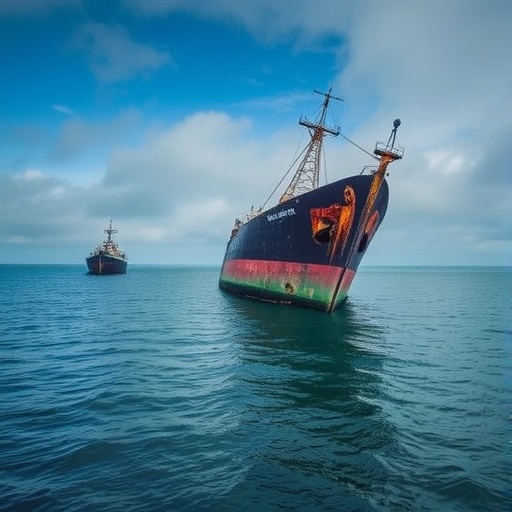
A century after a German submarine sank beneath the North Sea, scientists have found evidence that explosives trapped inside the wreck are still moving through the surrounding marine ecosystem. The submarine UC-30, which disappeared off the Danish island of Rømø in April 1917, carried 18 mines and six torpedoes when it struck a British mine and went down. All 27 crew members died, and the wreck remained undiscovered until 2016. Now, field investigations involving Danish Navy divers and marine scientists indicate that the vessel is not only a historical relic but also a continuing source of chemical pollution. Samples collected from the wreck, nearby seabed, overlying water, mussels, and starfish contained traces of trinitrotoluene, commonly known as TNT, demonstrating that explosive compounds are escaping into the environment as the submarine deteriorates.
The discovery forms part of a broader investigation conducted through the NorthSeaWrecks research project, in which scientists examined how shipwrecks from the two world wars affect modern marine ecosystems. Katrine Juul Andresen, a professor at Aarhus University’s Department of Geoscience, worked with Navy divers because civilian diving is prohibited at the UC-30 wreck. The divers collected sediment and water samples from several locations on and around the submarine, while also retrieving mussels and starfish living in the area. They documented the wreck with video and photographs, allowing researchers to assess the condition of its hull and the exposure of the weapons still inside. The study’s central concern was not simply whether TNT was present, but whether the contamination was biologically available and capable of producing measurable stress in marine organisms.
TNT is an energetic chemical designed to release large quantities of energy during detonation, but it can also persist in the environment when munitions corrode or leak. In seawater, explosive residues may dissolve, attach to particles, settle into sediment, or be transported by currents. Marine organisms can absorb these compounds directly from the water or ingest them through contaminated food and sediment. Mussels are particularly useful for monitoring pollution because they filter large volumes of water, remain in one location, and accumulate chemical contaminants in their tissues. Their biological responses can also reveal exposure before visible damage occurs. Changes in cellular defense systems, oxidative stress pathways, energy metabolism, and tissue condition can act as biomarkers—measurable signals that indicate an organism is responding to environmental pressure.
The researchers detected TNT residues in wildlife, seabed material, and the water column around the submarine. That pattern is significant because it shows that pollution is not confined to the metal structure of the wreck. The explosive material is entering several connected parts of the local food web and habitat. However, the findings do not mean that the entire North Sea is contaminated by UC-30. Andresen described the wreck as a likely localized pollution source, with the greatest concentrations expected near the submarine and its immediate surroundings. The geographic reach of the contamination depends on factors such as water movement, sediment composition, depth, and the physical condition of the seabed. Strong currents can disperse dissolved compounds, while fine sediments may trap pollutants and create a longer-term reservoir that can be disturbed by storms or seabed activity.
The threat is expected to increase as the wreck continues to corrode. A shipwreck functions as a changing chemical container: while intact sections of the hull and weapon casings may temporarily isolate explosives, rust, pressure, mechanical damage, and biological activity gradually open new pathways into the surrounding environment. Once exposed, mines and torpedoes can release compounds into seawater even if they never detonate. The process may accelerate when sediment shifts or sections of the wreck collapse. Scientists therefore view the problem as dynamic rather than historical. A wreck that appears relatively stable today could become a more significant source of pollution decades from now. Monitoring is essential because the timing and scale of release cannot be predicted from the wreck’s age alone.
UC-30 is only one example among thousands of potentially hazardous wrecks in Danish waters. A 2024 report prepared for the Danish Environmental Protection Agency identified 10,127 wrecks in the country’s marine territory. Approximately 15 percent date from the periods surrounding the two world wars, when naval combat, maritime accidents, and deliberate dumping placed enormous quantities of metal, fuel, and ammunition on the seabed. During World War I, Germany and Britain deployed an estimated 190,000 mines across the North Sea as they attempted to control shipping routes and blockade one another. The region also contains wrecks from the Battle of Jutland, the largest naval clash of the war, in which more than 25 ships sank and nearly 10,000 sailors lost their lives. Each wreck may represent a different combination of explosive risk and environmental threat.
Removing the weapons is not a straightforward solution. Retrieval can prevent future leakage, but operations around unstable explosives are technically difficult, expensive, and dangerous. Detonation is sometimes considered safer than recovery, yet underwater explosions can fragment munitions, spread contamination, and damage nearby habitats. Whether destruction or retrieval is preferable depends on local conditions, including currents, depth, seabed morphology, the type and condition of the ammunition, and the ecological sensitivity of the site. In some settings, the researchers warn, detonating the material could cause greater environmental harm than leaving it in place under controlled observation. A decision based solely on the presence of explosives could therefore be misleading; authorities must evaluate both the immediate hazard and the long-term chemical consequences of intervention.
Scientists in the European Union-funded REMARCO project are investigating less disruptive approaches to the problem. Among the technologies being explored are crawling seabed robots that can map wrecks, identify individual pieces of ammunition, and monitor changes without placing divers in danger. In some circumstances, robotic systems could collect objects from the seabed and transport them to a location where they can be neutralized under controlled conditions. Such systems could also improve risk assessments by repeatedly measuring chemical concentrations and documenting structural deterioration. Robots will not eliminate the engineering challenges, but they may allow authorities to distinguish between wrecks that require urgent action and those that can be safely monitored. The objective is to develop targeted interventions rather than disturb every wartime wreck indiscriminately.
Not every wreck demands immediate removal. Some are deeply or partially buried beneath sediment, which can sharply reduce contact between ammunition and seawater. Burial does not guarantee permanent containment, because storms, currents, erosion, and human activity can expose previously sealed material, but it may substantially lower the current risk. The emerging scientific picture is therefore one of prioritization: locate the wrecks, determine what they contain, measure their chemical releases, assess biological effects, and identify the sites where intervention would produce the greatest environmental benefit. The UC-30 investigation shows why that work matters. A submarine lost in 1917 can remain chemically active in 2026, linking the legacy of naval warfare to present-day marine conservation and forcing governments to treat the seabed not as a museum of the past, but as a living and changing part of the environment.
News Publication Date: 3-Aug-2026
Web References:
https://www.sciencedirect.com/science/article/pii/S0025326X26005254?via%3Dihub
https://www2.mst.dk/Udgiv/publications/2024/02/978-87-7038-587-9.pdf
References:
10.1016/j.marpolbul.2026.119738
http://doi.org/10.1021/acs.est.3c04873
Cite Scienmag News
Violet Maxwell. (August 21, 2026). World War I and II Shipwrecks Pollute the North Sea. Scienmag. https://scienmag.com/world-war-i-and-ii-shipwrecks-pollute-the-north-sea/
Violet Maxwell. "World War I and II Shipwrecks Pollute the North Sea." Scienmag, 21 August 2026, https://scienmag.com/world-war-i-and-ii-shipwrecks-pollute-the-north-sea/. Accessed 3 September 2026.
Violet Maxwell. "World War I and II Shipwrecks Pollute the North Sea." Scienmag. August 21, 2026. https://scienmag.com/world-war-i-and-ii-shipwrecks-pollute-the-north-sea/


