


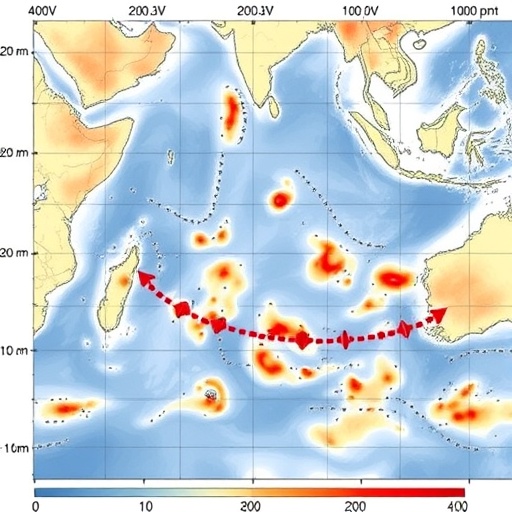
For 200,000 years, the equatorial Indian Ocean has acted as both a biological engine and a sensitive recorder of changes unfolding across the global climate system. A new study by L. Zhou, Z. Jiang, J. C. Larrasoaña and colleagues examines how biological productivity in this vast tropical basin changed through repeated glacial and interglacial cycles, and how those changes were connected to the movement of deep water through the ocean. Published in Communications Earth & Environment, the research places the equatorial Indian Ocean at the center of a climate story that links microscopic marine life, shifting circulation patterns and the planet’s long-term carbon balance.
Marine productivity describes the rate at which organisms, principally microscopic phytoplankton, create organic matter through photosynthesis. These organisms consume carbon dioxide at the ocean surface, and some of the carbon they incorporate eventually sinks into deeper water when cells die or are eaten. This process, known as the biological carbon pump, is one of the mechanisms that allows the ocean to influence atmospheric carbon dioxide. Productivity is not uniform across the ocean. It depends on sunlight, temperature, nutrient availability, stratification and the upwelling of deep water. In the equatorial Indian Ocean, these factors are additionally shaped by monsoon winds and by the exchange of water between the Indian, Southern and Atlantic oceans.
Zhou and colleagues reconstruct the history of this productivity across a period that includes multiple glacial-interglacial transitions. Over the last 200,000 years, Earth repeatedly shifted between colder intervals, when large ice sheets covered parts of the Northern Hemisphere, and warmer periods such as the present interglacial. These transitions altered sea level, wind systems, temperature gradients and the organization of ocean currents. They also changed the strength and distribution of deep-water masses. By examining marine sediments accumulated on the ocean floor, scientists can read some of these changes as layers in a natural archive. Sediment does not simply preserve particles; it stores chemical, biological and physical signals of the water and climate conditions that existed when each layer formed.
The study’s focus on the equatorial region is particularly important because tropical oceans receive intense sunlight throughout the year but are often strongly stratified. In a stratified ocean, warm, less-dense water sits above cooler, denser water, limiting the upward movement of nutrients. Phytoplankton may have abundant light yet still be constrained by the supply of nitrogen, phosphorus, iron or other essential elements. When circulation or winds weaken the barrier between surface and deep water, nutrients can reach the photic zone—the sunlit upper ocean—stimulating growth. The resulting productivity signal can therefore reveal changes not only in local surface conditions but also in the pathways that transport nutrients through the ocean.
Deep circulation is the slow, global-scale movement of seawater driven by differences in temperature and salinity. Cold, salty water is denser and tends to sink, while warmer or fresher water is more buoyant. Once formed, deep water can travel thousands of kilometers before returning toward the surface or mixing with other water masses. The Indian Ocean is not an isolated basin in this system. Deep waters entering from the Southern Ocean and connections with the Atlantic and Pacific influence its chemistry, temperature and nutrient content. If the strength or geometry of this circulation changes, the equatorial Indian Ocean can receive a different supply of nutrients and dissolved carbon, potentially altering productivity even when local sunlight remains relatively stable.
The research links fluctuations in equatorial productivity with variations in deep circulation, highlighting a two-way relationship between the surface ocean and the abyss. Changes in deep-water transport can affect nutrient delivery and therefore the amount of organic matter produced near the surface. At the same time, enhanced productivity can increase the export of organic carbon into deeper layers, where its carbon may remain isolated from the atmosphere for centuries or longer. This does not mean that every productivity increase automatically lowers atmospheric carbon dioxide. The fate of sinking organic matter depends on how efficiently it is transferred to the deep ocean, how rapidly it is remineralized and whether nutrients are subsequently recycled. Nevertheless, the connection is crucial for understanding how ocean circulation participates in climate feedbacks.
The 200,000-year perspective also allows the scientists to compare events that occurred under very different boundary conditions. Ice sheets, sea level and greenhouse-gas concentrations changed substantially between glacial and interglacial states. Monsoon intensity, which is closely related to the contrast between Asian land and the Indian Ocean, also varied as orbital changes modified the seasonal distribution of sunlight. Stronger or weaker monsoon winds can influence mixing and upwelling in the northern Indian Ocean, while remote changes in the Southern Ocean may affect the deep waters that enter the basin. The equatorial zone can therefore integrate signals from several parts of the climate system, making it a valuable location for identifying connections that may not be visible in a single region.
Sedimentary reconstructions are powerful because they extend far beyond the reach of instrumental observations, but they are not direct recordings in the modern sense. Researchers must interpret indirect indicators, or proxies, preserved in sediment layers. These may include the abundance and composition of microscopic fossils, the concentration of organic material, elemental ratios, isotopic signatures or magnetic properties. Each proxy responds to particular environmental factors and carries uncertainties related to preservation, sediment mixing and age determination. The strength of a long-term reconstruction comes from combining multiple lines of evidence and comparing their timing. When productivity indicators change alongside signs of altered deep-water circulation, the agreement can support a connection, while differences in timing can help distinguish cause from consequence.
The significance of the study extends beyond the ancient past. Modern observations show that the Indian Ocean is warming rapidly, its circulation is responding to changing winds and freshwater inputs, and marine ecosystems are being affected by deoxygenation, acidification and shifting nutrient conditions. The past record cannot provide a simple forecast of what will happen in the coming decades, because current greenhouse-gas changes are occurring rapidly and in combination with human pressures such as overfishing and pollution. It can, however, reveal the range of natural variability and show how tropical productivity and deep circulation responded when climate conditions changed. By identifying recurring relationships across several glacial cycles, the work offers a longer baseline for testing climate models and evaluating how effectively they represent ocean carbon cycling.
The equatorial Indian Ocean has often received less attention in public discussions of climate than the North Atlantic or Southern Ocean, yet its role may be disproportionately important. It connects tropical climate, monsoon behavior, marine ecosystems and global circulation in a region where even small changes in nutrient supply can affect enormous quantities of biological activity. Zhou and colleagues’ reconstruction underscores that the ocean’s surface cannot be understood separately from its depths. The productivity of microscopic organisms at the equator is linked to currents moving through the deep sea, while the carbon produced by those organisms can become part of a circulation system that shapes atmospheric climate. That perspective turns a seemingly remote sediment archive into evidence for a global process—and makes the Indian Ocean an increasingly important target for understanding Earth’s future.
Cite Scienmag News
Violet Maxwell. (August 20, 2026). Equatorial Indian Ocean productivity tracked deep circulation changes over 200,000 years. Scienmag. https://scienmag.com/equatorial-indian-ocean-productivity-tracked-deep-circulation-changes-over-200000-years/
Violet Maxwell. "Equatorial Indian Ocean productivity tracked deep circulation changes over 200,000 years." Scienmag, 20 August 2026, https://scienmag.com/equatorial-indian-ocean-productivity-tracked-deep-circulation-changes-over-200000-years/. Accessed 4 September 2026.
Violet Maxwell. "Equatorial Indian Ocean productivity tracked deep circulation changes over 200,000 years." Scienmag. August 20, 2026. https://scienmag.com/equatorial-indian-ocean-productivity-tracked-deep-circulation-changes-over-200000-years/


