


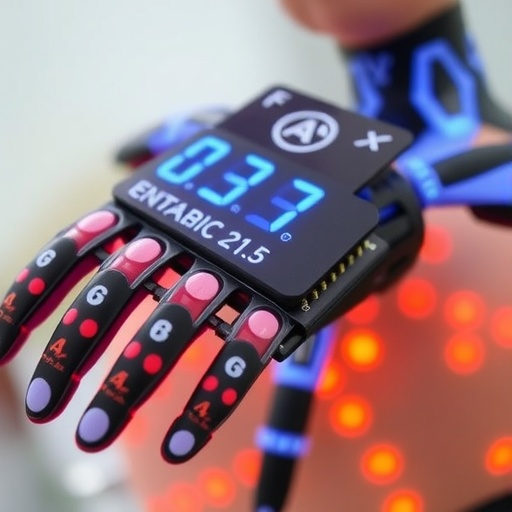
A robotic hand fitted with a new 3D-printed electronic skin developed by researchers at Washington State University has demonstrated a sensing system capable of detecting pressure and temperature across complex surfaces. The technology is designed to bring prosthetic devices closer to the behavior of natural skin, allowing them to recognize not only whether they are touching an object, but also details about its texture and material. Although the system does not yet provide sensation directly to an amputee, it represents an important step toward prosthetics that can gather and eventually transmit tactile information to the nervous system.
The research team’s work, published in Cell Reports Physical Science, addresses several persistent problems that have limited the development of practical electronic skin. Existing commercial glove-like sensors can be expensive, difficult to customize, and limited in their ability to cover curved or irregularly shaped surfaces. Their sensing resolution can also be too low for detailed tactile recognition. The Washington State University system can sense at a scale roughly ten times finer than current commercial glove sensors, according to the researchers. That higher resolution could allow a prosthetic hand to distinguish subtle changes in pressure and temperature that are important when identifying objects or controlling delicate movements.
Human skin performs a remarkable amount of processing through a distributed network of receptors. Different receptors respond to pressure, vibration, temperature, and other physical cues, while the brain combines those signals to interpret the environment. Reproducing this process electronically requires more than placing a single pressure sensor on a prosthetic fingertip. It requires arrays of sensors that can cover a broad area, conform to three-dimensional shapes, respond reliably to different stimuli, and transfer large amounts of information quickly. The WSU researchers developed thin, layered sensor modules that combine pressure and temperature sensing elements into a multimodal system, meaning that the same platform can collect different categories of physical information.
The system is built around a manufacturing strategy the team calls “scan-model-print.” First, a scanner captures the geometry of a prosthetic component or another freeform surface. That digital model is then used to map the positions of the sensors so that the electronic skin follows the shape of the device rather than being forced into a flat sheet. Finally, the components are fabricated using 3D printing and laser cutting. This geometry-aware process is intended to provide seamless sensor coverage over curved and irregular regions, where conventional fabrication methods can create gaps, wrinkles, or areas of reduced performance. By linking the sensing layout to the actual shape of a prosthesis, the researchers can produce customized systems without relying on a single standard design.
This ability to customize the sensor arrangement is central to the technology’s potential. Prosthetic limbs differ in size, shape, and construction, and the body regions where they are used are rarely simple flat surfaces. A sensor that works well on a laboratory plate may perform differently when wrapped around a curved finger, knuckle, palm, or forearm. The researchers report that their modules can measure pressure and temperature at high density on both flat and curved surfaces. Their design also avoids the need for permanent adhesives: individual sensor modules can be joined together in a manner the team compares to connecting Lego blocks. That modular architecture could make the system easier to assemble, repair, or reconfigure for different prosthetic designs.
The electronic skin is intended to do more than detect whether an object has been contacted. The pressure and temperature data can be used to identify surface texture and material properties. For example, the way an object responds to contact, combined with its thermal behavior, may help distinguish materials that feel similar through vision alone. Pressure patterns can also reveal whether a surface is smooth, rough, soft, or rigid. For a person using a prosthetic hand, such information could eventually support more accurate grip control. A device able to recognize increasing pressure could reduce the risk of crushing a fragile object, while temperature sensing might warn the user that an object is dangerously hot or unusually cold.
A major challenge is the amount of information generated by high-density sensor arrays. As more sensing elements are added, the system produces more data that must be collected, interpreted, and delivered in real time. If the data-processing architecture is too slow, the prosthesis may respond with a delay, making it difficult to perform natural movements. The WSU researchers emphasize that their system is designed to support reliable, high-resolution measurements while remaining relatively simple to manufacture. The combination of 3D printing and laser cutting could help lower production costs compared with more complex fabrication approaches, potentially making customized medical-grade electronic skins more accessible. The researchers describe this as a way to democratize e-skin production, although extensive testing and clinical development will still be required before the technology can be used routinely by patients.
The current device senses the physical world, but it does not yet restore the experience of touch. To achieve that, information from the sensors must be translated into signals that the user can perceive. The research team is working on an actuator that could convert the electronic skin’s measurements into stimulation, with the long-term goal of signaling nearby nerves. Such a system might transform pressure, temperature, or texture data into patterns of electrical, mechanical, or other stimulation that the brain could learn to interpret. Developing that interface will be considerably more complex than building the sensors themselves, because nerve stimulation must be safe, precise, comfortable, and compatible with the individual’s biology. Even partial tactile feedback, however, could improve confidence and control for people using prosthetic limbs.
The work was supported in part by Washington State University’s National Science Foundation Research Traineeship in Next-Generation Robotics, known as NRT-LEAD, along with funding from the startup and Cougar Cage funds associated with corresponding author Kaiyan Qiu. The project also involved Prashanta Dutta, Richard Schneider Jr. Professor and director in the university’s School of Mechanical and Materials Engineering. The researchers have submitted an invention disclosure for a provisional patent through WSU’s Office of Research Innovation and Entrepreneurship. For first author Hongyi Shen, whose background includes sensor research and 3D printing, the project brings together a long-standing interest in rehabilitation and assistive technology. The immediate achievement is a customizable sensing platform, but its larger promise is a future in which prosthetic devices can detect their surroundings and communicate that information back to the people who use them.
Web References: Cell Reports Physical Science: https://www.cell.com/cell-reports-physical-science/fulltext/S2666-3864%2826%2900364-4
References: DOI: 10.1016/j.xcrp.2026.103458; Cell Reports Physical Science; Article publication date: 27-Jul-2026.
Keywords
electronic skin, bionic skin, prosthetics, robotic hand, 3D printing, tactile sensing, pressure sensors, temperature sensors, haptic feedback, amputee rehabilitation, wearable technology, robotics, multimodal sensing, Washington State University
Cite Scienmag News
Denise Maddox. (August 20, 2026). Electronic skin lets prosthetics sense temperature and pressure, researchers report. Scienmag. https://scienmag.com/electronic-skin-lets-prosthetics-sense-temperature-and-pressure-researchers-report/
Denise Maddox. "Electronic skin lets prosthetics sense temperature and pressure, researchers report." Scienmag, 20 August 2026, https://scienmag.com/electronic-skin-lets-prosthetics-sense-temperature-and-pressure-researchers-report/. Accessed 3 September 2026.
Denise Maddox. "Electronic skin lets prosthetics sense temperature and pressure, researchers report." Scienmag. August 20, 2026. https://scienmag.com/electronic-skin-lets-prosthetics-sense-temperature-and-pressure-researchers-report/


