


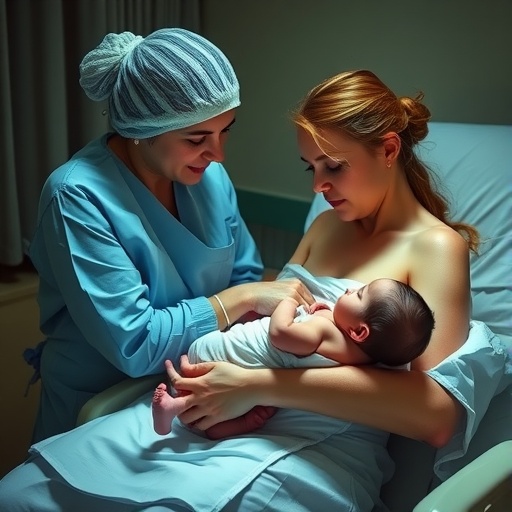
The first days after childbirth can transform an ordinary hospital room into an emotionally and physically demanding environment. Mothers are expected to recover from labor, respond to a newborn’s needs, learn feeding techniques and often remain responsible for care throughout the night. Yet the ability to perform these tasks is not determined solely by physical recovery. A study from Wroclaw Medical University in Poland suggests that a mother’s anxiety and capacity to manage emotional discomfort may influence how ready she feels to care for her baby more strongly than postpartum pain or normal changes in blood parameters.
Published in the Journal of Clinical Medicine, the observational study examined 200 women who were assessed between 48 and 72 hours after giving birth. This period is clinically important: many mothers are still recovering from delivery, while the demands of continuous newborn care are becoming more apparent. The researchers asked participants to rate their readiness to care for their newborn during the day and at night, as well as their readiness to breastfeed. They also evaluated pain, anxiety, mood, perceived social support, psychological flexibility and postpartum changes in hemoglobin levels.
The study focused on perceived readiness rather than a formal test of parenting ability. That distinction is central to interpreting the findings. A woman may possess the practical knowledge required to change a diaper, hold a baby or initiate breastfeeding, yet still feel unable to manage these responsibilities independently. In this context, readiness reflects a personal judgment about whether sufficient physical and emotional resources are available at a particular moment. It is therefore not a measurement of competence, intelligence or commitment to motherhood, but an indicator of how prepared a mother feels to cope with the immediate demands of newborn care.
Among the factors examined, anxiety showed the clearest association with reduced readiness. Women reporting higher anxiety on the second day after childbirth were more likely to describe themselves as less prepared to care for their babies independently, both during the day and at night. They were also less likely to feel ready to breastfeed. Anxiety can affect attention, confidence, sleep, decision-making and the interpretation of ordinary challenges. In a hospital setting, these effects may become especially visible because mothers are simultaneously coping with hormonal changes, fatigue, unfamiliar routines and concerns about whether they are meeting their newborn’s needs.
The researchers also identified psychological flexibility as an important factor. In psychological science, flexibility generally refers to the ability to remain connected to meaningful goals while adapting behavior in response to changing circumstances, including unpleasant thoughts, pain or emotional distress. For a new mother, this may mean continuing to respond to a baby’s needs despite uncertainty or tiredness without becoming overwhelmed by the discomfort itself. The association does not prove that flexibility directly causes greater readiness, but it suggests that emotional coping resources may help mothers perceive newborn care as manageable even when the postpartum period remains demanding.
By comparison, pain and the normal decline in hemoglobin after childbirth appeared to have a smaller relationship with how ready women felt. Postpartum pain is clinically relevant and can interfere with movement, sleep and feeding, but the findings indicate that pain alone may not explain why some mothers feel capable of independent care while others do not. Likewise, a physiological reduction in hemoglobin is common after delivery and may contribute to fatigue, yet its measured effect on perceived readiness was weaker than that of anxiety. The result challenges the assumption that readiness can be inferred mainly from physical recovery or routine clinical observations.
The study also found that readiness to breastfeed and readiness to care for a newborn were related but not identical. A mother may feel highly motivated and emotionally prepared to breastfeed while remaining uncertain about managing continuous care, particularly overnight. Breastfeeding readiness can involve intention, confidence and willingness to begin or continue feeding, whereas independent newborn care includes a much wider set of tasks: soothing, holding, changing, monitoring, responding to crying and sustaining attention through repeated day-and-night cycles. Treating these two forms of readiness as interchangeable could therefore cause healthcare professionals to overlook mothers who need broader practical or emotional assistance.
Daytime and nighttime readiness were strongly connected, but women generally felt more prepared for daytime care than nighttime care. This difference may reflect the cumulative effect of fatigue, reduced social support and the psychological burden of being awake when the rest of the environment is quiet. Nighttime care can also magnify uncertainty because feeding, crying and sleep disruption occur repeatedly while assistance may be less immediately available. The finding does not mean that every mother requires the same intervention, but it points to a period when individualized support could be particularly valuable. Help with feeding, positioning, soothing and safe handling may be more effective when offered before exhaustion becomes overwhelming.
The authors propose that a brief conversation about anxiety and perceived readiness could become a practical part of postpartum care. Instead of assuming that delivery automatically produces readiness for 24-hour newborn responsibility, midwives and other healthcare professionals could ask mothers how capable they currently feel and what type of assistance would make care more manageable. Such an assessment would not replace medical evaluation, nor would it label a mother as incapable. Its purpose would be to identify support needs early and tailor guidance to the mother’s present physical and psychological state. Demonstrations, supervised practice and encouragement from midwives or lactation consultants may help transform uncertainty into confidence.
Because the research was observational and based on women’s self-reports at a specific point after childbirth, it cannot establish that anxiety causes reduced readiness or determine how perceptions change over subsequent days and weeks. Nevertheless, the findings offer a clinically relevant perspective on rooming-in care, in which mothers and newborns stay together around the clock. That model can promote bonding and learning, but it may also place unequal demands on women recovering from childbirth. Recognizing readiness as a changing, individual experience could help maternity services support mothers more effectively—especially at night—while preserving the principle that every woman deserves care adapted to both her medical condition and her emotional reality.
News Publication Date: 11-Jun-2026
Web References: https://doi.org/10.3390/jcm15124522
References: Journal of Clinical Medicine, DOI: 10.3390/jcm15124522
Cite Scienmag News
Glenn Wilkins. (August 20, 2026). Many mothers aren’t immediately ready to care for their newborns after birth. Scienmag. https://scienmag.com/many-mothers-arent-immediately-ready-to-care-for-their-newborns-after-birth/
Glenn Wilkins. "Many mothers aren’t immediately ready to care for their newborns after birth." Scienmag, 20 August 2026, https://scienmag.com/many-mothers-arent-immediately-ready-to-care-for-their-newborns-after-birth/. Accessed 6 September 2026.
Glenn Wilkins. "Many mothers aren’t immediately ready to care for their newborns after birth." Scienmag. August 20, 2026. https://scienmag.com/many-mothers-arent-immediately-ready-to-care-for-their-newborns-after-birth/


