


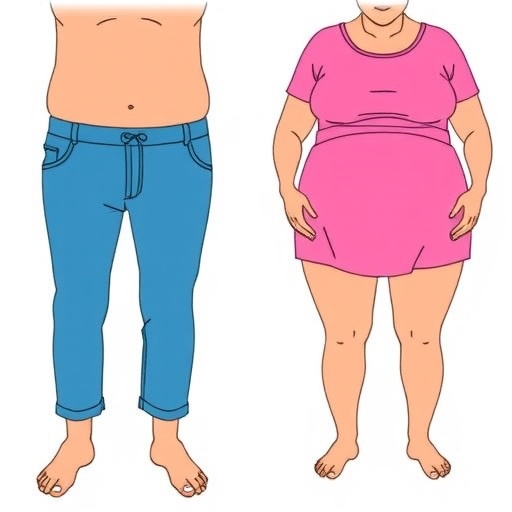
A large analysis of older adults in the United States is challenging one of the most familiar assumptions in public health: that a higher body mass index, or BMI, always signals a greater risk of death. The study, published in the Journal of the American Geriatrics Society, found that among 6,905 adults aged 65 and older followed between 2011 and 2024, higher BMI was generally associated with a lower risk of all-cause mortality. At the same time, a larger waist circumference, which is widely used as an indicator of abdominal fat, was independently associated with a higher risk of death after the researchers accounted for BMI. The results suggest that body size and body-fat distribution may tell different—and sometimes opposing—stories about health in later life.
The most striking findings appeared among men. Compared with men classified as normal weight, those in the overweight category had a 46% lower risk of mortality. Men with class I or class II obesity, corresponding to a BMI of 30 to less than 40 kilograms per square meter, had a 51% lower risk. These figures do not mean that gaining weight protects health, nor do they establish that obesity directly reduces mortality. They describe statistical associations observed in an older population, where body composition, pre-existing illness, muscle loss, smoking, functional decline and other factors can influence both BMI and survival. Nevertheless, the strength and direction of the association highlight why BMI can be difficult to interpret in older adults.
Waist circumference produced a very different signal. Among men, a high waist circumference was associated with a 24% higher mortality risk, even after BMI was taken into account. Similar patterns were observed in women, with higher BMI generally linked to lower mortality and greater waist circumference associated with higher risk. This distinction matters because BMI is calculated from weight and height but cannot determine how much of that weight comes from fat, muscle, bone or fluid. Two people with the same BMI can have very different body compositions and metabolic profiles. Waist circumference provides additional information about fat stored around the abdomen, although it is also an imperfect measure and can be influenced by body shape, age and measurement technique.
Abdominal fat is biologically important because fat deposited around internal organs, often called visceral adipose tissue, is metabolically active. Unlike much of the fat stored beneath the skin, visceral fat can contribute to chronic inflammation, insulin resistance, abnormal lipid levels and changes in blood pressure regulation. These processes are associated with cardiovascular disease, diabetes and other conditions that can increase mortality risk. A larger waist does not prove that an individual has harmful levels of visceral fat, but it can act as a practical clinical marker of increased cardiometabolic risk. The study’s findings therefore support the idea that waist circumference may reveal risk that is obscured when BMI is considered alone.
The researchers also examined BMI and waist circumference together rather than treating them as separate measurements. Among men, being overweight was associated with a lower mortality risk regardless of whether waist circumference was elevated. Class I and class II obesity were also associated with lower mortality, but this relationship was observed exclusively among men who had an elevated waist circumference. That counterintuitive result reinforces the complexity of interpreting weight in older age. It may reflect differences in muscle mass, patterns of weight loss before death, the presence of chronic disease or other characteristics that cannot be fully captured by BMI categories. It also demonstrates that the relationship between body measurements and mortality is not necessarily linear or uniform across groups.
The clearest adverse patterns involved low weight and the combination of a normal BMI with an enlarged waist. Being underweight, regardless of waist circumference, was associated with a higher mortality risk in both men and women. Normal-weight adults with elevated waist circumference also faced higher risk in both sexes. In older adults, low body weight can sometimes accompany frailty, loss of muscle tissue, poor appetite, chronic disease or unintentional weight loss. A normal BMI may similarly conceal a condition sometimes described as sarcopenic obesity, in which a person has relatively low muscle mass alongside excess fat. These possibilities help explain why a seemingly reassuring BMI may not always indicate low risk.
The results fit into a long-running debate over the so-called obesity paradox in aging research. In some studies of older adults, overweight or modest obesity has been associated with better survival than normal weight, a pattern that appears to contradict conventional expectations. Several explanations have been proposed. Extra energy reserves may be useful during serious illness, and people with higher body weight may receive medical attention earlier or differ in ways that are not fully measured. Conversely, normal-weight groups can include former smokers or people who have lost weight because of illness, while BMI does not distinguish muscle from fat. Statistical adjustment can reduce some of these effects, but observational studies cannot eliminate every source of confounding.
The study used time-varying measurements of BMI and waist circumference, an approach designed to account for changes in body size over the follow-up period rather than relying on a single measurement taken at the beginning. This is important because weight and waist size can change substantially in later life. A stable body weight, gradual weight gain, rapid weight loss and loss of muscle can have very different clinical meanings, even when the final BMI category is identical. By evaluating measurements over time, the analysis sought to provide a more realistic picture of how changing body size relates to mortality. However, the findings remain observational: they show how variables move together in a population and do not demonstrate that changing BMI or waist circumference would directly change an individual’s chance of survival.
Bryan Blissmer, PhD, of the University of Rhode Island and a co-author of the study, said BMI and waist circumference provide complementary information about health in older adults. The findings suggest that clinicians may obtain a more informative assessment by considering both measurements, alongside age, sex, muscle strength, physical function, medical history, nutrition and patterns of weight change. The message is not that BMI should be abandoned or that obesity is harmless. Rather, the analysis indicates that BMI alone can miss important differences in abdominal fat and frailty risk. For an aging population, a broader assessment of body composition and health status may help clinicians identify vulnerable patients more accurately and make better-informed decisions about prevention and care.
News Publication Date: 19-Aug-2026
Web References: https://doi.org/10.1111/jgs.70600
References: Journal of the American Geriatrics Society, DOI: 10.1111/jgs.70600
Cite Scienmag News
Beatrice Stafford. (August 19, 2026). How Body Mass Index and Waist Size Affect Mortality in Older Adults. Scienmag. https://scienmag.com/how-body-mass-index-and-waist-size-affect-mortality-in-older-adults/
Beatrice Stafford. "How Body Mass Index and Waist Size Affect Mortality in Older Adults." Scienmag, 19 August 2026, https://scienmag.com/how-body-mass-index-and-waist-size-affect-mortality-in-older-adults/. Accessed 3 September 2026.
Beatrice Stafford. "How Body Mass Index and Waist Size Affect Mortality in Older Adults." Scienmag. August 19, 2026. https://scienmag.com/how-body-mass-index-and-waist-size-affect-mortality-in-older-adults/


