


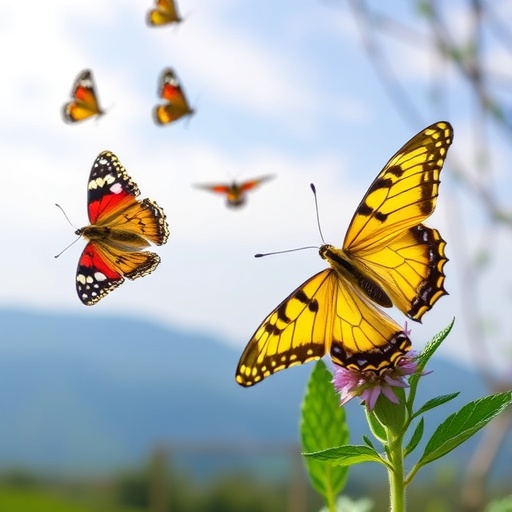
Climate change is forcing butterflies in the German Alps into a stark ecological choice: adapt to rising temperatures where they already live, or move toward cooler conditions at higher elevations. A new study published in Communications Biology suggests that, for many species, movement is the more important response. Rather than rapidly evolving greater heat tolerance or improved temperature regulation, butterflies with limited ability to control their body temperature are shifting their distributions upslope, where cooler air can reduce the risk of overheating.
The research, led by Dr Esme Ashe-Jepson of the Chair of Global Change Ecology at Julius-Maximilians-Universität Würzburg, examined butterfly communities across an elevational gradient in the German Alps. The study combined measurements of physical traits, including body size and wing colouration, with evidence of how species’ elevational ranges have changed over approximately the past decade. This approach allowed the researchers to compare the physiological characteristics of individual species with the broader geographic movements taking place as mountain climates warm.
Butterflies are ectothermic animals, meaning that they do not generate enough internal heat to maintain a stable body temperature independently of their surroundings. Their flight, digestion, growth, reproduction and ability to escape predators all depend on reaching an appropriate thermal range. Sunlight can warm a butterfly’s thorax enough to enable flight, but excessive heating can impair movement, disrupt physiological processes and ultimately become lethal. Because even small changes in body temperature can affect performance, butterflies are often regarded as sensitive biological indicators of environmental change.
A butterfly can respond to thermal stress in several ways. It may alter its behaviour by seeking shade, changing the time of day when it is active or selecting particular surfaces for basking. Over longer periods, populations could theoretically evolve traits that improve thermoregulation or increase tolerance to heat. Species may also relocate to habitats with more suitable temperatures. Ashe-Jepson’s study found little evidence that the butterflies examined had adapted their thermoregulatory capacity or heat tolerance to match the different climatic conditions found along the Alpine gradient. Instead, the species least capable of regulating body temperature showed the strongest upward range shifts.
That pattern is significant because it distinguishes redistribution from adaptation in place. A species may remain genetically and physiologically much the same while the areas it occupies change dramatically. In the Alpine landscape, cooler elevations can function as climatic refuges for butterflies exposed to increasing temperatures in valleys and lower mountain slopes. But this escape route is finite. As species move upward, available habitat may become smaller, more fragmented or unsuitable for other reasons. At the highest elevations, there may be no colder environment left to colonise, creating the ecological possibility of an “elevational trap” in which climate change continues beyond the species’ ability to follow it.
The study also highlights how body size and wing colour influence the thermal environment experienced by different butterflies. Larger species generally heat and cool more slowly than smaller species, giving them greater thermal inertia and helping them avoid rapid increases in body temperature. Pale wings reflect a greater proportion of incoming solar radiation, reducing the amount of energy absorbed from sunlight. Darker wings absorb radiation more efficiently and can help a butterfly warm rapidly when temperatures are low, but this advantage may become a liability during hot conditions. Although dark species can use behavioural and physical mechanisms to regulate their temperature, they may still reach higher body temperatures than pale species under intense solar radiation.
These traits help explain why butterfly communities differ so visibly between warmer and cooler parts of the Alps. At lower elevations, where temperatures are generally higher, larger and paler species are more common. Smaller, darker species become increasingly prevalent at higher elevations, where cooler conditions reduce the danger of overheating and may make rapid solar heat absorption advantageous. The result is not necessarily a landscape in which every species changes its characteristics. Instead, the composition of the community changes as some species become less frequent, disappear from particular sites or move toward higher ground, while others remain or expand into newly suitable areas.
This community-level transformation can be easy to overlook if climate impacts are measured only by counting total numbers of butterflies. A site may continue to support a similar number of species while the identities and ecological roles of those species change. Such turnover can affect pollination networks, food availability for insect-eating animals and competition among species that share nectar plants or breeding habitats. It can also create mismatches between butterflies and the plants on which their caterpillars depend. If a butterfly reaches a cooler location but its host plants cannot move at the same pace, relocation may not provide a viable long-term solution.
The findings carry a direct message for conservation policy. Protecting a population only where it occurs today may not be enough if its climate envelope is shifting across the landscape. Butterflies need connected habitats that allow them to move through valleys, slopes and mountain passes as temperatures change. Maintaining flower-rich meadows, preserving native vegetation and reducing barriers between habitat patches could provide the pathways required for upslope redistribution. Conservation planning may also benefit from identifying species with low thermoregulatory capacity, since these butterflies could be among those most likely to undergo pronounced range shifts and face the greatest need for connected habitat.
The researchers are now investigating whether comparable patterns occur in other insects, including grasshoppers and crickets. If species with limited thermal regulation also move most strongly toward cooler elevations in these groups, thermoregulatory capacity could become a useful tool for predicting which insects are most vulnerable to climate change. Such predictions would be valuable because many insects are poorly monitored, even though they support food webs, nutrient cycling and plant reproduction. The Alpine butterflies therefore offer more than a case study of one insect group: they provide a visible warning that warming can reorganise ecosystems not only by changing the behaviour or physiology of individual animals, but also by changing which species are able to remain together in the same place.
Web References: https://doi.org/10.1038/s42003-026-10534-z
References: Communications Biology, DOI: 10.1038/s42003-026-10534-z; Julius-Maximilians-Universität Würzburg.
Cite Scienmag News
Gavin Prescott. (August 17, 2026). Butterflies Move to Higher Elevations as Climate Conditions Change. Scienmag. https://scienmag.com/butterflies-move-to-higher-elevations-as-climate-conditions-change/
Gavin Prescott. "Butterflies Move to Higher Elevations as Climate Conditions Change." Scienmag, 17 August 2026, https://scienmag.com/butterflies-move-to-higher-elevations-as-climate-conditions-change/. Accessed 5 September 2026.
Gavin Prescott. "Butterflies Move to Higher Elevations as Climate Conditions Change." Scienmag. August 17, 2026. https://scienmag.com/butterflies-move-to-higher-elevations-as-climate-conditions-change/


