


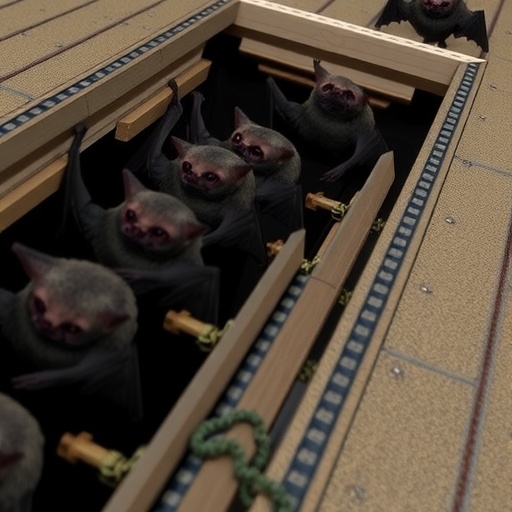
Vampire bats are confronting a rapidly changing night-time world, and a new study suggests that human disturbance can reshape not only where these animals sleep, but also how they behave after leaving their roosts. Published in Scientific Reports, the research by Ribeiro, Zariquiey, Chavez and colleagues examines roost switching and behavioural shifts among vampire bats living in complex landscapes—environments where forests, farms, roads, settlements and livestock operations overlap. The findings place a spotlight on a hidden consequence of development: when people alter or disturb a shelter, bats may respond by relocating, changing their routines or modifying how they use the surrounding landscape. Those changes could influence the ecology of the bats themselves, their interactions with livestock and wildlife, and the conditions under which viruses circulate among animals.
Vampire bats are highly specialised mammals whose survival depends on a combination of secure roosts, accessible food and the ability to move through landscapes at night. Unlike fruit bats or insect-eating species, vampire bats feed exclusively on blood, making their relationship with domestic animals and human-managed environments unusually close. They may shelter in caves, hollow trees, abandoned structures or other protected spaces, then travel to feeding sites after sunset. This lifestyle gives them flexibility, but it also exposes them to direct human activity. Clearing vegetation, occupying caves, removing roost structures, installing lights, increasing traffic or attempting to exclude bats can all transform the conditions around a colony. In a complex landscape, disturbance rarely affects a single location in isolation; it can alter the network of places and routes that bats depend on.
The study’s central subject—roost switching—refers to the movement of bats from one daytime shelter to another. Such movement can be temporary, seasonal or persistent, depending on the intensity and duration of the disturbance and on the availability of alternative roosts. A switch may appear simple, but it can have cascading effects. A new roost could be farther from feeding areas, forcing bats to spend more energy travelling. It might be closer to livestock, increasing contact with potential prey. It may also offer different temperatures, humidity, space and protection from predators. These physical conditions matter because roosts are not merely places where bats wait for night. They are social environments where animals rest, interact, reproduce and exchange information. Relocation therefore has the potential to reorganise both the geography and the social dynamics of a colony.
By focusing on behavioural shifts as well as movement between shelters, the research addresses a more subtle question: what happens after bats respond to disturbance? Animals can change their activity patterns, flight routes, feeding behaviour, social interactions and use of surrounding habitat without immediately abandoning a site. A disturbed colony might become more cautious, emerge later, leave in smaller groups or concentrate its activity in areas that appear less exposed. These responses can be understood as behavioural plasticity—the capacity of an animal to alter its behaviour when environmental conditions change. Plasticity may help bats cope with human pressure in the short term, but it is not unlimited. If every available roost is disturbed, or if safe movement corridors disappear, behavioural flexibility may no longer be enough to maintain the colony’s ecological stability.
The phrase “complex landscapes” is especially important because it moves the discussion beyond a simple conflict between bats and people. In many regions, vampire bats inhabit mosaics rather than untouched wilderness. A single night’s journey may connect forest fragments, pasture, agricultural fields, villages and livestock holdings. Each element can provide opportunities or risks. Pastures may supply abundant food, while forest remnants may provide shelter and cover. Roads and buildings can divide habitat, yet abandoned structures may become useful roosts. Human activity can therefore create both attractive resources and dangerous disturbances. Understanding the bats’ response requires examining how these features interact, rather than treating a roost as an isolated point on a map. The study’s landscape perspective is designed to reveal how local disturbance can produce wider changes in animal movement and behaviour.
These findings also carry implications for viral science. Bats are widely studied in disease ecology because they host diverse viruses, although the presence of a virus does not automatically mean that transmission to humans will occur. Viral spillover depends on a chain of conditions, including which hosts encounter one another, how often they interact, whether a pathogen is present, and whether it can cross species barriers. Disturbance may influence several links in that chain. If bats move into new shelters, they may encounter different bat groups or other wildlife. If their feeding routes change, contact with livestock may increase or decrease. If stress, crowding or altered social organisation affects infection dynamics, the pattern of viral maintenance within a colony could also shift. These are mechanisms to investigate, not conclusions that can be assumed from relocation alone, but they explain why behavioural ecology is central to modern disease surveillance.
The research is also relevant to public health because poorly planned responses to vampire bats can intensify the very contacts that communities are trying to prevent. Destroying a roost or sealing an entrance without understanding where bats will go may push animals into buildings, livestock facilities or neighbouring colonies. In contrast, evidence-based management can combine habitat protection, careful monitoring and targeted measures around vulnerable animals. The goal is not necessarily to eliminate bats from human-influenced landscapes, but to reduce risky encounters while preserving ecological functions. For researchers and health agencies, records of roost location, movement, feeding activity and disturbance history can provide early warning of changes in wildlife behaviour before an outbreak occurs. Behavioural data can therefore complement laboratory testing, genomic surveillance and vaccination programmes.
The study arrives at a moment when scientists are increasingly examining disease emergence as a product of environmental change rather than a purely biological accident. Deforestation, agricultural expansion, infrastructure development and climate change can reshape animal communities long before a pathogen is detected. Research on roost switching contributes to this broader framework by showing why the physical location of animals matters. A colony that remains present in a region may nevertheless be functioning differently after disturbance, with new movements, new social contacts and new patterns of exposure. At the same time, the paper underscores the need for detailed field evidence. To translate behavioural observations into reliable disease-risk assessments, researchers must connect movement data with measurements of population structure, pathogen prevalence, environmental conditions and interactions with domestic animals. That integrated approach is essential for avoiding simplistic claims that blame bats for problems created by ecological disruption.
The wider message is both scientific and practical: protecting human health may depend on understanding how wildlife adapts before its adaptations become invisible. Vampire bats are not passive occupants of changing landscapes. They assess shelter, navigate fragmented habitats and adjust their behaviour in response to threats and opportunities. When human disturbance forces those decisions, the consequences can extend beyond a single colony or roost. The work by Ribeiro, Zariquiey, Chavez and colleagues highlights the value of following animals through the landscape rather than studying them only at one site. As development continues to transform habitats, such research can help scientists identify where disturbance is most likely to alter animal behaviour, where preventive measures should be concentrated and how conservation and disease management can be designed together. In the viral science era, the night-time movements of a small mammal may provide an early signal of much larger ecological change.
Cite Scienmag News
Gavin Prescott. (August 15, 2026). Vampire Bats Change Roosts and Behavior After Human Disturbance in Complex Landscapes. Scienmag. https://scienmag.com/vampire-bats-change-roosts-and-behavior-after-human-disturbance-in-complex-landscapes/
Gavin Prescott. "Vampire Bats Change Roosts and Behavior After Human Disturbance in Complex Landscapes." Scienmag, 15 August 2026, https://scienmag.com/vampire-bats-change-roosts-and-behavior-after-human-disturbance-in-complex-landscapes/. Accessed 4 September 2026.
Gavin Prescott. "Vampire Bats Change Roosts and Behavior After Human Disturbance in Complex Landscapes." Scienmag. August 15, 2026. https://scienmag.com/vampire-bats-change-roosts-and-behavior-after-human-disturbance-in-complex-landscapes/


