


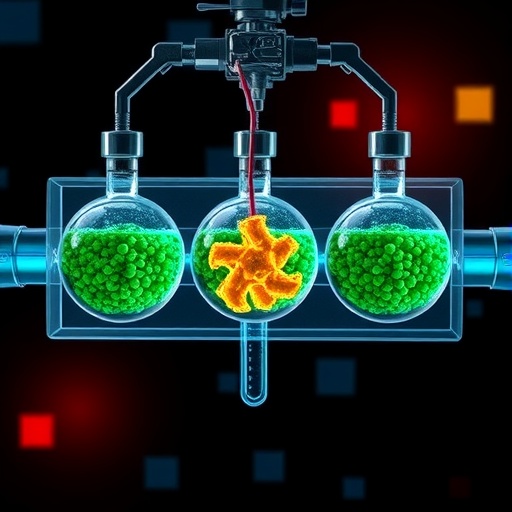
A new study published in Nature Communications describes a catalytic strategy that could change how difficult-to-remove pollutants are treated in water. Researchers D. Zhang, Q. Tian, Y. Wang and colleagues report a material capable of driving oxidation and reduction reactions at the same time, targeting a broad range of emerging contaminants without adding a conventional chemical oxidant. The approach, presented under the title “Triple-reaction-center catalysis drives simultaneous oxidation-reduction towards diverse emerging contaminants under oxidant-free conditions,” offers a glimpse of a new generation of water-treatment technologies designed to be more selective, less chemically intensive and potentially easier to operate at scale.
Emerging contaminants include pharmaceutical residues, personal-care chemicals, pesticides, industrial additives and other compounds that can pass through conventional wastewater-treatment systems. Even when present at low concentrations, these substances may persist in rivers, groundwater and drinking-water sources, where their long-term ecological and health consequences remain a growing concern. Many treatment methods rely on powerful oxidants such as ozone, hydrogen peroxide or persulfates to break pollutant molecules apart. Although effective in some settings, these reagents can be expensive, difficult to transport and store, or capable of generating secondary products that require additional control.
The central idea of the new work is to make the catalyst itself organize several chemical processes at once. Rather than depending on an externally supplied oxidant, the reported system uses what the researchers describe as triple-reaction-center catalysis. In practical terms, this means that distinct active sites within the catalytic structure can cooperate during treatment. Some sites promote oxidation, removing electrons from contaminant molecules, while others facilitate reduction, adding electrons to different molecular targets. A third reaction center may help connect or balance these pathways, allowing charge and reactive intermediates to move through the material instead of being lost in competing reactions.
This architecture addresses one of the major challenges in advanced oxidation technologies: controlling the movement of electrons. In a conventional catalytic reaction, electrons and positively charged holes can recombine before they react with pollutants. That recombination wastes energy and reduces treatment efficiency. A catalyst containing spatially or chemically differentiated reaction centers can, in principle, separate these charge carriers and direct them toward different destinations. The result is a coupled redox network in which oxidation and reduction occur simultaneously, rather than as isolated steps that compete for the same reactive species.
The oxidant-free feature is particularly significant. Instead of injecting a reagent that generates reactive oxygen species from outside the system, the catalyst is designed to activate reactions through its own electronic structure and the surrounding water and contaminants. Depending on the material’s composition and operating conditions, such systems can involve charge transfer, surface-bound intermediates and the formation of highly reactive species at the catalyst interface. These intermediates can attack stable chemical bonds in pollutants, fragmenting complex molecules into smaller compounds that may be further transformed into less persistent products.
A key promise of the strategy is its ability to address chemically diverse contaminants through one catalytic platform. Pollutants vary widely in size, charge, polarity and resistance to degradation. A molecule that is vulnerable to electron loss may not respond to the same pathway as one that is more easily reduced. By combining multiple reaction centers, the catalyst may create several routes for contaminant conversion, increasing the range of compounds that can be treated under the same general conditions. This is an important departure from highly specialized systems that work well for one pollutant but perform poorly when wastewater contains a complex mixture.
The research also highlights a broader shift in environmental catalysis. Scientists are increasingly trying to design materials not simply as passive surfaces, but as microscopic reaction networks with carefully arranged functions. At the nanoscale, the location of an active site, the distance between neighboring sites and the movement of electrons across an interface can determine whether a reaction proceeds efficiently or stalls. Triple-reaction-center catalysis applies this principle to water purification by treating the catalyst as an integrated chemical circuit. Its purpose is not merely to accelerate one reaction, but to coordinate several linked reactions in a controlled sequence.
For real-world treatment, however, catalytic activity is only one part of the challenge. A practical system must remain stable in complex water, where natural organic matter, salts and other chemicals can block active sites or consume reactive intermediates. It must also avoid releasing potentially harmful components into the treated water, operate repeatedly without rapid loss of performance and produce transformation products that are less concerning than the original pollutants. The reported oxidant-free design could reduce the logistical burden associated with chemical storage, but its long-term environmental and economic performance will depend on material durability, regeneration requirements and energy consumption.
The study arrives as water utilities and environmental engineers search for technologies that can keep pace with pollution sources that conventional treatment was never designed to remove. Its triple-reaction-center concept suggests that the next viral breakthrough in water purification may not come from using a stronger oxidant, but from engineering a smarter catalyst—one that directs oxidation and reduction together, activates several molecular pathways and treats a mixture of contaminants without relying on a separate chemical trigger. If the approach can be validated in realistic wastewater and scaled beyond laboratory conditions, it could help transform advanced treatment from a highly specialized process into a more adaptable tool for protecting water supplies from an expanding chemical threat.
Cite Scienmag News
Violet Maxwell. (August 13, 2026). Triple reaction centers enable oxidant-free simultaneous oxidation-reduction of diverse emerging contaminants. Scienmag. https://scienmag.com/triple-reaction-centers-enable-oxidant-free-simultaneous-oxidation-reduction-of-diverse-emerging-contaminants/
Violet Maxwell. "Triple reaction centers enable oxidant-free simultaneous oxidation-reduction of diverse emerging contaminants." Scienmag, 13 August 2026, https://scienmag.com/triple-reaction-centers-enable-oxidant-free-simultaneous-oxidation-reduction-of-diverse-emerging-contaminants/. Accessed 4 September 2026.
Violet Maxwell. "Triple reaction centers enable oxidant-free simultaneous oxidation-reduction of diverse emerging contaminants." Scienmag. August 13, 2026. https://scienmag.com/triple-reaction-centers-enable-oxidant-free-simultaneous-oxidation-reduction-of-diverse-emerging-contaminants/


