


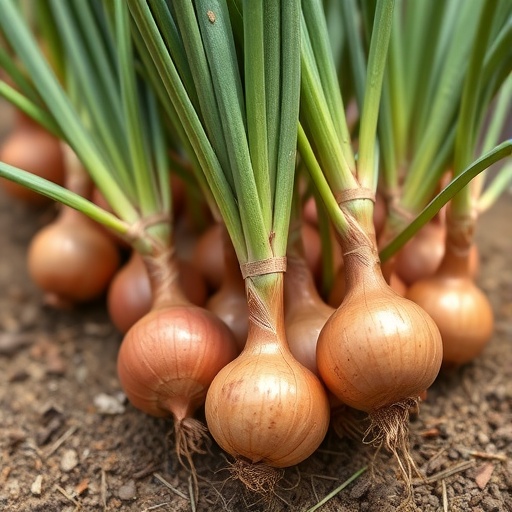
Onion growers in Ethiopia are turning to an unexpectedly powerful resource beneath their feet—and behind their poultry sheds—as scientists investigate how chicken manure and planting distance can reshape the crop’s productivity and quality. A new study from Bonga, in southwestern Ethiopia, examines the interaction between organic fertilization and plant spacing, two relatively simple agricultural decisions that can determine whether an onion field produces small, poorly developed bulbs or a harvest capable of meeting demanding food and market needs.
The research, published in Scientific Reports, focuses on a challenge shared by many farmers in regions where access to expensive synthetic fertilizers is limited. Onion production depends heavily on the availability of essential nutrients, particularly nitrogen, phosphorus and potassium. Yet fertilizer performance is not determined only by the amount applied. Soil structure, moisture, microbial activity, climate and the distance between plants all influence how efficiently onions convert nutrients and sunlight into leaves and bulbs. The Bonga study brings these factors together in an effort to understand how organic manure and field geometry work as a combined production system.
Chicken manure is more than a waste product. Properly handled, it contains organic matter and plant nutrients that can improve soil fertility over time. As microorganisms decompose the manure, nutrients are gradually released into the soil, making them available for uptake by plant roots. This process, known as mineralization, is influenced by temperature, moisture and the chemical composition of the manure. Nitrogen released during decomposition supports leaf growth, while phosphorus contributes to root development and energy transfer within the plant. Potassium helps regulate water movement, enzyme activity and the transport of sugars into developing bulbs.
The timing and balance of those nutrients are particularly important for onions. The crop must first establish a healthy canopy of leaves, because each leaf contributes to the photosynthetic machinery that eventually feeds the bulb. If nutrition is inadequate, the plants may remain weak and produce undersized bulbs. If nitrogen is excessive or supplied too late, onions may continue producing leaves instead of shifting efficiently toward bulb enlargement, potentially affecting maturity, storage life and quality. By examining chicken manure within an onion production system, the study addresses not only how much the crop grows, but also how nutrient release may influence the biological transition from vegetative growth to bulb formation.
Spacing adds a second layer of complexity. When onion plants are established too close together, they compete for light, water and nutrients. Dense stands can produce a larger number of bulbs per unit of land, but individual bulbs may be smaller because resources are divided among more plants. Wider spacing can reduce competition and allow each plant greater access to soil resources, potentially promoting larger bulbs. However, excessively wide spacing may leave valuable field area unused and reduce total yield even if individual onions become heavier. The most productive arrangement therefore depends on the balance between bulb size and the number of bulbs harvested.
This distinction is critical because “yield” is not a single concept in agricultural science. Researchers may assess total biological production, marketable yield, average bulb weight, bulb diameter and the proportion of onions that reach commercially desirable grades. Quality can also include attributes such as bulb firmness, uniformity, moisture content and the concentration of compounds responsible for onion flavor and pungency. These traits matter to farmers, traders and consumers in different ways. A field with the greatest total weight may not generate the highest income if much of the harvest consists of small, damaged or poorly stored bulbs.
At Bonga, the study’s experimental design is centered on comparing chicken-manure management with different distances between onion plants. Such trials allow researchers to separate the effects of fertilization from the effects of plant density and, crucially, to examine whether the two factors interact. An interaction occurs when the response to one treatment changes depending on the level of another. For example, a spacing arrangement that performs poorly in nutrient-depleted soil might become highly productive when organic matter and nutrients are improved. Conversely, applying more manure may not deliver its full benefit if plants are crowded and cannot access enough space, water or light.
The importance of this work extends beyond a single field in southwestern Ethiopia. Smallholder farmers often operate under tight financial constraints, making locally available organic inputs especially valuable. Poultry production is expanding in many agricultural communities, generating manure that can either become an environmental burden or be returned to the soil as a resource. Using it effectively could reduce dependence on purchased fertilizers, improve soil organic matter and support more circular farming systems. But manure is not automatically safe or uniform: its nutrient concentration varies, immature manure can injure roots, and poor handling may introduce pathogens or cause nutrient losses. Scientific guidance is needed to turn a readily available material into a reliable farm input.
The Bonga investigation also highlights why agricultural recommendations cannot always be transferred directly from one region to another. Onion performance is shaped by local altitude, temperature, rainfall patterns, soil texture, fertility status and farming practices. A spacing recommendation developed for one climate may not produce the same result elsewhere, just as a manure rate that works in one soil may be insufficient or excessive in another. Field-based experiments therefore provide essential evidence for location-specific production, particularly in regions where farmers must make decisions with limited irrigation, variable weather and restricted access to laboratory soil testing.
By linking a locally available fertilizer with a practical crop-management decision, the study offers a pathway toward more precise and sustainable onion production. Its central message is not simply that chicken manure can improve a field, or that spacing can change bulb size, but that these choices must be considered together. The way plants are arranged determines how efficiently they use the nutrients released into the soil, while the fertility of that soil influences how strongly plants respond to the space available to them. For Ethiopian growers and agricultural advisers, the findings could help refine recommendations aimed at producing more uniform, marketable onions without relying exclusively on costly external inputs. More broadly, the research illustrates a principle increasingly shaping modern agriculture: the future of food production may depend not on one miracle input, but on carefully engineered combinations of biology, resource recycling and field design.
Cite Scienmag News
Alan Morgan. (August 13, 2026). Chicken Manure and Spacing Affect Onion Yield and Quality in Bonga Ethiopia. Scienmag. https://scienmag.com/chicken-manure-and-spacing-affect-onion-yield-and-quality-in-bonga-ethiopia/
Alan Morgan. "Chicken Manure and Spacing Affect Onion Yield and Quality in Bonga Ethiopia." Scienmag, 13 August 2026, https://scienmag.com/chicken-manure-and-spacing-affect-onion-yield-and-quality-in-bonga-ethiopia/. Accessed 4 September 2026.
Alan Morgan. "Chicken Manure and Spacing Affect Onion Yield and Quality in Bonga Ethiopia." Scienmag. August 13, 2026. https://scienmag.com/chicken-manure-and-spacing-affect-onion-yield-and-quality-in-bonga-ethiopia/


