


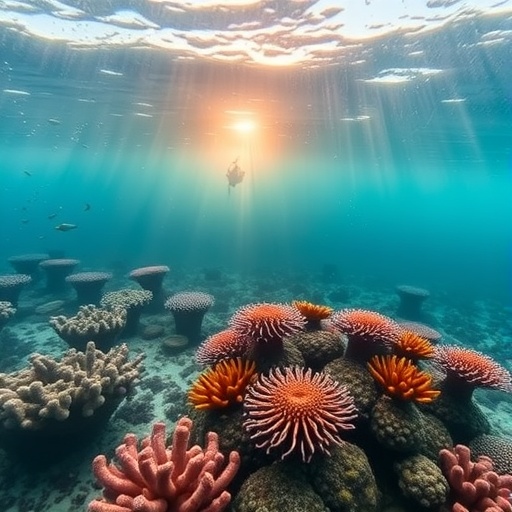
The Great Barrier Reef has shown tentative signs of recovery after a summer marked by unusually warm ocean temperatures, coral bleaching, flooding and tropical cyclones. According to the Australian Institute of Marine Science’s (AIMS) latest annual survey, coral cover increased slightly in the northern and central regions and remained broadly stable in the south during the 2025/26 field season. Scientists say a late-summer monsoon likely reduced the severity of heat stress by increasing cloud cover and lowering sea temperatures, giving many corals a narrow window in which to survive and begin rebuilding.
The findings come from the 40th year of AIMS’s Long-Term Monitoring Program, one of the world’s longest continuous datasets on coral reef condition. Researchers surveyed 121 reefs across the Great Barrier Reef, using manta tow surveys to estimate hard coral cover across large reef areas. Hard coral cover is not a complete measure of reef health, but it provides a practical indicator of the amount of living reef-building coral present and allows scientists to track broad changes over time. The surveys showed that the reef has not suffered another large-scale collapse comparable to the impacts recorded after the 2024 mass bleaching event.
In the Northern region, stretching from Cape York to Cooktown, coral cover increased by 16.7 percent relative to 2025, rising from 30 percent to 35.1 percent. The Central region, extending from Cooktown to Proserpine, increased from 28.6 percent to 31.6 percent, a 10.2 percent relative rise that remains within the survey’s margin of error. In the Southern region, between Proserpine and Gladstone, coral cover declined slightly from 26.9 percent to 26.4 percent, a 2 percent relative decrease that was also within the margin of error. Across all three regions, coral cover remained near or above long-term averages.
The results suggest that the 2025/26 bleaching season caused limited additional losses in total hard coral cover, but scientists warn that stable cover does not necessarily mean the ecosystem has fully recovered. Of the reefs surveyed, 16 percent showed a decline in coral cover, 56 percent showed no measurable change and 28 percent recorded an increase. Most reefs had moderate to high levels of coral cover, with 64 reefs between 10 and 30 percent and 42 reefs between 30 and 50 percent. Twelve reefs had cover between 50 and 75 percent, while three had less than 10 percent and none exceeded 75 percent.
The apparent reprieve was closely linked to weather conditions. The reef experienced another summer of above-average sea temperatures, exposing corals to the thermal stress that causes bleaching. During bleaching, corals expel the microscopic algae living within their tissues, known as zooxanthellae. These algae provide much of a coral’s energy through photosynthesis and give corals their characteristic colors. If heat stress is brief, corals may recover their algae and survive. If it is intense or prolonged, the loss of energy can lead to starvation, disease and mortality. AIMS scientists believe the late-summer monsoon reduced both the intensity and duration of this stress across parts of the reef.
The report also highlights why total coral cover can conceal major ecological changes. Detailed surveys at permanently marked sites on 71 reefs found that fast-growing Acropora corals were especially vulnerable during the 2024 mass bleaching event. These branching and table-shaped corals create complex three-dimensional habitats used by fish and other reef organisms, but their thin tissues and rapid growth strategies can make them highly sensitive to extreme heat. Reefs dominated by Acropora may therefore appear to recover quickly when surviving colonies expand, yet remain structurally and biologically fragile. A subsequent bleaching event, cyclone or disease outbreak could reverse that recovery within a single year.
The 2024 event also affected deeper reef habitats in the Southern Great Barrier Reef. Scientists recorded elevated bleaching and mortality at depths of 10 to 15 metres across several coral groups, challenging the traditional assumption that shallow corals face the greatest risk because they generally experience the highest temperatures. As oceans warm, deeper waters may increasingly reach temperatures capable of triggering bleaching. This could reduce the number of thermal refuges available to corals and expose a wider range of reef habitats to repeated heat stress.
Other disturbances continue to compound the pressure. Flooding can deliver sediment, nutrients and pollutants to coastal reefs, reducing water quality and interfering with coral growth. Tropical cyclones can physically break colonies and reshape reef structures, while outbreaks of crown-of-thorns starfish consume living coral tissue. AIMS scientists say rising numbers of these coral-eating starfish in the Northern Great Barrier Reef indicate the beginning of the fifth major outbreak wave recorded since the 1960s. The latest surveys were largely completed before Cyclone Narelle crossed the Northern region as a category five system in March, meaning some of its effects will be assessed in future monitoring.
Despite the signs of resilience, researchers describe the reef as an ecosystem under sustained and intensifying pressure. The Great Barrier Reef experienced six mass bleaching events between 2016 and 2025, whereas such events were considered exceptionally rare before the 1990s. Repeated bleaching leaves less time for coral colonies to grow, reproduce and rebuild their calcium-carbonate skeletons between disturbances. It can also alter the composition of coral communities, favoring more heat-tolerant but often slower-growing species while reducing habitat-forming corals such as Acropora. The result may be a reef that retains measurable coral cover but loses complexity, biodiversity and capacity to support marine life.
The 40-year AIMS dataset is increasingly important because it separates short-term fluctuations from long-term ecological trends. Its findings indicate that the Great Barrier Reef still retains higher coral cover than many reef systems globally, and that natural recovery remains possible when severe disturbances are limited. However, scientists emphasize that recovery is conditional rather than guaranteed. Reducing greenhouse-gas emissions remains essential to limit ocean warming, while effective management can reduce additional stress from poor water quality, crown-of-thorns starfish and local disturbances. The latest report therefore offers both a rare piece of encouraging news and a warning: the reef can recover, but its ability to do so is being steadily narrowed by a climate that is making extreme bleaching more frequent and more severe.
Web References: https://www.aims.gov.au/research-topics/monitoring-and-discovery/monitoring-great-barrier-reef/long-term-monitoring-program; https://www.aims.gov.au/monitoring-great-barrier-reef/gbr-condition-summary-2024-25
References: Australian Institute of Marine Science, Great Barrier Reef Long-Term Monitoring Program; DOI: 10.25845/440g-d478
Cite Scienmag News
Violet Maxwell. (August 10, 2026). Monsoon Cooling Offers Relief to Recovering Coral Reef. Scienmag. https://scienmag.com/monsoon-cooling-offers-relief-to-recovering-coral-reef/
Violet Maxwell. "Monsoon Cooling Offers Relief to Recovering Coral Reef." Scienmag, 10 August 2026, https://scienmag.com/monsoon-cooling-offers-relief-to-recovering-coral-reef/. Accessed 3 September 2026.
Violet Maxwell. "Monsoon Cooling Offers Relief to Recovering Coral Reef." Scienmag. August 10, 2026. https://scienmag.com/monsoon-cooling-offers-relief-to-recovering-coral-reef/


