


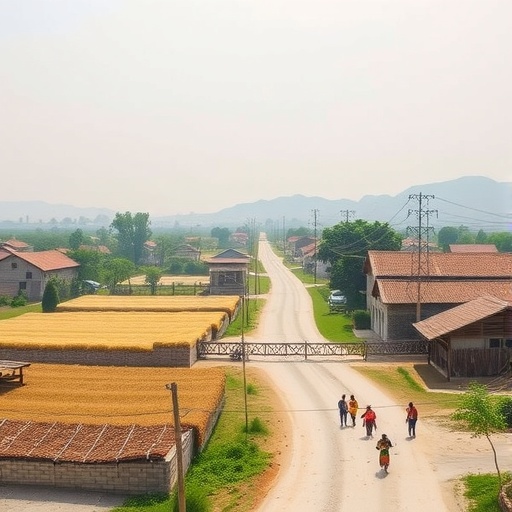
A quiet warning is emerging from the expanding edges of China’s cities. In the Beijing–Tianjin–Hebei urban agglomeration, landscapes undergoing the shift from countryside to city appear to lose their ability to absorb shocks before urban development fully takes hold. A new study describes these rural–urban transition zones as fragile social-ecological systems—places where communities, infrastructure, economies, land, water and ecosystems are being reorganized at extraordinary speed. The researchers report that resilience is generally low in these zones and can temporarily collapse before a landscape crosses a critical threshold into urbanity.
The finding matters because the world’s most dramatic urban growth is not occurring only inside established city centers. It is unfolding across broad, ambiguous fringes where farmland is converted, villages are redeveloped, roads and industrial parks spread, and rural residents adapt to new economic systems. These areas are neither fully rural nor fully urban. They function as transitional systems, exposed to simultaneous pressures from population change, land-use transformation, environmental degradation and institutional disruption. Yet they have received far less scientific attention than either cities or rural regions.
Yang Yang, Wei Bao, Y. Wei and colleagues investigated this overlooked phase of urbanization using both spatial comparisons and a two-decade time series covering 2000 to 2020. Their study focused on the Beijing–Tianjin–Hebei urban agglomeration, one of China’s largest and most rapidly transforming metropolitan regions. The area contains densely populated cities, agricultural landscapes, industrial corridors and villages being absorbed into expanding urban systems, making it a powerful natural laboratory for examining what happens before rural land becomes urban territory.
The researchers treated each transition zone as a coupled social-ecological system rather than as a simple land-use category. In this framework, resilience refers to the capacity of a system to withstand disturbance, reorganize and continue functioning without entering a fundamentally different state. Social components may include demographic stability, economic diversity, public services and institutional capacity. Ecological components can involve land, water, vegetation and the ability of local environments to provide essential functions. By combining these dimensions, the researchers assessed how well different areas could cope with mounting change.
Their results revealed a consistent pattern: resilience was low in rural–urban transition zones, and it declined as areas moved across the boundaries separating rural and urban systems. This boundary effect is important because transition zones are often treated as temporary spaces destined to disappear beneath development. Instead, the study suggests they are periods of heightened instability in their own right. The physical landscape may still look partly rural while social networks, resource demands and governance arrangements are already being reshaped by urban expansion.
The most striking discovery was a temporary loss of resilience before the transition to urbanity, a pattern associated with the approach of a regime shift. In complex systems, a regime shift occurs when gradual pressures eventually push a system beyond a critical threshold, causing it to reorganize into a new state. A shallow lake can abruptly become algae-dominated, for example, or a grassland can shift toward shrubland after prolonged disturbance. In rural–urban settings, the comparable shift is from a predominantly rural social-ecological system to an urban one. The study’s findings suggest that the system may become especially vulnerable immediately before that change.
This temporary weakening can be understood as a period in which old structures are breaking down faster than new ones can stabilize. Agricultural livelihoods may decline before urban employment becomes secure. Traditional community networks may be disrupted while new social institutions remain incomplete. Ecosystems can lose land, water and habitat functions as construction accelerates, even before urban infrastructure is capable of replacing those services. Such mismatches may produce a resilience gap, leaving residents and local environments less able to absorb floods, pollution, economic shocks or sudden demographic change.
The researchers describe their results as archetypical evidence that rural–urban transition zones can display the warning dynamics of impending social-ecological regime shifts. The study does not imply that every transitioning landscape will follow an identical trajectory, nor does it establish that urbanization inevitably produces collapse. Rather, it shows that the pathway from rural to urban can contain a distinct and measurable phase of instability. Recognizing that phase could help planners detect risk before development locks communities into costly and difficult-to-reverse outcomes.
The implications extend far beyond northern China. Much of the fastest urban growth is occurring across the global south, where municipal governments often face limited resources, fragmented planning authority and intense pressure to accommodate new residents and investment. Transition zones may be excluded from both rural development programs and urban planning systems, leaving them vulnerable to unmanaged construction and unequal access to services. The study argues that these areas should be treated as critical intervention points. Monitoring resilience across social and ecological dimensions could allow decision-makers to strengthen livelihoods, protect ecosystem functions and build infrastructure before a temporary loss of resilience becomes a permanent crisis.
As cities spread across the planet, the future of sustainable urbanization may be decided not in downtown districts but along their uncertain edges. Rural–urban transition zones are where old systems weaken, new systems emerge and the possibility of instability becomes most visible. By placing resilience at the center of urban expansion research, the study offers a new way to understand why some transitions remain adaptable while others generate lasting social and environmental damage. The message is urgent: the fringe is not a leftover space awaiting development. It is the frontline where the next urban regime is being formed.
Cite Scienmag News
Denise Maddox. (August 10, 2026). Rural-to-Urban Transition Temporarily Weakens Social-Ecological Resilience. Scienmag. https://scienmag.com/rural-to-urban-transition-temporarily-weakens-social-ecological-resilience/
Denise Maddox. "Rural-to-Urban Transition Temporarily Weakens Social-Ecological Resilience." Scienmag, 10 August 2026, https://scienmag.com/rural-to-urban-transition-temporarily-weakens-social-ecological-resilience/. Accessed 4 September 2026.
Denise Maddox. "Rural-to-Urban Transition Temporarily Weakens Social-Ecological Resilience." Scienmag. August 10, 2026. https://scienmag.com/rural-to-urban-transition-temporarily-weakens-social-ecological-resilience/


