


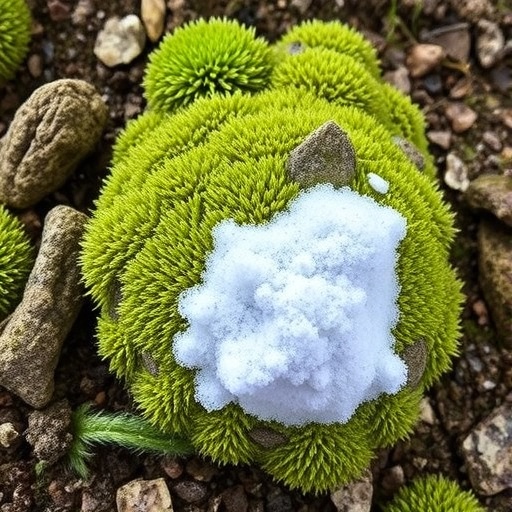
A thin green layer of moss may be doing something far more consequential in the world’s cold deserts than simply coating the ground. New research suggests that moss-dominated biological soil crusts, commonly known as biocrusts, can hold snow on the landscape for longer, increase the amount of water stored in seasonal snowpacks and help sustain the underground biological activity that keeps fragile desert ecosystems functioning.
The study, published in Nature Geoscience, is one of the first to examine continuously and over multiple years how moss biocrusts influence snowpack behavior in natural desert environments. Compared with nearby areas of bare soil, surfaces covered by moss biocrusts maintained snow cover for 20.1 percent longer—equivalent to approximately 65 additional hours—and supported an average snow depth that was 27.1 percent greater. In regions where water arrives in short, seasonal pulses, those extra hours and centimeters could have major ecological consequences.
Cold deserts are not lifeless wastelands. They are ecosystems in which water availability is limited, temperatures fluctuate sharply and much of the annual biological activity depends on the timing of snowmelt. Snow acts as a temporary reservoir, storing precipitation during winter and releasing it gradually as temperatures rise. The rate at which that reservoir disappears determines when soils become wet, when microorganisms become active and how long plants and other organisms can access water.
Biocrusts are communities of organisms that live at the soil surface, including mosses, lichens, cyanobacteria, algae, fungi and bacteria. They bind soil particles together and can alter the physical properties of the ground. In this study, moss-dominated crusts changed the way snow interacted with the land surface by increasing roughness and modifying thermal conductivity. A rougher surface can create small depressions and sheltered microsites that capture drifting snow and reduce its redistribution by wind, while changes in heat transfer can affect how quickly energy moves from the soil into the snowpack.
Those processes appear to have slowed the loss of snow from moss-covered ground. Snow ablation—the combined removal of snow through melting, sublimation and other processes—is governed by incoming sunlight, air temperature, wind, humidity and the exchange of heat between the snow, soil and atmosphere. By changing the structure and thermal behavior of the surface, moss biocrusts can disrupt that balance. The result is not simply a deeper snow layer, but a more persistent water store that remains available to the ecosystem over a longer period.
The researchers found that the influence of the crust did not end when the snow disappeared. Soil beneath moss biocrusts contained 16.0 percent more water than soil beneath nearby bare surfaces. This suggests that prolonged snow retention and altered meltwater delivery helped move more moisture into the soil or kept it there for longer. Instead of losing winter precipitation rapidly through evaporation, runoff or uneven melting, crust-covered areas may convert more of the snowpack into water that can be used by organisms in the soil.
The biological response was striking. Microbial richness beneath moss biocrusts increased by as much as 46.1 percent compared with bare soil, with the analysis considering both bacterial and fungal communities. Soil microorganisms are central to nutrient cycling, decomposition and the transformation of organic matter into forms that can be used by plants and other organisms. A longer period of moisture availability can create a wider window for microbial growth and metabolism in environments where dry conditions normally keep biological processes dormant.
The study also recorded soil carbon efflux up to 33.5 percent higher under moss biocrusts. Carbon efflux measures the release of carbon dioxide from soil, primarily through the respiration of microorganisms and plant roots. Higher efflux in this context indicates that the wetter, biologically richer soils beneath the biocrusts were supporting more active microbial respiration. That does not automatically mean the ecosystem is losing more carbon overall; carbon release must be considered alongside carbon fixation, decomposition and long-term storage. It does show, however, that the crusts are linked to a more active soil carbon cycle.
The findings carry particular weight as climate change reshapes cold deserts. Warmer conditions can shorten the snow season, accelerate melt and increase the frequency of soil drying, potentially reducing the time available for microbial activity and plant growth. If moss biocrusts help preserve snow and extend the period of soil moisture, their loss could trigger a feedback in which less snow leads to drier soils, reduced microbial diversity and weaker ecosystem function. Protecting these delicate communities may therefore be a practical climate adaptation strategy, not merely a conservation priority.
The researchers’ results reveal that an easily overlooked surface community can influence an entire chain of ecosystem processes, from the physical storage of winter precipitation to the activity of invisible microbial networks underground. Moss biocrusts appear to act as natural regulators of snowpack dynamics, reshaping the timing and availability of water in landscapes where every melt event matters. As warming accelerates across cold desert regions, understanding—and protecting—the living skin of the soil could become essential to preserving the ecosystems beneath it.
Cite Scienmag News
Alan Morgan. (August 10, 2026). Moss biocrusts preserve snowpack and soil health in cold deserts. Scienmag. https://scienmag.com/moss-biocrusts-preserve-snowpack-and-soil-health-in-cold-deserts/
Alan Morgan. "Moss biocrusts preserve snowpack and soil health in cold deserts." Scienmag, 10 August 2026, https://scienmag.com/moss-biocrusts-preserve-snowpack-and-soil-health-in-cold-deserts/. Accessed 4 September 2026.
Alan Morgan. "Moss biocrusts preserve snowpack and soil health in cold deserts." Scienmag. August 10, 2026. https://scienmag.com/moss-biocrusts-preserve-snowpack-and-soil-health-in-cold-deserts/


