


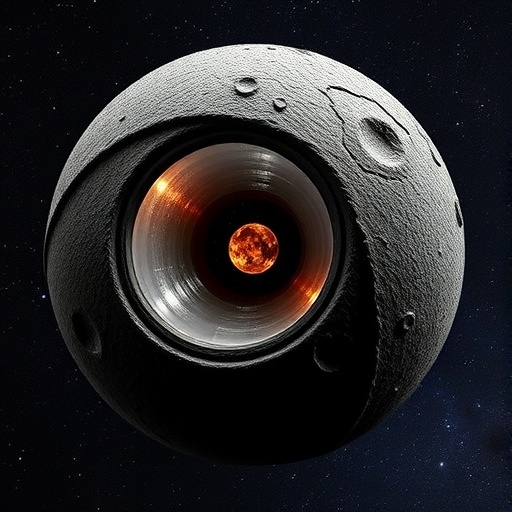
For decades, planetary scientists have treated meteorites as fragments of worlds that no longer exist—or that remain hidden inside larger asteroids. Now, a new study has strengthened a remarkable connection between a rare class of metallic meteorites and the deep interior of the asteroid believed to have produced the howardite–eucrite–diogenite, or HED, meteorites. The research, published in Communications Earth & Environment, identifies genetic links between IIIE iron meteorites and the core of the HED parent asteroid, offering a new way to reconstruct the internal structure and violent history of an ancient planetary body.
Iron meteorites are not ordinary space rocks. Many formed when their parent asteroids melted early in Solar System history, allowing dense metal—primarily iron and nickel—to sink toward the center and create a metallic core. Silicate rock rose above it, forming a mantle and crust. When collisions shattered these differentiated bodies, pieces of the core could be launched into space and eventually fall to Earth as meteorites. Because they sample regions that spacecraft rarely visit, iron meteorites provide direct chemical evidence of how small planetary bodies formed, separated into layers and later broke apart.
The HED meteorites are among the most important examples of material from a differentiated asteroid. Their parent body is widely associated with Vesta, one of the largest objects in the main asteroid belt. Howardites are breccias assembled from mixed surface material, eucrites are volcanic rocks that crystallized from molten basalt, and diogenites are deeper igneous rocks rich in pyroxene. Together, these meteorites preserve a geological record extending from the crust toward the interior of their parent asteroid. Yet the nature of its metallic core has remained more difficult to determine because no confirmed core sample from Vesta has been available.
The new work focuses on IIIE iron meteorites, a chemically distinctive group whose origin has long been debated. Scientists classify iron meteorites according to their compositions, trace elements, mineral textures and isotopic characteristics. These signatures act as geological fingerprints. If two meteorite groups formed in the same differentiated asteroid, they may share patterns in elements created by radioactive decay, chemical fractionation or the segregation of metal from silicate. Such similarities can reveal a common parent body even when the samples were separated by billions of years of impacts and collisions.
The researchers’ conclusion that IIIE irons are genetically linked to the HED parent asteroid is significant because it connects metallic material with the better-known basaltic and pyroxene-rich rocks represented by HED meteorites. In planetary geology, “genetic link” does not simply mean that two samples look alike. It implies that they share a coherent origin established through chemical and isotopic evidence, including the behavior of elements during melting, crystallization and core formation. The result suggests that IIIE iron meteorites may preserve material derived from, or closely associated with, the metallic core of the body that generated the HED meteorites.
This connection changes the way scientists can interpret the internal architecture of the HED parent asteroid. The composition of an iron meteorite is influenced by the conditions under which metal separated from silicate, the temperatures reached during melting and the subsequent cooling rate of the core. Trace elements can reveal whether the metal crystallized from a liquid core, interacted with silicate minerals or experienced later chemical modification. When these data are considered alongside HED crustal and mantle samples, researchers can build a more complete model of a small planetary body that underwent large-scale differentiation only a few million years after the Solar System formed.
The timing is crucial. Early-formed asteroids contained short-lived radioactive isotopes, especially aluminium-26, whose decay generated enough heat to melt portions of their interiors. Once melting began, dense metal could descend through a silicate ocean or partially molten mantle. The efficiency of this process determined whether a true core formed and how large it became. IIIE iron meteorites may therefore provide a rare record of the physical and chemical conditions during this early stage. Their relationship with HED material could help constrain how rapidly the parent asteroid melted, how completely it differentiated and how its core evolved as it cooled.
The findings also have implications beyond a single meteorite group. Asteroids are often treated as primitive leftovers, but many are miniature planetary systems with crusts, mantles and cores. Understanding the HED parent asteroid provides a natural laboratory for studying the earliest steps of planet formation, including processes that later operated on much larger bodies such as Earth, Mars and the Moon. A small asteroid could preserve these stages in a simpler form, allowing scientists to isolate the effects of metal–silicate separation, magma crystallization and impact-driven disruption without the geological recycling that has erased much of Earth’s earliest history.
The study arrives as planetary exploration increasingly tests laboratory-based meteorite interpretations. NASA’s Dawn mission revealed Vesta’s enormous impact basin, diverse surface geology and evidence for extensive volcanic activity, while continuing meteorite research seeks to connect specific samples to specific regions within the asteroid. If IIIE iron meteorites truly represent material from the HED parent body’s core, they could become essential benchmarks for interpreting its deep interior. Future analyses of metal textures, platinum-group elements, stable isotopes and cooling histories may refine the link and determine whether these meteorites formed directly in the core or in a related metallic reservoir.
For now, the central message is that fragments once regarded as isolated metallic relics may belong to the same vanished world as the volcanic and mantle rocks delivered by HED meteorites. By tying IIIE iron meteorites to the core of the HED parent asteroid, the research brings scientists closer to reconstructing an entire differentiated asteroid—from its surface basalts to its hidden metallic center. Each meteorite is a small, durable piece of that lost planetary body, and together they reveal that even an asteroid can preserve the dramatic geological biography of a world.
Cite Scienmag News
Grant Pearson. (August 8, 2026). Study Links IIIE Iron Meteorites to HED Asteroid Parent Body’s Core. Scienmag. https://scienmag.com/study-links-iiie-iron-meteorites-to-hed-asteroid-parent-bodys-core/
Grant Pearson. "Study Links IIIE Iron Meteorites to HED Asteroid Parent Body’s Core." Scienmag, 8 August 2026, https://scienmag.com/study-links-iiie-iron-meteorites-to-hed-asteroid-parent-bodys-core/. Accessed 4 September 2026.
Grant Pearson. "Study Links IIIE Iron Meteorites to HED Asteroid Parent Body’s Core." Scienmag. August 8, 2026. https://scienmag.com/study-links-iiie-iron-meteorites-to-hed-asteroid-parent-bodys-core/


